
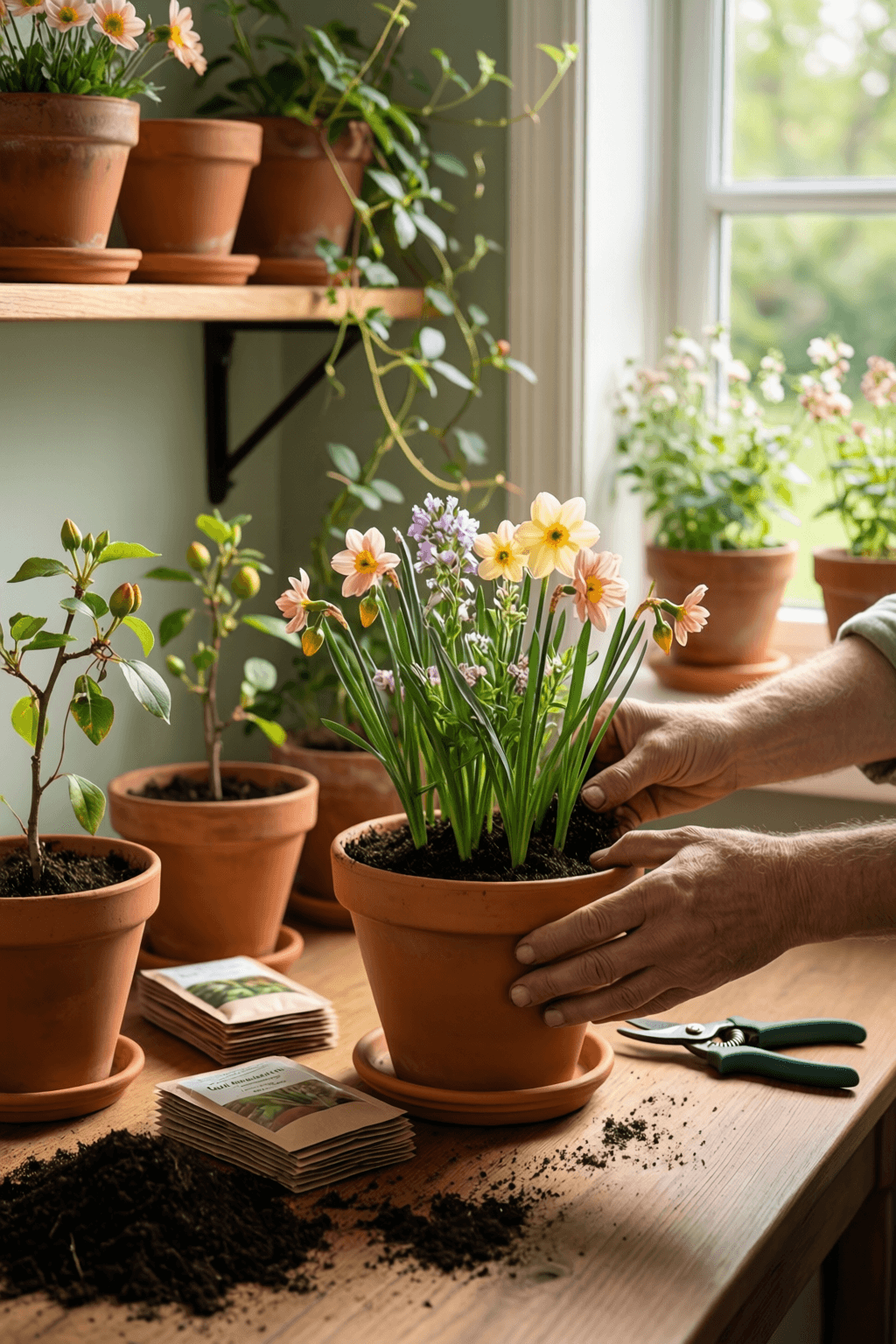
He who cultivates a garden and brings to perfection flowers and fruits, cultivates and advances at the same time his own nature. — Reginald Farrer
—What lingers after this line?
The Garden as a Mirror
At first glance, Reginald Farrer’s remark appears to praise horticulture alone, yet it quickly opens into a deeper claim: the garden reflects the gardener. To bring flowers and fruits to perfection requires patience, observation, restraint, and care, and in practicing these habits outwardly, a person refines them inwardly as well. The soil becomes a mirror in which character is slowly revealed. In this way, Farrer suggests that self-improvement is not always achieved through abstract reflection. Instead, it can emerge through steady physical engagement with living things. As one learns what a rose, pear tree, or climbing vine needs, one also learns something about discipline, humility, and attentiveness within oneself.
Patience Learned Through Growth
From there, the quote naturally turns toward time. A garden cannot be rushed: seeds germinate in their own season, buds open gradually, and fruit matures only after long intervals of unseen development. By submitting to this rhythm, the gardener is gently trained away from impatience and toward trust in gradual progress. This lesson has broad human significance. Much like personal growth, gardening involves effort without immediate reward, and therefore it teaches endurance. The Roman writer Cicero, in *De Senectute* (44 BC), praised cultivation for its harmony with nature’s pace, implying that the person who tends growth also learns how to live more wisely within time.
Humility Before Nature
Yet Farrer’s insight is not merely about mastery. Although the gardener may plan beds, prune branches, and enrich the ground, weather, pests, disease, and chance always intervene. Consequently, gardening tempers pride: one may guide life, but never fully command it. This balance between agency and surrender shapes a more modest and resilient self. Indeed, many classic writers saw this humility as essential. Voltaire’s *Candide* (1759) ends with the famous counsel to “cultivate our garden,” a phrase that suggests meaningful labor within human limits. The gardener learns that excellence comes not from domination, but from cooperation with forces larger than oneself.
Beauty Joined to Nourishment
Moreover, Farrer carefully mentions both “flowers and fruits,” linking beauty with usefulness. Flowers delight the senses, while fruits sustain the body; together they represent a complete vision of cultivation in which aesthetics and practicality are not opposites. To care for both is to become a person who values grace without neglecting substance. This union also enriches the inner life. A gardener who prizes only productivity may become mechanical, while one who seeks only beauty may become detached from necessity. By tending blossoms and harvest alike, one develops a fuller nature—capable of delight, provision, and balance all at once.
Attention as a Moral Practice
As the thought deepens, gardening can also be understood as training in attention. Healthy cultivation depends on noticing small changes: a yellowing leaf, drying soil, the first sign of blossom, or the arrival of insects. Such close observation fosters a disciplined awareness that easily extends beyond the garden into relationships, work, and thought. Simone Weil wrote in *Waiting for God* (1951) that attention is one of the rarest and purest forms of generosity. In that light, the gardener’s care becomes more than technique; it becomes a moral habit. To attend well to growing things is, little by little, to become a more responsive and considerate human being.
Cultivating the Inner Landscape
Finally, Farrer’s sentence reaches its fullest meaning when the outer garden and the inner self are seen as one continuous field of cultivation. Weeds in a border suggest neglected habits; pruning suggests discernment; compost suggests the transformation of decay into new life. Through these recurring acts, gardening becomes a quiet philosophy of renewal. Therefore, the perfection of flowers and fruits is never only about plants. It is also about forming a self that is patient, humble, attentive, and balanced. In nurturing life outside us, we discover that our own nature is being shaped at the same time—slowly, season by season, into something more fertile and complete.
Recommended Reading
As an Amazon Associate, we earn from qualifying purchases.
One-minute reflection
Why might this line matter today, not tomorrow?
Related Quotes
6 selectedThe glory of gardening: hands in the dirt, head in the sun, heart with nature. — Alfred Austin
Alfred Austin
Alfred Austin’s line condenses the appeal of gardening into one vivid scene: the body grounded in soil, the mind lifted by sunlight, and the emotions attuned to the natural world. At once physical and poetic, the quote s...
Read full interpretation →We have the power to craft our growth the way a landscaper crafts a majestic garden. — Chögyam Trungpa
Chögyam Trungpa
Chögyam Trungpa’s image immediately shifts growth from something accidental to something consciously shaped. Rather than imagining personal development as a wild process beyond our control, he suggests that we participat...
Read full interpretation →Gardening is the slowest of the performing arts. — Mac Griswold
Mac Griswold
Mac Griswold’s remark transforms gardening from a practical chore into a form of performance, one staged not on a theater floor but in soil, weather, and seasons. At first glance, the comparison seems surprising; yet the...
Read full interpretation →A garden is always a series of losses set against a few triumphs, like life itself. — May Sarton
May Sarton
May Sarton’s reflection turns the garden into more than a cultivated space; it becomes a compressed image of human life. At first glance, the statement seems gently pessimistic, yet its deeper balance is what gives it fo...
Read full interpretation →Happiness is a condition that must be prepared for, cultivated, and defended privately by each person. — Mihaly Csikszentmihalyi
Mihaly Csikszentmihalyi
At first glance, Mihaly Csikszentmihalyi’s statement rejects the comforting idea that happiness simply arrives through luck or favorable circumstances. Instead, he frames it as a condition that requires preparation, sugg...
Read full interpretation →We might think we are nurturing our garden, but of course it's our garden that is really nurturing us. — Jenny Uglow
Jenny Uglow
At first glance, Jenny Uglow’s remark seems to describe a simple exchange: we water, weed, and prune, and the garden flourishes. Yet her deeper point is a reversal of ownership and care.
Read full interpretation →More From Author
More from Reginald Farrer →