
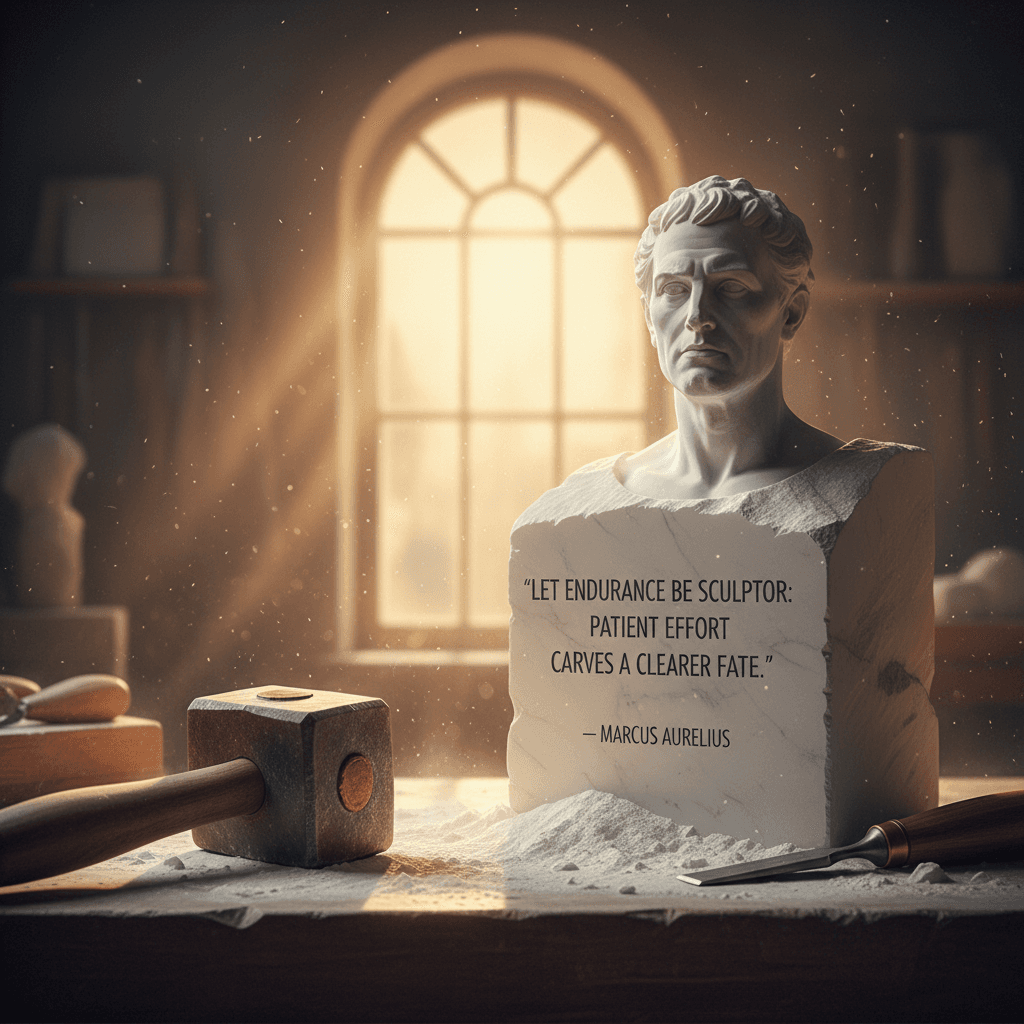
Let endurance be a sculptor: patient effort carves a clearer fate. — Marcus Aurelius
—What lingers after this line?
A Stoic Metaphor in Motion
To picture endurance as a sculptor is to imagine time, pressure, and intention steadily removing what is unnecessary. The chisel is not a single blow but a rhythm: tap, assess, tap again. In Stoic terms, fate is not a fixed statue waiting behind a curtain; rather, character clarifies fate by shaping how we meet events. Thus, the clearer fate is not a different destiny, but a more intelligible path through it—one cut by patient effort, where rough impulses are pared away and a coherent form begins to appear.
Marcus Aurelius and the Weight of Duty
This image echoes Marcus Aurelius’s life, forged amid the Antonine Plague and the Marcomannic Wars, where endurance was not theatrical but administrative, daily, and humane. In Meditations he notes that obstacles redirect action into its proper channel—“what stands in the way becomes the way” (Meditations 5.20). Such lines reveal endurance as purposeful, not passive: the emperor’s chiseling was composed of morning resolve, equitable judgments, and steady kindness. From this lived practice arises our next question: how does repeated effort actually reshape us?
From Chisel to Habit: How Effort Forms Us
Neuroscience provides the grain of the marble. Repetition strengthens synaptic pathways (Eric Kandel’s work on memory, Nobel lecture, 2001), while myelination speeds efficient circuits, making practiced responses feel natural (Fields, “White Matter Matters,” 2008). Likewise, habit loops—cue, routine, reward—gradually automate useful actions (Duhigg, The Power of Habit, 2012). In other words, patient effort carves not only outcomes but capacities: the hand learns the stroke, the mind learns the stance, and the will learns to return. With the mechanism in view, we can see how history’s craftspeople embodied the metaphor.
Historical Chisels: Artisans and Engineers
Renaissance biographer Ascanio Condivi records Michelangelo’s belief that a figure lies within marble, awaiting release (Life of Michelangelo, 1553). Each deliberate strike removes excess to reveal essence—just as disciplined days free the better self. Romans thought similarly in stone and water: Frontinus’s De aquaeductu (c. 97 CE) praises the relentless maintenance that keeps aqueducts clear. Nothing grand occurs in a single act; rather, consistent tending makes form and flow reliable. From these material analogies, we turn to the philosophical heart: what, in Stoicism, can endurance actually change?
Clarifying Fate: Freedom Within Necessity
Stoics argue that while external events belong to fate, our judgments and choices remain ours. Epictetus opens the Enchiridion by dividing what is up to us from what is not (Enchiridion 1). Endurance, then, sculpts the faculty of choice—prohairesis—so our responses grow cleaner, less warped by fear or vanity. Seneca’s On Providence insists that trials serve as training grounds for virtue, not punishments. In this light, “a clearer fate” means a life whose inward governance is legible: constraints acknowledged, values prioritized, and actions aligned. Yet such chiseling requires care to avoid cracking the stone.
Guardrails: Endurance Without Erosion
True endurance is not grim obstinacy but sustainable steadiness. Research on deliberate practice shows that improvement hinges on targeted effort paired with recovery (Ericsson et al., Psychological Review, 1993). Likewise, sleep consolidates learning and emotional regulation (Walker, Why We Sleep, 2017). Marcus reminds us to work “in accordance with nature,” which implies pacing, not self-sabotage. Thus, the right pressure refines; excessive force shatters. With these guardrails in place, we can specify the daily strokes that shape character over time.
Practices: Daily Strokes of the Chisel
Ground the metaphor in routines: morning intention-setting and evening review translate ideals into feedback (Aurelius’s Meditations model the habit). Negative visualization—premeditatio malorum—rehearses obstacles to reduce surprise and sharpen preparation (Seneca, Letters 91). Periodic voluntary discomfort trims dependency and strengthens resolve (Musonius Rufus, Lectures 6). Finally, design habits with small, repeatable cues: a set hour, a simple trigger, a brief first step. Each act is a measured strike, and over months the silhouette emerges—less noise, more form—until endurance has indeed sculpted a clearer fate.
One-minute reflection
What does this quote ask you to notice today?
Related Quotes
6 selectedNothing befalls a man except what is in his nature to endure. — Marcus Aurelius
Marcus Aurelius
At its core, Marcus Aurelius’ line expresses a central Stoic conviction: life does not place us outside the boundaries of our moral and psychological capacity. In his Meditations (c.
Read full interpretation →Mastery grows from patient practice, not from sudden perfection. — Marcus Aurelius
Marcus Aurelius
Marcus Aurelius’ line pushes against a common fantasy: that excellence arrives as a clean, dramatic breakthrough. Instead, he defines mastery as something that accumulates—quietly and predictably—through repetition and t...
Read full interpretation →Act with steady patience: momentum is the reward of persistent effort. — Marcus Aurelius
Marcus Aurelius
Marcus Aurelius frames patience not as passive waiting, but as a deliberate mode of conduct—“act with steady patience.” In the Stoic spirit of his Meditations (c. 170–180 AD), this kind of patience is something you pract...
Read full interpretation →Temper ambition with patience; greatness grows in the quiet between efforts. — Marcus Aurelius
Marcus Aurelius
Marcus Aurelius’ counsel begins with an acknowledgment: ambition itself is not condemned; it is the fuel that drives achievement. Yet, like fire, uncontained ambition can scorch rather than strengthen.
Read full interpretation →Everything that is great in life is the product of slow growth; the newer, and greater, and higher, and nobler the work, the slower is its growth. — William George Jordan
William George Jordan
William George Jordan’s reflection begins with a quiet but demanding truth: the most meaningful achievements rarely arrive quickly. He suggests that greatness is not manufactured in sudden bursts but cultivated through t...
Read full interpretation →You cannot force ideas. Successful ideas are the result of slow growth. — Alexander Graham Bell
Alexander Graham Bell
Alexander Graham Bell’s statement begins with a quiet warning against impatience: ideas cannot be commanded into maturity simply because we desire results. Like plants, they require conditions, time, and repeated attenti...
Read full interpretation →More From Author
More from Marcus Aurelius →Consistency is the sum that equals what we become. — Marcus Aurelius
Marcus Aurelius’ line frames becoming as a kind of moral mathematics: each repeated action adds to the total of a life. Rather than imagining identity as a single grand decision, the quote suggests that character is accu...
Read full interpretation →If anyone can refute me—show me I'm making a mistake or looking at things from the wrong perspective—I'll gladly change. — Marcus Aurelius
Marcus Aurelius begins from a position that appears modest but is actually deeply disciplined: he is willing to be corrected. Rather than treating disagreement as an insult, he frames it as an opportunity to see more cle...
Read full interpretation →The art of life is more like the wrestler's art than the dancer's; stand ready and firm to meet sudden and unexpected onsets. — Marcus Aurelius
Marcus Aurelius contrasts two arts to clarify what living well demands. A dancer suggests elegance, rhythm, and practiced beauty; a wrestler, by contrast, suggests balance under pressure, resistance, and constant readine...
Read full interpretation →How much time he gains who does not look to see what his neighbour says or does or thinks, but only at what he does himself, to make it just and holy. — Marcus Aurelius
Marcus Aurelius argues that a great deal of life is wasted in watching other people—what they say, what they do, and even what they might be thinking. Instead, he recommends a disciplined inward turn: focus on your own c...
Read full interpretation →