
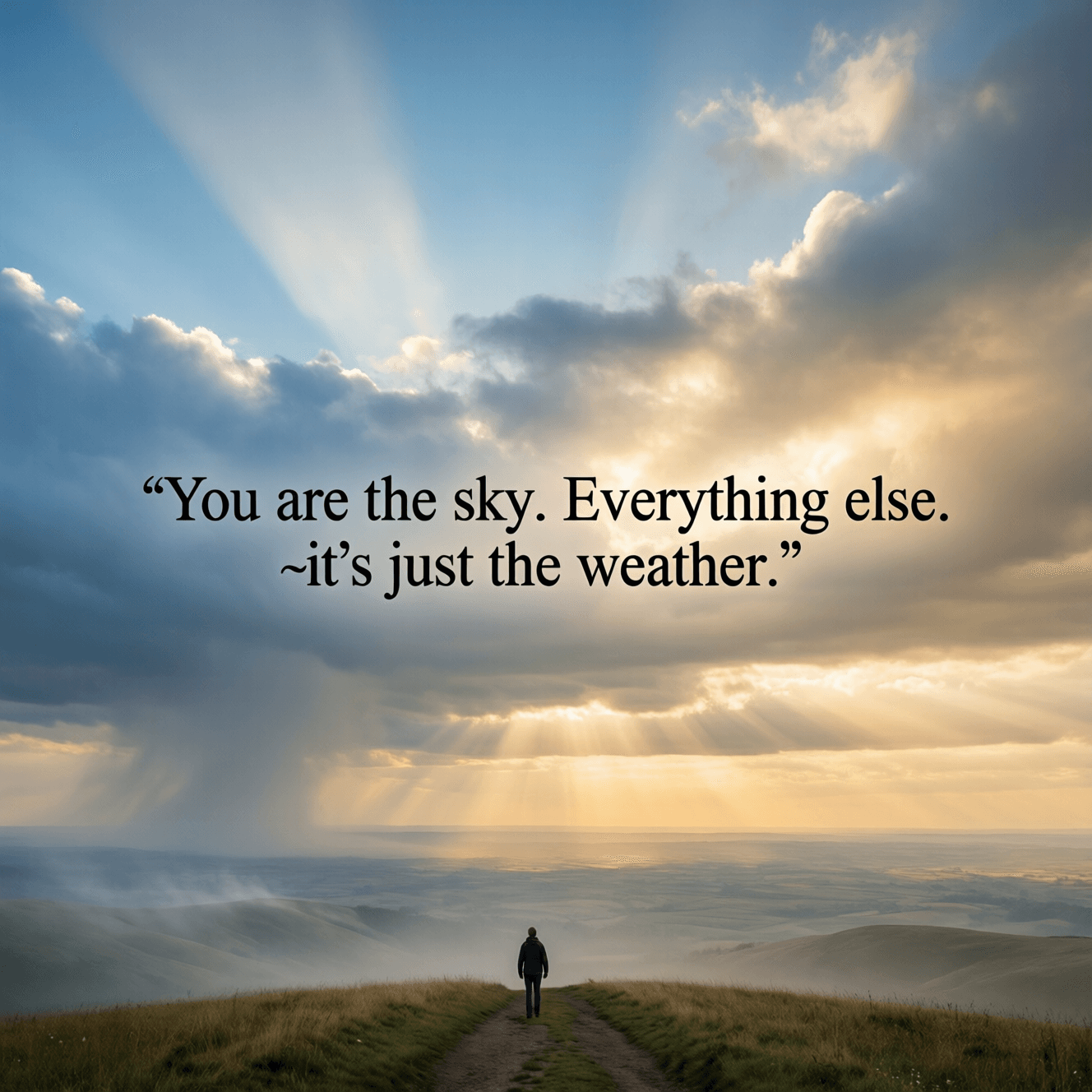
You are the sky. Everything else—it’s just the weather. — Pema Chödrön
—What lingers after this line?
A Metaphor for the Mind
Pema Chödrön’s line begins with a simple but radical reframing: what we most fundamentally are is not the swirl of thoughts and feelings, but the open awareness in which they appear. By calling you “the sky,” she points to something vast, stable, and accommodating, while “the weather” evokes the changing patterns of mood, fear, desire, and commentary that move through experience. This metaphor immediately loosens the grip of self-definition. If anger is only a storm passing through, then it is not your identity; it is an event. From there, the quote invites a gentler curiosity—less “What’s wrong with me?” and more “What is moving through me right now?”
Disentangling Identity from Emotion
Once the sky-weather distinction lands, the next step is recognizing how often we fuse with our internal climate. A harsh thought arrives—“I’m failing”—and we unconsciously become it, as if the thought were a verdict rather than a passing formation. Chödrön’s phrasing works like a lever: it pries apart the experiencer and the experience. In Buddhist psychology, this resembles the practice of observing mental events without clinging, a theme that runs through teachings on non-attachment and impermanence. The point isn’t to deny emotion, but to stop letting it appoint itself as the ruler of the whole inner world.
Impermanence as a Source of Relief
The weather changes. That’s both obvious in nature and easy to forget in suffering, when a single mood feels endless. Chödrön’s reminder quietly restores a timeline: what rises will also pass. In that sense, the quote offers relief without requiring immediate improvement; even the worst storm is, by nature, temporary. This aligns with a classic Buddhist emphasis on anicca (impermanence), found throughout early discourses like the Pāli Canon’s reflections on change. When you remember that feelings are weather, you gain the patience to let them move through rather than forcing a premature fix.
Mindfulness as Taking the Sky’s View
From this perspective, mindfulness becomes less about controlling the forecast and more about inhabiting a wider vantage point. Instead of wrestling with anxiety, you notice its sensations, thoughts, and urges as patterns—wind, pressure, shifting clouds. The act of naming—“worrying,” “planning,” “tightness”—can be like watching clouds form and dissolve. Over time, this “sky view” builds a steadier intimacy with experience. You may still feel the full force of grief or excitement, yet you’re less likely to interpret those states as permanent truths. The practice becomes a rehearsal in spaciousness.
A Practical Moment: When the Storm Hits
Consider a familiar scene: you receive a sharp email, and heat rushes in—anger, defensiveness, a rehearsed argument. In the weather model, you don’t pretend it’s fine; you simply recognize a storm front moving in. You might pause, feel your breath, notice the storyline accelerating, and delay the reply. That pause is the sky remembering itself. The email is real, and the anger is real, but neither needs to define who you are or what happens next. By the time you respond, the weather may have shifted enough to choose clarity over combustion.
Compassion for Yourself and Others
Finally, the metaphor widens beyond self-management into compassion. If your inner turmoil is weather, so is everyone else’s. The colleague’s coldness, the partner’s irritability, even your own reactivity can be seen as temporary conditions rather than fixed character flaws. This doesn’t excuse harm, but it reduces the impulse to essentialize and condemn. Chödrön’s broader teaching—echoed in works like her book *When Things Fall Apart* (1996)—often emphasizes staying present with discomfort without hardening. Seeing yourself as sky makes room for tenderness: storms can be intense, yet the sky remains, capable of holding it all.
One-minute reflection
Where does this idea show up in your life right now?
Related Quotes
6 selectedYou are the sky. Everything else—it's just the weather. — Pema Chödrön
Pema Chödrön
Pema Chödrön’s line hinges on a simple but expansive metaphor: awareness is the sky, while thoughts, emotions, and circumstances are weather. The sky is vast enough to hold anything without being permanently altered by i...
Read full interpretation →You are the sky. Everything else—it’s just the weather. — Pema Chödrön
Pema Chödrön
Pema Chödrön’s line offers a simple but radical reframe: who you are is not the passing content of experience, but the spacious awareness in which experience appears. If the mind is “the sky,” then thoughts, moods, and e...
Read full interpretation →You are the sky. Everything else—it’s just the weather. — Pema Chödrön
Pema Chödrön
Pema Chödrön’s line draws a clean distinction between what we are and what we experience. If you are the sky, then thoughts, emotions, and external events are like weather systems—temporary patterns moving through a much...
Read full interpretation →You are the sky. Everything else—it’s just the weather. — Pema Chödrön
Pema Chödrön
Pema Chödrön’s line opens with an arresting reversal: you are not the shifting content of experience, but the vast capacity in which experience appears. By naming you “the sky,” she points to a stable, open awareness tha...
Read full interpretation →You are the sky. Everything else—it’s just the weather. — Pema Chödrön
Pema Chödrön
Pema Chödrön’s line begins with a simple reversal: instead of identifying with everything that happens inside you, she invites you to identify with the capacity that can hold it. The “sky” points to awareness itself—wide...
Read full interpretation →You are the sky. Everything else is just the weather. — Pema Chödrön
Pema Chödrön
Pema Chödrön’s line begins with a simple reversal of identity: instead of defining yourself by what passes through you, you identify with what can hold it all. The “sky” represents the open, steady awareness that remains...
Read full interpretation →More From Author
More from Pema Chödrön →The only way to move forward is to stop pretending that the past is still happening. — Pema Chödrön
Pema Chödrön’s line begins with a gentle but piercing insight: suffering often persists not only because something painful happened, but because part of us keeps reliving it as if it were still unfolding. In that sense,...
Read full interpretation →The best parts of your life are the ones that happen when absolutely no one is looking. — Pema Chödrön
Pema Chödrön’s quote turns attention away from applause and toward the private texture of living. At first glance, it suggests that life’s richest moments are not always the dramatic ones shared with an audience, but the...
Read full interpretation →Learning is not a sprint toward an end goal; it is a life-long rhythm of shedding what no longer serves you to make room for what does. — Pema Chödrön
At first glance, Pema Chödrön’s reflection challenges one of the most common assumptions about education: that learning is a race with a clear endpoint. Degrees, promotions, and certifications often tempt us to think of...
Read full interpretation →The truth is rarely comfortable, but it is the only thing that will actually set you free. Stop hiding from your reality and start owning your choices. — Pema Chödrön
At its core, Pema Chödrön’s statement argues that freedom does not come from denial, distraction, or carefully managed appearances. Instead, it begins with the willingness to confront what is real, even when that reality...
Read full interpretation →