
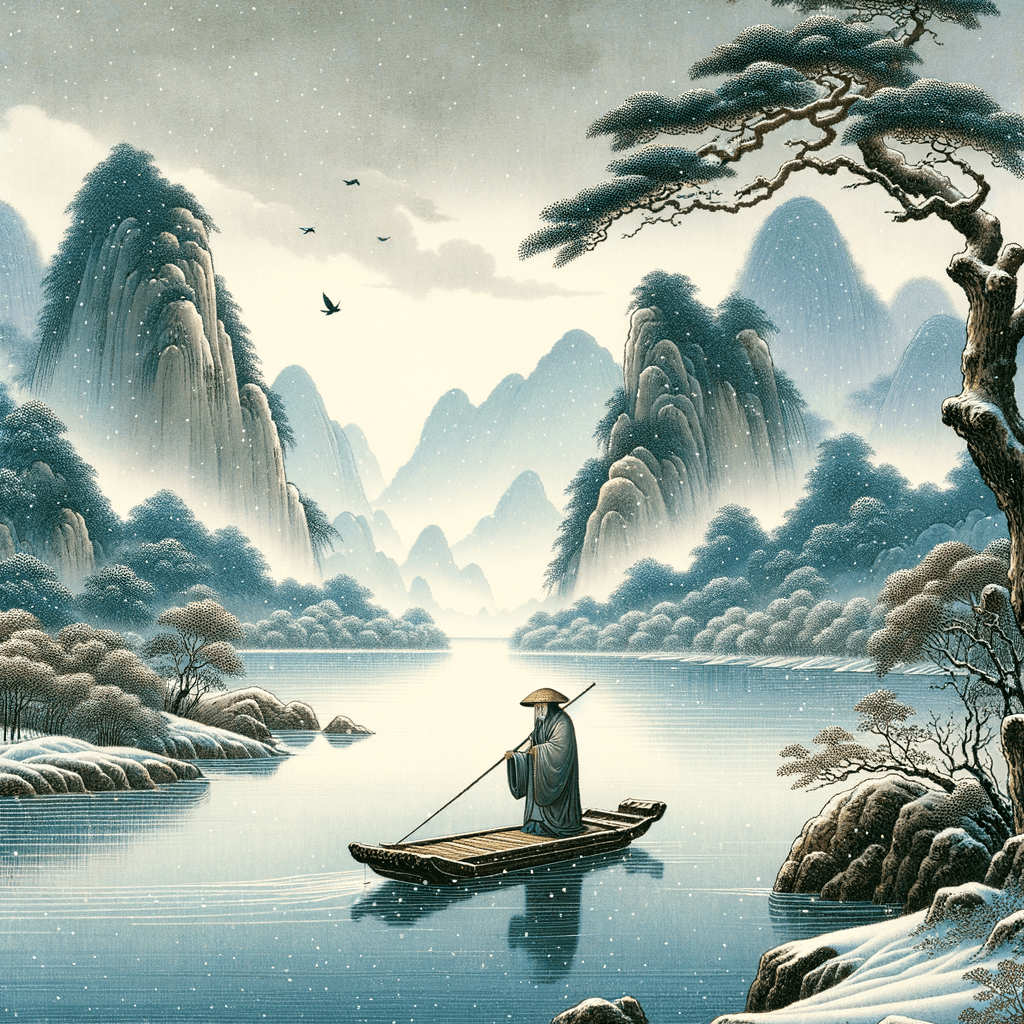
Birds have all vanished over thousands of mountains, On myriad paths, no trace of human tread. A lonely boat, an old man in bamboo hat and cloak, Alone fishing amid the cold river snow.
—What lingers after this line?
Desolation and Solitude
The lines convey a profound sense of desolation and solitude. The complete absence of birds and human activity underscores the isolating environment the old man is in.
Nature's Barren Beauty
The imagery of thousands of mountains and myriad paths highlights the vast and barren beauty of nature. The setting is pristine yet devoid of any signs of life except for the old man and his boat.
Human Resilience
The old man, despite the harsh and cold environment, continues to fish. This reflects the resilience and perseverance inherent in human nature, even in the face of adversity.
Traditional Imagery
The old man is described in traditional attire—a bamboo hat and cloak—evoking a timeless and cultural aspect of the fisherman's life. This imagery connects the present scene to a long-standing tradition.
Contrast Between Man and Nature
The poem contrasts the solitary human figure against the vast, uninhabited natural landscape. This stark contrast accentuates the loneliness of the old man, making his solitary fishing journey stand out even more.
Symbol of Endurance
The old man fishing alone amid the cold, snowy river can be seen as a symbol of endurance and the human spirit's ability to find purpose and peace even in the most challenging conditions.
One-minute reflection
Where does this idea show up in your life right now?
Related Quotes
6 selectedI care for myself. The more solitary, the more friendless, the more unsustained I am, the more I will respect myself. — Charlotte Brontë
Charlotte Brontë
Charlotte Brontë’s words begin as a quiet but forceful act of self-possession. Rather than treating loneliness as proof of failure, the speaker transforms it into evidence of resilience.
Read full interpretation →But many of us seek community solely to escape the fear of being alone. Knowing how to be solitary is central to the art of loving. — bell hooks
bell hooks
Bell hooks begins with a quiet but difficult observation: not every search for community is rooted in love. Sometimes, we reach for others because solitude feels threatening, as though being alone exposes a lack within u...
Read full interpretation →To have passed through life and never experienced solitude is to have never known oneself. — Joseph Krutch
Joseph Krutch
Joseph Krutch’s statement begins with a striking reversal: what many people avoid—solitude—he treats as essential to a meaningful life. In his view, simply moving through the world surrounded by noise, duties, and compan...
Read full interpretation →The mind needs solitude in the same way a forest needs quiet after a storm. It is not because nothing is happening; it is because that is when everything begins to grow. — Pico Iyer
Pico Iyer
Pico Iyer compares the mind to a forest recovering after a storm, and the image immediately shifts our understanding of solitude. Rather than treating aloneness as emptiness, he presents it as a necessary period of renew...
Read full interpretation →The real problem with being alone is that you're stuck with yourself all day. Make sure you're someone you actually like hanging out with. — Maya Angelou
Maya Angelou
Maya Angelou’s line begins with a sharp but compassionate truth: being alone is difficult not merely because others are absent, but because the self becomes unavoidable. In solitude, distraction fades, and our habits, th...
Read full interpretation →If you want to be happy, learn to be alone without being lonely. Learn that being alone does not mean being unhappy. — Michael Josephson
Michael Josephson
Michael Josephson’s remark turns on a subtle but life-changing distinction: being alone is a circumstance, while being lonely is an emotional interpretation of that circumstance. In other words, solitude does not automat...
Read full interpretation →More From Author
More from Unknown →The language is the substrate. The architecture is the contract.
The line sets up a deliberate pairing: language lies beneath everything, while architecture governs everything above it. In other words, what you can express determines what you can build, and what you commit to structur...
Read full interpretation →A scroll is not a break; it is a trap disguised as rest. — Unknown
The quote begins by challenging a familiar story we tell ourselves: that a brief scroll is a harmless pause between tasks. On the surface, it looks like recovery—no effort, no decision, no commitment.
Read full interpretation →Don't let your ice cream melt while you're counting someone else's sprinkles. — Unknown
The quote uses ice cream as a simple stand-in for life’s fleeting pleasures: what you have is delicious, but it won’t last forever if you ignore it. Meanwhile, “counting someone else’s sprinkles” captures the habit of mo...
Read full interpretation →If your absence doesn't affect them, your presence never mattered. — Unknown
The quote frames absence as a revealing experiment: remove yourself, and the reaction—concern, curiosity, indifference—becomes a kind of data. If nothing changes when you’re gone, it suggests your role was never integrat...
Read full interpretation →