
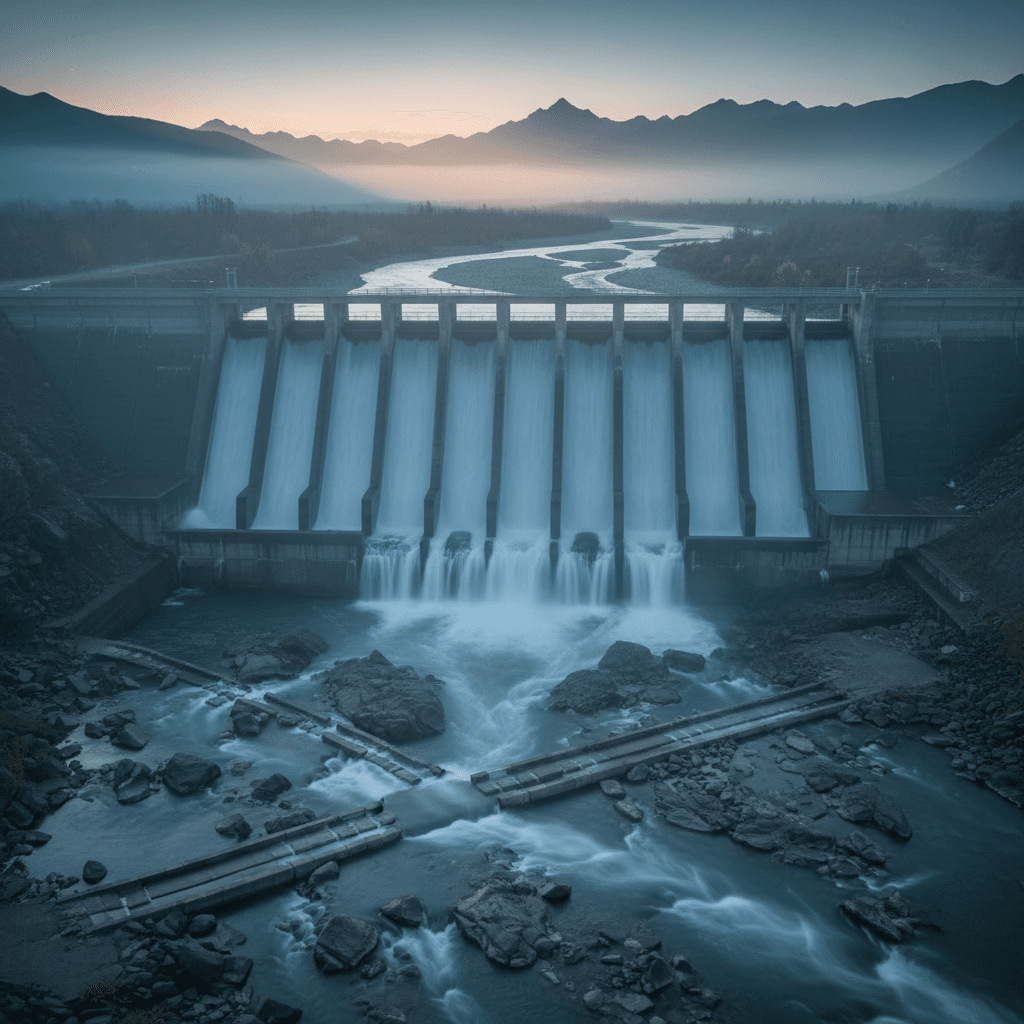
Move like water: persistent, patient, impossible to dam. — Nikos Kazantzakis
—What lingers after this line?
A Metaphor for Unstoppable Progress
Kazantzakis distills a life strategy into a single image: water. Rather than announcing itself with force, water advances through steady motion—flowing around obstacles, seeping into cracks, and returning again and again. In this way, “persistent, patient” becomes more than a motivational slogan; it describes a method of progress that does not depend on dramatic breakthroughs. From this starting point, the phrase “impossible to dam” signals inevitability. A dam can halt a river’s surface, but it cannot erase water’s nature: pressure builds, channels form elsewhere, and time keeps working. The quote therefore frames perseverance not as stubborn rigidity, but as a long, adaptive commitment to movement.
Persistence as Daily Return
To “move like water” is to return to the task even when nothing seems to change. Water shapes stone not by winning a single battle, but by countless small contacts that add up. This reframes persistence as a practice of showing up—writing one paragraph, taking one walk, making one difficult phone call—without demanding immediate proof that it matters. As a result, the quote quietly rejects the myth of the heroic sprint. It invites a slower heroism: the kind that keeps going after the initial excitement fades. In many creative lives, the difference between aspiration and achievement is simply the willingness to come back tomorrow and continue flowing.
Patience as a Form of Strength
Patience, in Kazantzakis’ formulation, is not passive waiting; it is controlled tempo. Water can rush as a torrent or settle as a lake, yet in both states it retains direction and potential. Likewise, patient effort means knowing when to press forward and when to gather strength—without abandoning the larger course. This matters because impatience often turns obstacles into verdicts: a rejection becomes “never,” a delay becomes “failure.” Water teaches a different interpretation—delay is merely terrain. Over time, patience becomes a stabilizing force, allowing a person to endure uncertainty without hardening into despair.
Adaptability Over Head-On Collision
The phrase “move like water” also celebrates flexibility. Water rarely confronts a barrier by ramming it; it explores edges, finds openings, and changes shape without changing essence. That shift—around rather than against—turns obstacles into information: where is the gap, what is the new route, what can be reshaped? Consequently, the quote hints at a tactical intelligence. In Sun Tzu’s The Art of War (c. 5th century BC), effective action is compared to water precisely because it avoids fixed form and exploits the contours of the situation. Kazantzakis extends that logic into character: resilience is often the capacity to adjust without surrendering.
Why Some Efforts Are “Impossible to Dam”
“Impossible to dam” points to an inner momentum that outlasts external control. Dams work when pressure is finite and predictable, but human resolve—when rooted in meaning—can keep generating force. A person who knows why they’re moving can reroute, rebuild, and continue even after repeated setbacks. This is why oppressive systems so often fear small, persistent acts: they are hard to fully contain. The image suggests that lasting change comes less from one explosive moment than from accumulated flow—conversations that shift norms, habits that reshape identity, and communities that keep returning to their aims until barriers erode.
Living the Quote Without Becoming a Flood
Still, water’s power comes with responsibility: it nourishes, but it can also destroy. To adopt this philosophy wisely means pairing persistence with discernment—choosing channels that sustain rather than harm. The goal is not to overwhelm everything in your path, but to keep moving with purpose and restraint. In the end, Kazantzakis offers a model of courage suited to long lives and hard problems. By flowing—again and again—one becomes difficult to stop not through brute force, but through a calm refusal to be finalized by obstacles. The motion itself becomes the victory.
Recommended Reading
As an Amazon Associate, we earn from qualifying purchases.
One-minute reflection
Why might this line matter today, not tomorrow?
Related Quotes
6 selectedIf you're going through hell, keep going. Why would you stop in hell? — Winston Churchill
At its core, Churchill’s line reframes suffering as a place of passage rather than a permanent home. If life feels like hell, the worst response is paralysis, because stopping only prolongs exposure to what is already un...
Read full interpretation →When you learn how to suffer, you suffer far less. Resilience is not about avoiding the fire; it is about becoming fireproof. — Thich Nhat Hanh
Thich Nhat Hanh
At first glance, Thich Nhat Hanh’s quote appears paradoxical: how could learning to suffer make suffering lighter? Yet his point is that pain intensifies when we resist it, fear it, or treat it as a personal failure.
Read full interpretation →When the pace of change becomes relentless, the most radical act of resilience is to protect your own peace and internal equilibrium. — Dr. Thema Bryant
Dr. Thema Bryant
At first glance, Dr. Thema Bryant’s statement reframes resilience in a striking way: rather than merely enduring external pressure, it asks us to preserve our inner steadiness.
Read full interpretation →The brick walls are there for a reason... to give us a chance to show how badly we want something. — Randy Pausch
Randy Pausch
At first glance, Randy Pausch’s line turns frustration into meaning. Rather than treating barriers as pointless interruptions, he frames them as tests that reveal the seriousness of our intentions.
Read full interpretation →There is no royal road to anything. One thing at a time, all things in succession. That which grows fast, withers as rapidly. That which grows slowly, endures. — J. G. Holland
J. G. Holland
J. G.
Read full interpretation →Adaptability is not imitation. It means power of resistance and assimilation. — Rabindranath Tagore
Rabindranath Tagore
At the heart of Tagore’s statement lies a careful distinction between changing and merely copying. Adaptability, he argues, is not the passive act of becoming like one’s surroundings; rather, it is an active power that a...
Read full interpretation →More From Author
More from Nikos Kazantzakis →Scatter bold colors into routine moments; revolution often looks like art. — Nikos Kazantzakis
Kazantzakis’s line invites us to treat the dull edges of routine as a canvas, where a splash of boldness is not mere ornament but a spark of transformation. In Zorba the Greek (1946), a dance interrupts drudgery, turning...
Read full interpretation →You have your brush, you have your colors, you paint the paradise, then in you go. — Nikos Kazantzakis
Kazantzakis compresses a whole philosophy into a single motion: with tools in hand and colors chosen, you make a world—and then you step inside it. The final clause, “then in you go,” turns art from spectacle into thresh...
Read full interpretation →I hope for nothing. I fear nothing. I am free. — Nikos Kazantzakis
Carved on Kazantzakis’s grave in Heraklion, Crete, the line—"I hope for nothing. I fear nothing.
Read full interpretation →