
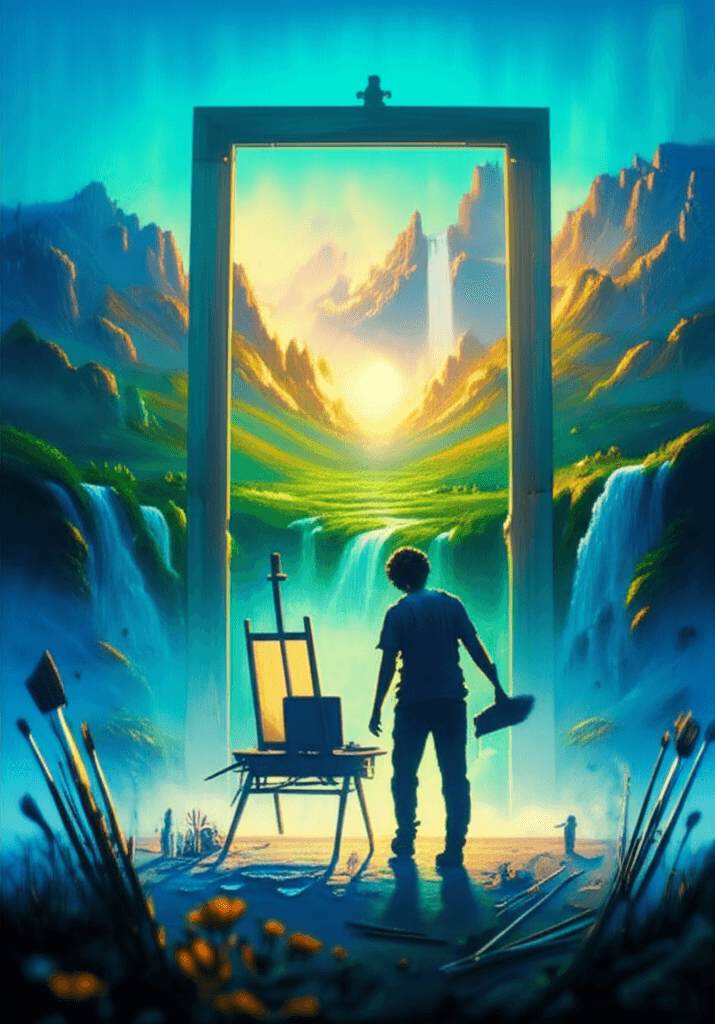
You have your brush, you have your colors, you paint the paradise, then in you go. — Nikos Kazantzakis
—What lingers after this line?
From Imagining to Inhabiting
Kazantzakis compresses a whole philosophy into a single motion: with tools in hand and colors chosen, you make a world—and then you step inside it. The final clause, “then in you go,” turns art from spectacle into threshold. It echoes his characters’ urgency in Zorba the Greek (1946), where dancing after failure becomes a way to live one’s creation, not merely contemplate it. Likewise, in Report to Greco (1961), he describes chiseling meaning from the raw rock of existence. By naming the brush and the colors, he rejects passivity; by walking into the canvas, he makes craft into courage. Thus the quote inaugurates a movement from conception to habitation, insisting that the good life is not only designed but also dwelt in.
The Ethics of Making Your World
Yet once we accept this invitation, responsibility follows. The paradise we paint is not morally neutral, because environments educate their inhabitants. As Sartre argued in Being and Nothingness (1943), existence precedes essence; by choosing, we draft the selves we must then become. Moreover, expectations shape outcomes: the Pygmalion effect, first documented by Rosenthal and Jacobson (1968), shows how beliefs can elevate performance by quietly steering behavior. In this light, creating a “paradise” is an ethical act: it sets the standards, rituals, and limits that will later shape our character. Consequently, we should choose colors—values, narratives, constraints—worthy of habitation, since we will live under their hues.
How Vision Becomes Action
Moving from ethics to mechanism, psychology clarifies how a painted vision becomes a lived place. Bandura’s self-efficacy theory (1997) shows that believing you can act drastically increases persistence and skill acquisition. Mental imagery strengthens this belief: studies of motor imagery (e.g., Kosslyn, 1994) find that rehearsed scenes prime neural pathways for real performance. Crucially, “implementation intentions” translate dreams into doors; as Gollwitzer (1999) demonstrated, if-then plans bridge aspiration and behavior. Organizational theorist Karl Weick called this “enactment” (1979): we partly create the environments we later confront. Even at the societal level, prospection research argues that humans are “future-making” creatures (Seligman et al., 2013). Thus the painted paradise is not a mirage but a scaffold; stepping in becomes the predictable outcome of prepared seeing.
Art as Practice, Not Escape
Nevertheless, painting paradise is not an invitation to flee reality. Kazantzakis’s own spiritual stance—severe, striving, ascetic in The Saviors of God (1927)—frames creation as ascent through struggle, not a pastel refuge. John Dewey’s Art as Experience (1934) likewise dissolves the boundary between studio and street, arguing that art matures only when it returns to ordinary life. Therefore, the canvas must touch the ground: a business plan that funds fair labor, a classroom that dignifies curiosity, a neighborhood garden that feeds bodies as well as dreams. Paradise, in this reading, is practice—daily, testable, revisable. And because practice meets resistance, it keeps us honest, ensuring that what we enter is sturdy enough to live in.
Paradises Are Often Collective
Extending from the self to the city, we discover that most paradises are co-authored. Jane Jacobs’s The Death and Life of Great American Cities (1961) showed how sidewalk choreography and mixed uses generate safety and joy; Christopher Alexander’s A Pattern Language (1977) translated such insights into design patterns communities can adopt. Consider New York’s High Line: residents and designers reimagined an obsolete railway into a suspended park, and then millions “went in,” inhabiting a new urban ritual. When we paint together—policies, plazas, platforms—we also agree to abide by them. Hence the communal canvas demands dialogue and iteration, so the place we enter can welcome more than its creators.
A Small Toolkit for Stepping Inside
Finally, a brief toolkit keeps the motion honest: name your colors by articulating values in a sentence you can say aloud; sketch the scene by writing a narrative identity paragraph (McAdams, 1993) that begins, “The next chapter starts when…”; set if-then doors for three behaviors (Gollwitzer, 1999); frame constraints—budget, time, rules—so the work bears weight; build daily strokes with a 20-minute protected block; and create an entry ritual—a walk, a playlist, a shared check-in—that signals, “now we go in.” Each move links vision to habit, so paradise does not hover above life but grows, brushstroke by brushstroke, around the life you already lead.
One-minute reflection
What's one small action this suggests?
Related Quotes
6 selectedEach day is a blank canvas; paint on it the life you desire.
Unknown
This quote emphasizes that each day presents a fresh start. Like a blank canvas, it offers endless possibilities and the opportunity to make new choices and changes.
Read full interpretation →Write the future with steady hands; imagination is the draft of change. — Margaret Atwood
Margaret Atwood
Margaret Atwood’s line splits the work of the future into two complementary tasks: envisioning and building. “Imagination is the draft of change” suggests that transformation begins as a mental sketch—an early version fu...
Read full interpretation →Create what you long to see, then live as its first citizen. — Kahlil Gibran
Kahlil Gibran
Kahlil Gibran’s line begins with a quiet challenge: longing, by itself, is not a plan. Instead of treating desire as a private ache, he reframes it as an instruction—make the thing you want to exist.
Read full interpretation →Refuse to be reduced by doubt; write your answer with steady hands. — Toni Morrison
Toni Morrison
Toni Morrison’s line, “Refuse to be reduced by doubt; write your answer with steady hands,” begins as a quiet defiance against an invisible force. Doubt, in her framing, does not merely slow us down; it actively tries to...
Read full interpretation →Live your projects; identity grows where action is sown — José Ortega y Gasset
José Ortega y Gasset
José Ortega y Gasset’s phrase suggests that identity is less a finished sculpture and more a field under cultivation. Instead of being something we simply discover inside ourselves, identity emerges in the open air, wher...
Read full interpretation →Refuse to wait for permission to make beauty from what you have. — Haruki Murakami
Haruki Murakami
Murakami’s line urges a quiet but radical defiance: stop waiting for someone else to authorize your creativity. Rather than treating institutions, experts, or distant gatekeepers as judges of what is worthy, he suggests...
Read full interpretation →More From Author
More from Nikos Kazantzakis →Move like water: persistent, patient, impossible to dam. — Nikos Kazantzakis
Kazantzakis distills a life strategy into a single image: water. Rather than announcing itself with force, water advances through steady motion—flowing around obstacles, seeping into cracks, and returning again and again...
Read full interpretation →Scatter bold colors into routine moments; revolution often looks like art. — Nikos Kazantzakis
Kazantzakis’s line invites us to treat the dull edges of routine as a canvas, where a splash of boldness is not mere ornament but a spark of transformation. In Zorba the Greek (1946), a dance interrupts drudgery, turning...
Read full interpretation →I hope for nothing. I fear nothing. I am free. — Nikos Kazantzakis
Carved on Kazantzakis’s grave in Heraklion, Crete, the line—"I hope for nothing. I fear nothing.
Read full interpretation →