
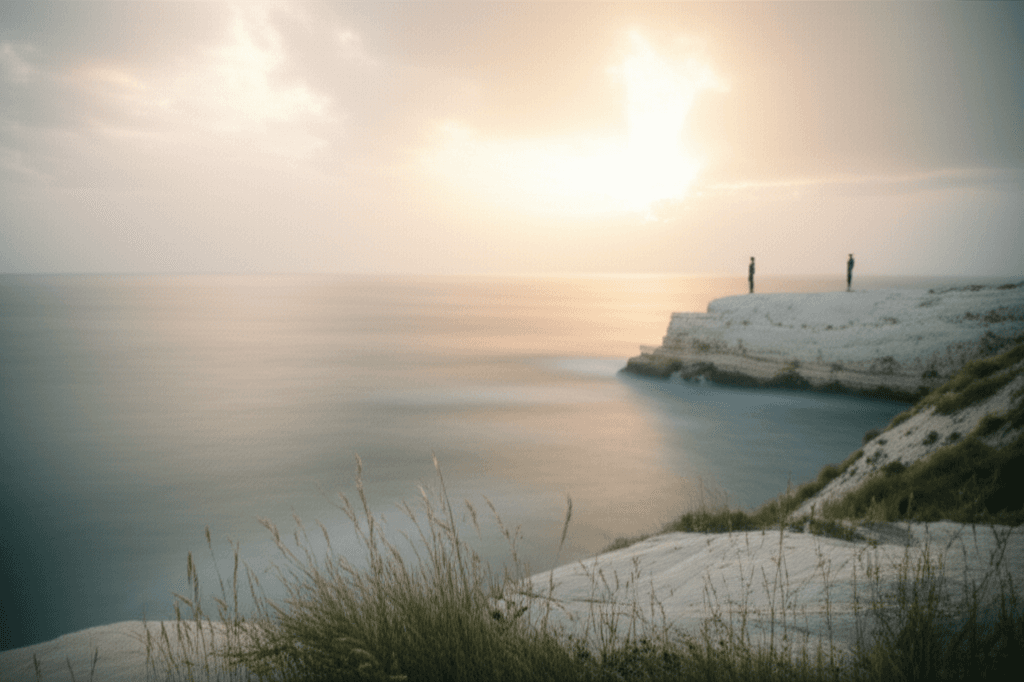
I hope for nothing. I fear nothing. I am free. — Nikos Kazantzakis
—What lingers after this line?
The Epitaph’s Stark Invitation
Carved on Kazantzakis’s grave in Heraklion, Crete, the line—"I hope for nothing. I fear nothing. I am free."—reads like a koan. Rather than bleak resignation, it issues a challenge: loosen the grip of expectation. By pairing hope with fear, he exposes how both tether us to imagined futures; in cutting those cords, he suggests, the present becomes livable. This opening paradox sets the tone for a more demanding form of freedom.
Uncoupling Freedom from Outcomes
Seen this way, hope and fear are twin projections: one craves a specific outcome, the other dreads its opposite. Both make liberty conditional. Kazantzakis reframes freedom as a stance available before results arrive. The move is subtle—less about passivity than about unbinding agency from guarantees. Once the contract with the future is revoked, effort can be wholehearted because it is no longer hostage to success or failure.
Stoic and Buddhist Kinships
This posture echoes Stoic ataraxia and apatheia. Epictetus’s Enchiridion 1 advises focusing only on what is up to us, while Marcus Aurelius’s Meditations counsels equanimity amid flux. Likewise, Buddhist non-attachment and equanimity (upekkha) in the Dhammapada urge release from clinging and aversion. Even Tibetan lojong slogans—popularized by Chögyam Trungpa as "no hope, no fear" (1973)—mirror the sentiment. Through these convergences, Kazantzakis’s epitaph joins a long tradition of inner sovereignty.
Existential Courage, Not Nihilism
Yet the line is not a call to emptiness. In Zorba the Greek (1946), Kazantzakis celebrates voracious engagement with life; and in Report to Greco (1961), he frames struggle as a sacred duty. The absence of hope and fear here protects action from paralysis, much as Camus’s rebel acts without metaphysical guarantees and Sartre’s free subject accepts responsibility without excuses. Thus, freedom emerges as courageous clarity, not a retreat from meaning.
Disciplines That Cultivate Detachment
Translating the aphorism into practice requires training. Stoic premeditatio malorum and memento mori (Seneca, Letters) blunt fear by rehearsing loss; mindfulness meditation loosens clinging by noticing thoughts as passing weather. In psychology, Acceptance and Commitment Therapy (Hayes et al., 1999) teaches willingness and values-based action, decoupling behavior from outcome anxiety. Together, these disciplines make "no hope, no fear" a skill rather than a slogan.
Responsibility Without Illusion
Finally, freedom from hope and fear sharpens ethical focus. Without fantasizing results or dreading backlash, one can act for what is right because it is right—a stance akin to Kant’s duty but tempered by humility. Viktor Frankl’s Man’s Search for Meaning (1946) adds a pragmatic coda: while circumstances may strip us of outcomes, we retain the freedom to choose our attitude. In that quiet space of choice, Kazantzakis locates liberty.
One-minute reflection
Why might this line matter today, not tomorrow?
Related Quotes
6 selectedI'll tell you what freedom is to me: no fear. I mean really, no fear! — Nina Simone
Nina Simone
Nina Simone’s line refuses abstractions and replaces them with something bodily and immediate: fearlessness. By saying “I’ll tell you what freedom is to me,” she frames freedom not as a slogan or a legal condition but as...
Read full interpretation →Before complaining that you are a slave to another, be sure that you are not a slave to self. — James Allen
James Allen
James Allen’s warning begins with a reversal: the most immediate master may not be another person, institution, or circumstance, but one’s own impulses. Before condemning external control, he asks us to examine whether a...
Read full interpretation →The sort of fearless openness required to turn toward our suffering is only possible within the spacious receptivity of love. — Frank Ostaseski
Frank Ostaseski
Frank Ostaseski’s statement begins with a striking claim: real courage is not simply toughness or willpower. Instead, the bravery required to face suffering honestly arises from love’s presence.
Read full interpretation →It is only when we are no longer fearful that we begin to create. — J.M.W. Turner
J.M.W. Turner
Turner’s statement begins with a simple but profound insight: fear often stands between imagination and expression. Before a person can create, they must first loosen the grip of self-doubt, judgment, and uncertainty.
Read full interpretation →I have a lot of things to prove to myself. One is that I can live my life fearlessly. — Oprah Winfrey
Oprah Winfrey
At first glance, Oprah Winfrey’s words shift the idea of achievement away from public applause and toward an inner reckoning. She is not speaking about proving worth to critics, rivals, or even admirers; rather, she iden...
Read full interpretation →True freedom is being without anxiety about imperfection. — Seng-tsan
tsan
Seng-tsan’s line shifts freedom away from external conditions and toward an internal posture: a mind no longer bullied by the fear of being flawed. In this framing, you can have choices, status, or even safety and still...
Read full interpretation →More From Author
More from Nikos Kazantzakis →Move like water: persistent, patient, impossible to dam. — Nikos Kazantzakis
Kazantzakis distills a life strategy into a single image: water. Rather than announcing itself with force, water advances through steady motion—flowing around obstacles, seeping into cracks, and returning again and again...
Read full interpretation →Scatter bold colors into routine moments; revolution often looks like art. — Nikos Kazantzakis
Kazantzakis’s line invites us to treat the dull edges of routine as a canvas, where a splash of boldness is not mere ornament but a spark of transformation. In Zorba the Greek (1946), a dance interrupts drudgery, turning...
Read full interpretation →You have your brush, you have your colors, you paint the paradise, then in you go. — Nikos Kazantzakis
Kazantzakis compresses a whole philosophy into a single motion: with tools in hand and colors chosen, you make a world—and then you step inside it. The final clause, “then in you go,” turns art from spectacle into thresh...
Read full interpretation →