
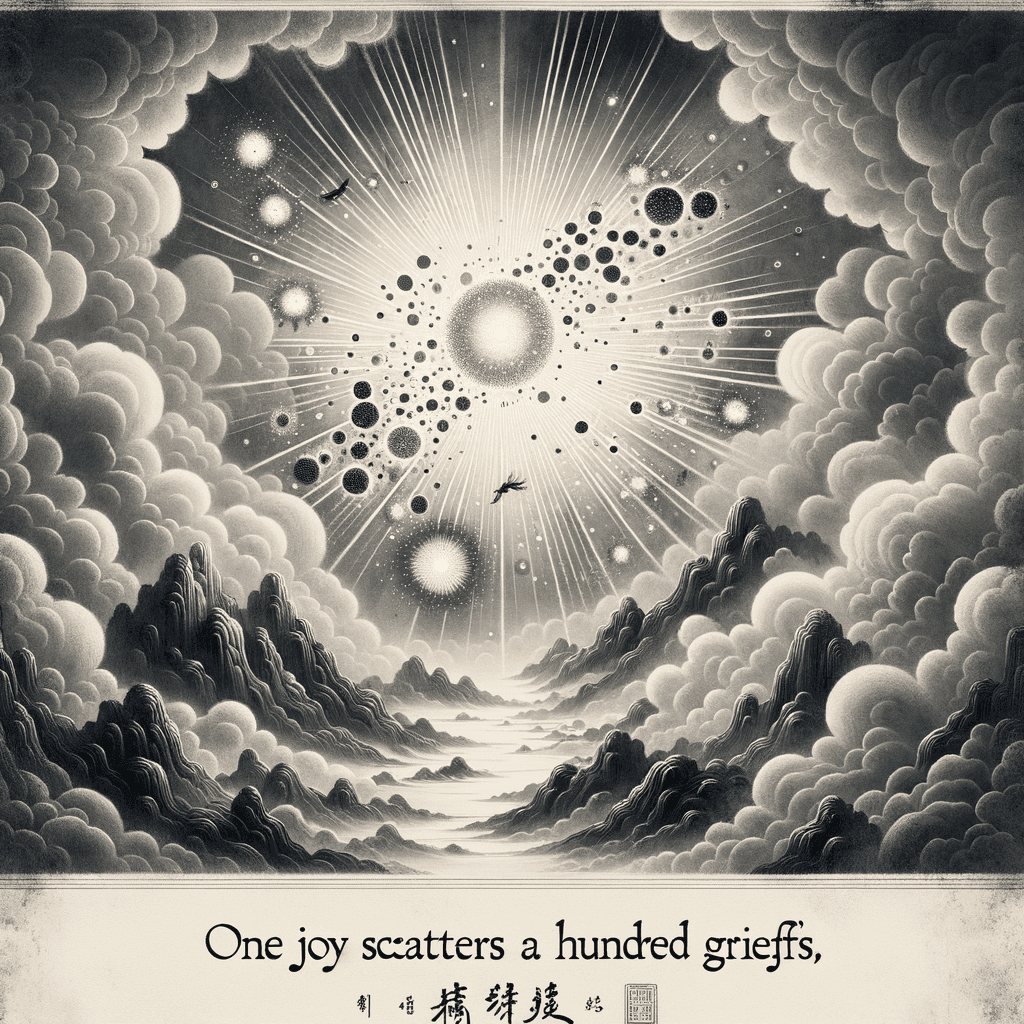
One joy scatters a hundred griefs. - Chinese Proverb
—What lingers after this line?
Power of Positivity
This proverb suggests that a single moment of joy or happiness has the power to diminish or overshadow numerous moments of sadness or grief. It emphasizes the impact of positive emotions on our overall well-being.
Emotional Resilience
It implies that experiencing joy can build emotional strength, making it easier to cope with and overcome multiple adversities. Joy serves as a form of emotional resilience that helps us face life's challenges.
Hope and Optimism
The quote underscores the importance of maintaining hope and optimism. Even in times of grief, the possibility of experiencing joy can provide comfort and encouragement, suggesting that happiness can be found even in difficult circumstances.
Momentary Happiness
It highlights the value of cherishing moments of happiness, no matter how brief or small. Such moments can alleviate a significant amount of sorrow and bring relief.
Cultural Wisdom
As a Chinese proverb, it reflects the cultural wisdom and philosophy that values balance and the transformative power of positive emotions. It is a reminder of the influence of ancient culture on contemporary life and thought.
One-minute reflection
Why might this line matter today, not tomorrow?
Related Quotes
6 selectedOne joy dispels a hundred cares. - Confucius
Confucius
This quote by Confucius highlights the overwhelming power of positive emotions. A single moment of joy has the potential to outweigh multiple worries and concerns, demonstrating the transformative impact of happiness.
Read full interpretation →Healing isn't about erasing the past. It's about changing how the past lives within you so it no longer controls your present. — Cory Muscara
Cory Muscara
Cory Muscara’s quote begins with a gentle but important correction: healing does not require pretending that pain never happened. Instead, it asks us to transform our relationship with memory, so the past becomes part of...
Read full interpretation →Healing may not be so much about getting better, as about letting go of everything that isn't you. — Rachel Naomi Remen
Rachel Naomi Remen
Rachel Naomi Remen’s insight gently shifts healing away from the usual language of repair. Instead of imagining ourselves as broken machines that must be made efficient again, she suggests that healing may involve removi...
Read full interpretation →We need joy as we need air. We need love as we need water. We need each other as we need the earth we share. — Maya Angelou
Maya Angelou
Maya Angelou’s words turn emotional needs into elemental ones, placing joy beside air, love beside water, and human connection beside the earth itself. By doing so, she refuses to treat happiness, affection, and communit...
Read full interpretation →Healing is not the absence of pain—it's a steady return to wholeness despite it. — Mark Nepo
Mark Nepo
Mark Nepo’s reflection begins by challenging a common assumption: that healing means pain has disappeared. Instead, he suggests that pain may remain present while healing is still underway.
Read full interpretation →It's when we start working together that the real healing takes place. — Yoko Ono
Yoko Ono
At its heart, Yoko Ono’s statement shifts healing away from the isolated individual and toward shared effort. The phrase “start working together” suggests that repair begins not merely with intention, but with cooperatio...
Read full interpretation →More From Author
More from Chinese Proverb →Tension is who you think you should be. Relaxation is who you are. — Chinese Proverb
The proverb draws a clean line between two inner experiences: tension and relaxation. Tension arises when a person is braced against themselves, trying to meet an imagined standard—what you think you should be—rather tha...
Read full interpretation →He who has never been to the Great Wall is not a true man. - Chinese Proverb
The quote reflects the immense pride that Chinese culture holds for the Great Wall. It represents the idea that experiencing this monumental structure is crucial to truly understanding and appreciating Chinese heritage a...
Read full interpretation →Keep a green tree in your heart and perhaps a singing bird will come. - Chinese Proverb
This proverb suggests that maintaining hope and positivity within oneself can attract joy and good fortune.
Read full interpretation →The flower that blooms in adversity is the most rare and beautiful of all. - Chinese Proverb
This proverb highlights the concept of resilience, suggesting that individuals who thrive despite facing difficult circumstances are particularly extraordinary.
Read full interpretation →