
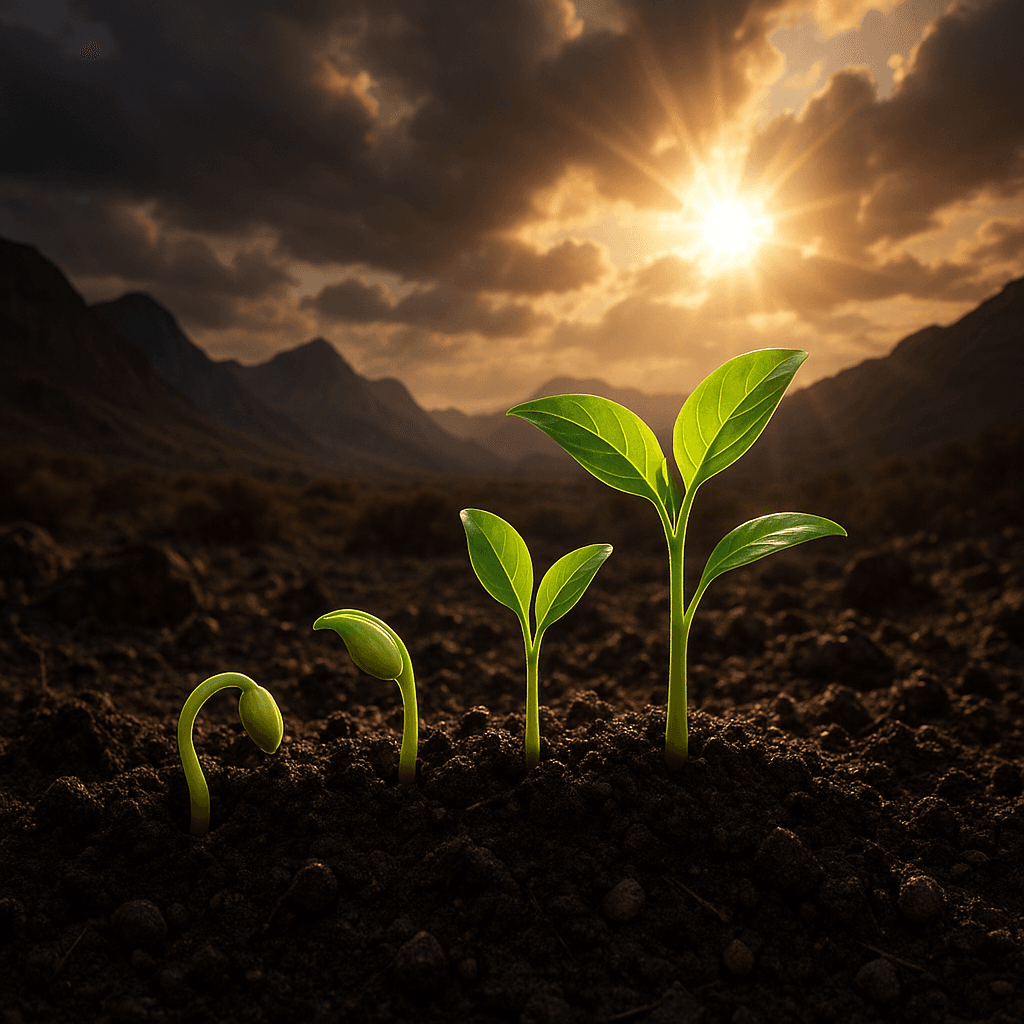
Seeds of greatness grow in the soil of struggle. — bell hooks
—What lingers after this line?
The Transformative Power of Adversity
Bell hooks’ evocative metaphor highlights an enduring truth: genuine greatness often arises from hardship. Adversity, much like rough soil, tests and strengthens the ‘seeds’ within us—our potential, creativity, and resilience. Just as a plant pushes through resistance to reach the sun, so too do individuals discover their capabilities when faced with difficulties.
Historical Figures Rooted in Struggle
Throughout history, many renowned leaders and thinkers flourished precisely because they endured and overcame adversity. For instance, Nelson Mandela’s decades-long imprisonment became the crucible through which his legacy of peace and perseverance was forged. Similarly, Maya Angelou’s early life struggles shaped her profound perspective and voice, as seen in ‘I Know Why the Caged Bird Sings’ (1969). Each story affirms that hardship is not a barrier but a foundation for greatness.
Psychological Insights into Growth Through Difficulty
Building upon this idea, psychology offers the concept of ‘post-traumatic growth’—the phenomenon by which individuals emerge from struggle not only intact but transformed. Research by Richard Tedeschi and Lawrence Calhoun in the 1990s found that those who experience hardship can cultivate deeper appreciation for life, enriched relationships, and newfound strengths. Thus, struggle, far from being destructive, can sow the seeds of remarkable personal development.
Community and Collective Struggle
In addition, hooks’ statement underscores the collective dimensions of struggle, echoing the experiences of marginalized communities. The civil rights movement, for example, demonstrates how shared adversity can galvanize collective action and foster leaders who embody resilience. As hooks frequently argued in her work, hardship endured together often yields not only individual greatness but also transformative social change.
Nurturing Potential in Challenging Times
Ultimately, recognizing the value of struggle invites a shift in how we approach difficulty. Instead of viewing challenges as setbacks, we might see them as opportunities to nurture our deepest potential. As educators, mentors, or friends, we can support others in understanding that the soil of struggle is fertile ground, where the roots of greatness take hold and prepare to blossom.
One-minute reflection
What's one small action this suggests?
Related Quotes
6 selectedWe are gardeners of our own resilience, tending to the soil of our minds with the quiet, persistent care that growth requires. — Robin Wall Kimmerer
Robin Wall Kimmerer
Robin Wall Kimmerer’s image begins by turning resilience into something living rather than fixed. Instead of portraying strength as hard armor, she imagines it as a garden that must be tended, suggesting that the mind is...
Read full interpretation →Resilience is not just enduring the storm; it is learning to harvest the rain to nourish the roots you've already planted. — Elizabeth Edwards
Elizabeth Edwards
At first glance, Elizabeth Edwards rejects the common image of resilience as simple endurance. To ‘endure the storm’ suggests gritting one’s teeth and waiting for suffering to pass, yet her metaphor quickly moves further...
Read full interpretation →When I hear somebody sigh, 'Life is hard,' I am always tempted to ask, 'Compared to what?' — Sydney J. Harris
Sydney J. Harris
Sydney J. Harris’s remark begins with an ordinary expression of fatigue: “Life is hard.” Yet his response, “Compared to what?” quietly turns complaint into inquiry.
Read full interpretation →Don't fight the challenges. Just find a new way to stand. — Germany Kent
Germany Kent
Germany Kent’s words begin with a quiet reversal of instinct: instead of treating every challenge as an enemy to defeat, she invites us to reconsider our posture toward difficulty. The emphasis is not on surrender, but o...
Read full interpretation →Optimist: someone who figures that taking a step backward after taking a step forward is not a disaster, it's more like a cha-cha. — Robert Brault
Robert Brault
Robert Brault’s line begins with a witty redefinition: an optimist is not someone who denies backward motion, but someone who interprets it differently. Instead of treating a setback as proof of failure, the optimist see...
Read full interpretation →A mind grows by staying with difficulty long enough for the experience to change it. — Mary Catherine Bateson
Mary Catherine Bateson
Mary Catherine Bateson’s observation begins with a quiet but demanding truth: the mind does not grow merely by encountering difficulty, but by remaining with it. Challenge becomes transformative only when we resist the u...
Read full interpretation →More From Author
More from bell hooks →But many of us seek community solely to escape the fear of being alone. Knowing how to be solitary is central to the art of loving. — bell hooks
Bell hooks begins with a quiet but difficult observation: not every search for community is rooted in love. Sometimes, we reach for others because solitude feels threatening, as though being alone exposes a lack within u...
Read full interpretation →Your presence is a form of resistance against a culture that profits from your isolation. Show up for those you love, even when it is inconvenient. — bell hooks
At first glance, bell hooks reframes something ordinary—being present for others—as a political and moral act. Her words suggest that care is not merely private sentiment; rather, it pushes back against a social order th...
Read full interpretation →If you don't build your own sanctuary, you will spend your life living in the wreckage of someone else's expectations. — Bell Hooks
Bell hooks frames sanctuary as more than a physical refuge; it is an inner and outer space where a person can live by values they have consciously chosen. At first glance, the quote sounds like a warning about independen...
Read full interpretation →The art of living is a constant process of refining one's own sanctuary against the tide of external expectations. — bell hooks
At its core, bell hooks presents living not as a finished achievement but as a continuous act of shaping and reshaping the self. The phrase “constant process” suggests that identity, peace, and integrity are never perman...
Read full interpretation →