
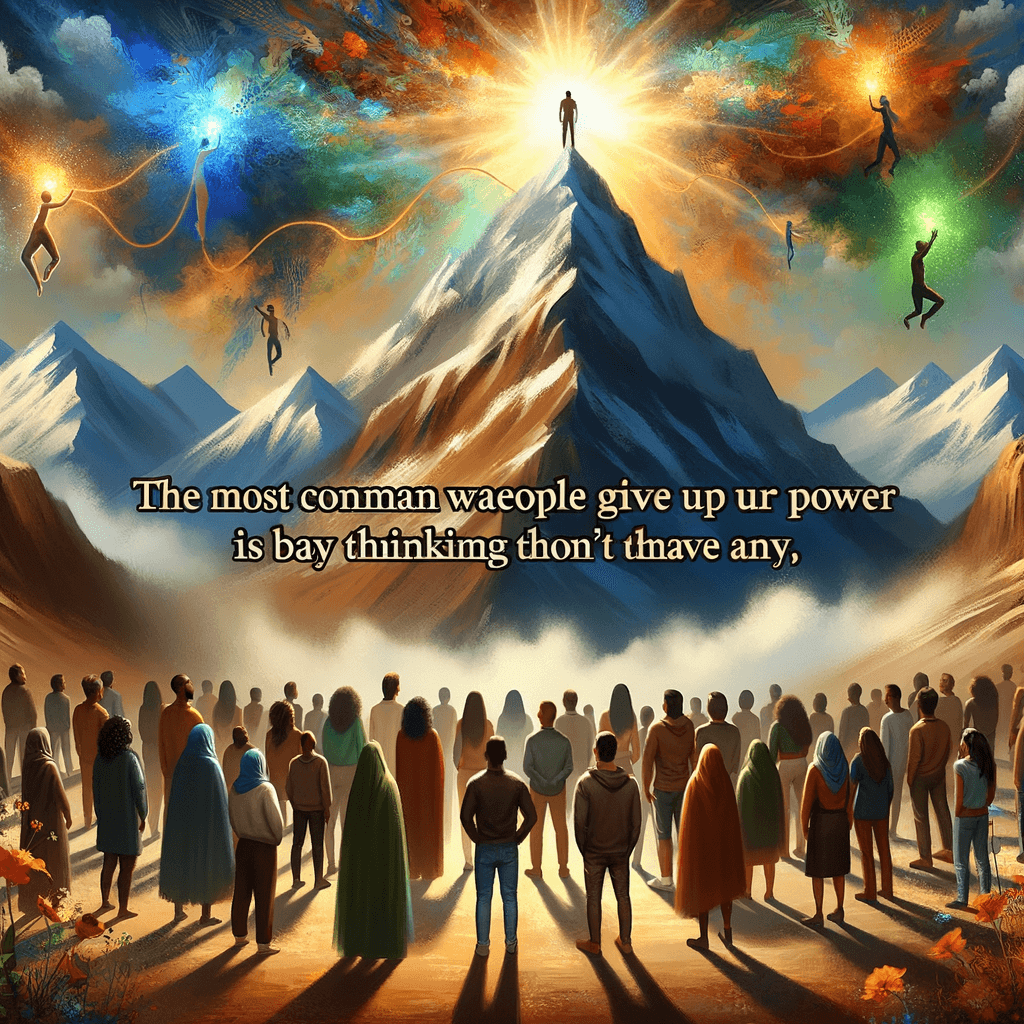
The most common way people give up their power is by thinking they don't have any. — Alice Walker
—What lingers after this line?
Understanding Personal Power
This quote highlights the misconception that individuals lack power. It suggests that the belief in one's own power is crucial for exercising and maintaining it.
Psychological Self-Efficacy
It touches on the concept of self-efficacy, the belief in one's ability to succeed. When people doubt their capabilities, they inadvertently relinquish their potential to influence outcomes.
Societal Influences
Alice Walker's statement implies that social structures and cultural narratives can undermine personal power by instilling feelings of inadequacy or helplessness in individuals.
Empowerment through Awareness
The quote serves as a call to awareness and self-empowerment. Recognizing and embracing one’s power can lead to greater agency and control over one’s life and circumstances.
Alice Walker's Impact
Alice Walker, an acclaimed author and activist, often explores themes of power, identity, and resilience in her works, advocating for social justice and awareness regarding personal and collective empowerment.
One-minute reflection
Where does this idea show up in your life right now?
Related Quotes
6 selectedThe most common way people give up their power is by thinking they don't have any. — Alice Walker
Alice Walker
Alice Walker’s line points to a paradox: people often lose power not through force, but through a belief that power was never theirs to begin with. That assumption quietly reshapes behavior—choices narrow, risks feel poi...
Read full interpretation →The most common way people give up their power is by thinking they don’t have any. — Alice Walker
Alice Walker
Alice Walker’s line points to a subtle but widespread form of surrender: not the dramatic loss of rights, money, or status, but the quiet decision to see oneself as incapable of influence. When people believe they have n...
Read full interpretation →Our boundaries define our personal space — and we need to be sovereign there in order to be able to step into our full power and potential. — Brené Brown
Brené Brown
Brené Brown’s insight begins with a simple but profound claim: boundaries are not walls meant to isolate us, but lines that clarify where our responsibility begins and ends. To be sovereign in our personal space means to...
Read full interpretation →The greatest reclamation of power is to stop letting your circumstances dictate your inner stillness. — Epictetus
Epictetus
At its heart, this statement distills a central Stoic lesson: real power begins when we stop treating external events as masters of our inner life. Epictetus, in the Discourses (2nd century AD), repeatedly argued that wh...
Read full interpretation →You can, if you believe you can. — George Reeves
George Reeves
At first glance, George Reeves’s line seems almost circular: you can, if you believe you can. Yet that apparent simplicity is precisely its force.
Read full interpretation →Whatever you want in life, other people are going to want it too. Believe in yourself enough to accept the competition. — Diane Sawyer
Diane Sawyer
Diane Sawyer’s quote begins with a sober truth: our desires are rarely unique. Whether the goal is a job, a creative breakthrough, or personal recognition, others are often reaching for the same prize.
Read full interpretation →More From Author
More from Alice Walker →The most beautiful things are those that take time to grow, requiring a commitment to the process rather than a hunger for the end. — Alice Walker
Alice Walker’s reflection shifts beauty away from instant results and toward slow formation. At its heart, the quote suggests that what becomes truly beautiful does so through time, care, and endurance rather than speed...
Read full interpretation →Hard times require furious dancing. Each of us is the proof. — Alice Walker
Alice Walker’s line treats “hard times” not as a cue for silence, but as a summons to movement. The phrase “furious dancing” reads like an intentional contradiction—how can joy or art survive suffering?
Read full interpretation →The most common way people give up their power is by thinking they don't have any. — Alice Walker
Alice Walker’s line points to a paradox: people often lose power not through force, but through a belief that power was never theirs to begin with. That assumption quietly reshapes behavior—choices narrow, risks feel poi...
Read full interpretation →In an age of speed, I began to think nothing is as precious as slowness. — Alice Walker
Alice Walker’s line begins with a modern assumption—life is accelerating—and then performs a quiet reversal: the rarer something becomes, the more it is worth. In an age that prizes quick replies, rapid production, and c...
Read full interpretation →