
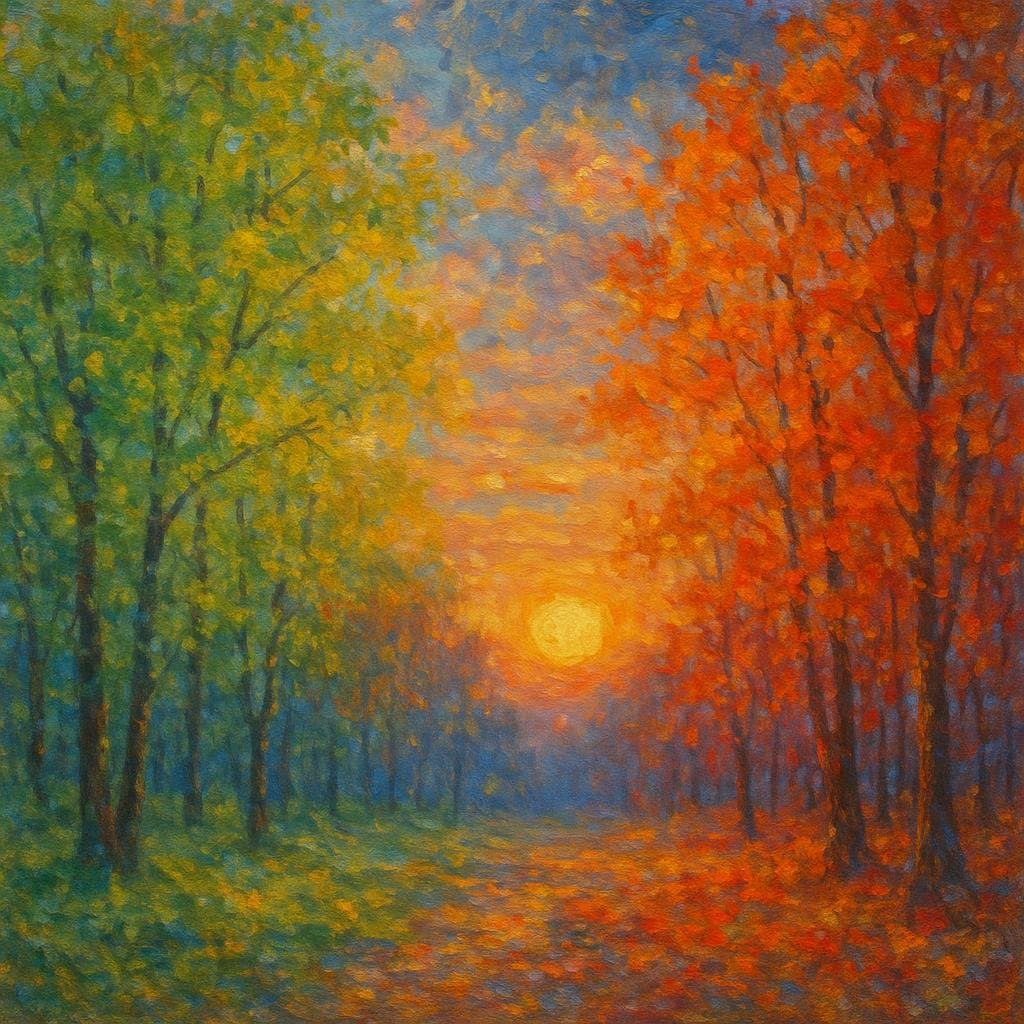
A work of art which did not begin in emotion is not art. — Paul Cézanne
—What lingers after this line?
Cézanne’s Artistic Philosophy
Paul Cézanne’s assertion that art must be rooted in emotion reveals the depth of his creative process. He, along with many post-impressionists, saw art not as a technical exercise but as an emotional endeavor—a means to transmit feelings visually. By positioning emotion as the catalyst, Cézanne invites us to view every painting or sculpture as a manifestation of an internal impulse, rather than a mere replication of reality.
Emotion Versus Technique
Although technical mastery is essential, Cézanne’s statement prioritizes feeling over flawless execution. This idea distinguishes true art from craftsmanship: while both may require skill, only art transforms technique into a vessel for emotion. Echoes of this perspective can be found in Vincent van Gogh’s letters, where he laments that art born solely from technique feels empty, lacking the passion that breathes life into it.
Historical and Modern Perspectives
Transitioning through art history, we find similar attitudes in Romanticism, where artists like Delacroix championed personal expression over formal rules. Contemporary art critics continue to debate whether emotional genesis separates iconic works from the mundane. Marina Abramović, for example, insists her performances emanate from visceral feeling—suggesting the relevance of Cézanne’s viewpoint even today.
The Viewer’s Experience
Furthermore, works that originate in deep feeling often resonate more powerfully with audiences. When art is born from authentic emotion, it forges a lasting connection, prompting empathy or catharsis in the viewer. Kandinsky, in his text ‘Concerning the Spiritual in Art’ (1911), observed that such works vibrate with an intensity felt beyond words, transcending cultural and temporal boundaries.
Emotion as the Spark of Creativity
Ultimately, Cézanne’s belief reminds us that emotion is the spark igniting artistic innovation. This principle not only defines the nature of fine art but also guides artists as they search for inspiration. Rather than suppressing feeling, true creativity embraces it, channeling inner experience into universal forms. Thus, art’s enduring magic stems from its emotional genesis—a truth that holds across generations and genres.
One-minute reflection
What does this quote ask you to notice today?
Related Quotes
6 selectedThere is no must in art because art is free. — Wassily Kandinsky
Wassily Kandinsky
At its core, Kandinsky’s statement rejects the idea that art must obey fixed obligations. By saying there is no ‘must’ in art, he frees creation from rigid formulas, academic demands, and social expectation.
Read full interpretation →Often what the artist expresses is unconscious, but we can learn to decode the story by collaboratively finding the pieces to the puzzle that create new possibilities for innovation. — Ben Okri
Ben Okri
At the heart of Ben Okri’s statement is the idea that art often says more than the artist consciously intends. A poem, painting, or song may carry hidden fears, cultural memories, or emotional truths that emerge without...
Read full interpretation →I think that when you create something, you leave a part of yourself in it. — Henri Matisse
Henri Matisse
At its core, Matisse’s reflection suggests that making anything—a painting, a poem, a song, even a room—inevitably transfers something inward into outward form. Creation is not merely the arrangement of materials; rather...
Read full interpretation →There is a deep peace that comes from creating something that didn't exist before. It is your way of telling the universe that you were here, and you felt something. — Maya Angelou
Maya Angelou
At its heart, Maya Angelou’s reflection suggests that creation is not merely productive but restorative. To make something that did not exist before—a poem, a garden, a melody, even a repaired room—is to experience a rar...
Read full interpretation →The creative act is not an escape from reality, but a way to encounter it more deeply. — bell hooks
bell hooks
At first glance, creative work can look like withdrawal: a painter disappears into a studio, a writer vanishes into pages, a musician closes the door and listens inward. Yet bell hooks reverses that assumption.
Read full interpretation →The best use of imagination is creativity. The worst use of imagination is anxiety. — Deepak Chopra
Deepak Chopra
Deepak Chopra frames imagination as a neutral force whose value depends on its direction. In one sense, imagination is the mind’s simulator: it can invent possibilities that do not yet exist, letting us rehearse outcomes...
Read full interpretation →More From Author
More from Paul Cézanne →The painter tries to master color; the color is the artist's language. — Paul Cézanne
At first glance, Cézanne’s remark seems simple: painters work to control color. Yet the second half deepens the thought by suggesting that color is not merely a tool but the very medium through which the artist thinks an...
Read full interpretation →Don't be an art critic, but paint, there lies salvation. — Paul Cézanne
Cézanne’s line reads less like a theory of aesthetics than a stern piece of life advice. Instead of standing back and judging art, he urges us to make it—to enter the difficult, absorbing labor of painting itself.
Read full interpretation →Do not wait to be struck by lightning; learn to build your own fire. — Paul Cezanne
This quote encourages individuals to take proactive steps in their lives rather than waiting for external circumstances to bring about change or inspiration.
Read full interpretation →We live in a rainbow of chaos. — Paul Cézanne
Paul Cézanne’s vivid expression, 'We live in a rainbow of chaos,' encapsulates the vibrant turbulence of human experience. By juxtaposing 'rainbow'—a symbol of beauty and diversity—with 'chaos,' Cézanne acknowledges the...
Read full interpretation →