
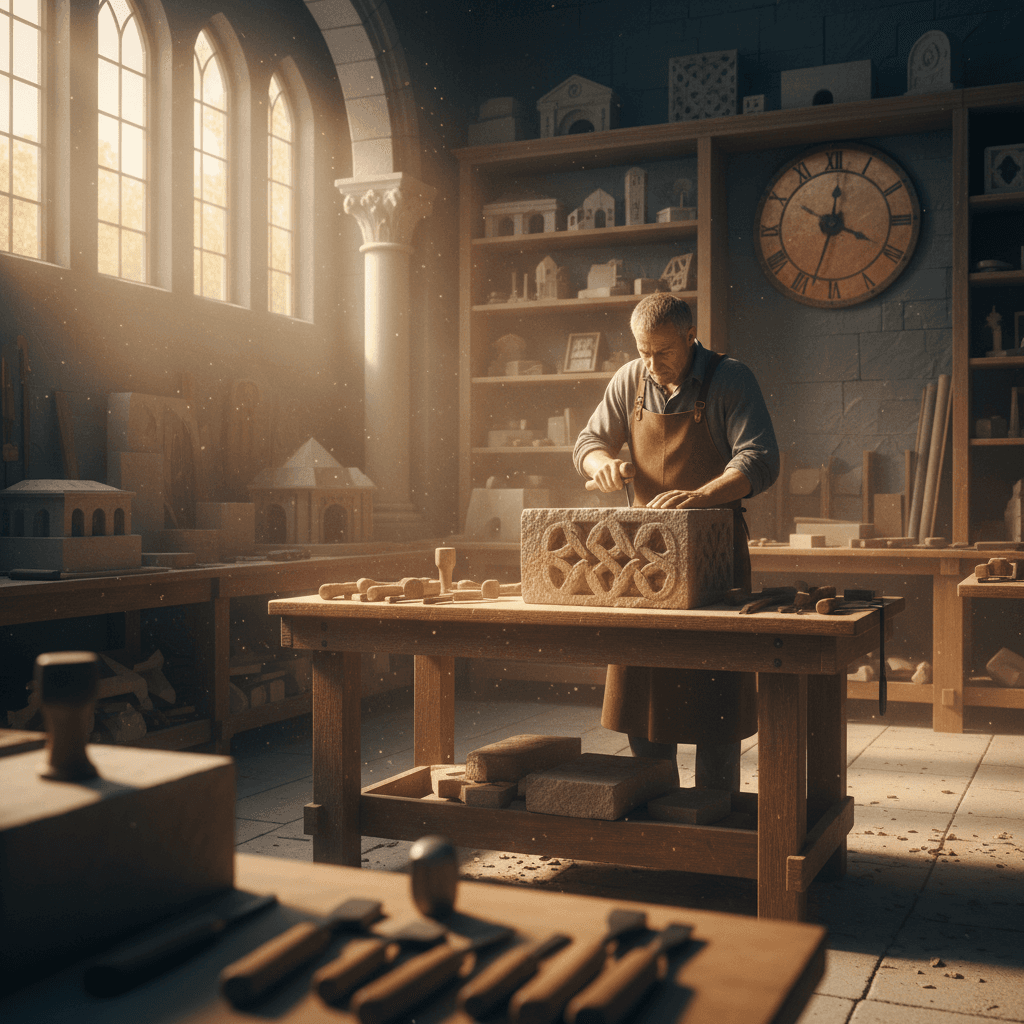
Work with honesty and your creations will stand the test of time. — Victor Hugo
—What lingers after this line?
Integrity as the Root of Endurance
To begin, Hugo’s maxim suggests that truthfulness is not mere morality; it is a structural property of lasting work. Honesty anchors a creation to reality—material, social, or emotional—so it resists the erosion of fashion. The Roman poet Horace intuited this when he wrote, in Odes III.30, that he had “raised a monument more lasting than bronze,” implying that fidelity to truth and craft outlives the ages. In this light, honesty operates like a load-bearing beam: invisible once the facade is admired, yet indispensable to what stands.
Hugo’s Own Proof of Principle
Building on this, Hugo modeled the principle himself. Les Misérables (1862) endures because its moral clarity and social observation refuse sentimentality; it is attentive to the workings of law, poverty, and redemption. Likewise, Notre-Dame de Paris (1831) fuses romance with a painstaking portrait of Gothic architecture, helping spur preservationist sentiment. His pamphlet “Guerre aux démolisseurs” (1832) openly decried erasures of heritage, arguing that truthful conservation is a civic duty. Because the work and the working ethic were aligned, the creations keep speaking across centuries.
Architecture and the Truth of Materials
Furthermore, the built environment illustrates how honesty breeds longevity. John Ruskin’s The Seven Lamps of Architecture (1849) champions the “Lamp of Truth,” urging builders to let stone look like stone and structure remain legible. Shaker furniture offers a parallel: simple joinery, proportion, and utility—free of masquerade—have kept ladder-back chairs useful and beautiful for over a century. As a result, these artifacts weather taste cycles because they never depended on disguise; their integrity is the aesthetic.
Science, Replicability, and Time
In parallel, science shows how honesty underwrites durability. Robert K. Merton’s 1942 norms—communalism, universalism, disinterestedness, organized skepticism—codify the ethic that makes findings reproducible and thus timeless. Richard Feynman’s “Cargo Cult Science” (1974) warns that wishful results collapse when checked. Fraudulent constructs like the Piltdown Man (exposed in 1953) fade, while Newton’s Principia (1687) persists because its claims survive repeated tests. In short, transparent methods make knowledge weatherproof.
Trust as a Competitive Advantage
Likewise, in commerce, honesty builds reputational compounding. Johnson & Johnson’s decisive transparency during the 1982 Tylenol crisis rebuilt trust that could have been permanently lost. Decades later, Patagonia’s 2011 “Don’t Buy This Jacket” campaign acknowledged environmental costs and invited repair, turning candor into loyalty. Because stakeholders can audit words against deeds, such brands endure beyond marketing cycles; trust becomes an asset with long half-life.
The Psychology of Authentic Creation
Psychologically, honesty aligns creator and creation, producing work that resonates. Carl Rogers described “congruence” in On Becoming a Person (1961): when one’s outer expression matches inner experience, communication gains power. Complementing this, Self-Determination Theory (Deci & Ryan, 1985) shows that autonomy and integrity fuel intrinsic motivation, which sustains effort through difficulty. Thus, authenticity is not a pose; it is energy that carries a project to completion and equips it to speak plainly to strangers later.
Transparency in the Digital Commons
In our digital era, transparency operationalizes honesty at scale. Open-source software—Linux (1991), PostgreSQL—survives because version control exposes decisions and invites verification; as Eric S. Raymond observed in The Cathedral and the Bazaar (1999), “given enough eyeballs, all bugs are shallow.” Similarly, Wikipedia endures by enforcing verifiability and revision history. By embedding provenance and critique into the medium, creators give their work the defenses it needs against entropy and oblivion.
Practices That Build Lasting Work
Ultimately, honest work is a practice, not a mood. Document sources and methods; prefer reversible choices where possible—as conservation’s Venice Charter (1964) advises—so future stewards can adapt. Test claims, invite peer review, and keep transparent logs or version histories. In craft, choose materials you can maintain, and design joints that reveal, not hide, how things hold. Through such habits, honesty becomes architecture—scaffolding that lets your creations meet the future on their feet.
One-minute reflection
Why might this line matter today, not tomorrow?
Related Quotes
6 selectedFind the quiet courage to create when the world offers no applause. — Audre Lorde
Audre Lorde
At the outset, Audre Lorde’s call positions creation as an ethical act rather than a performance. Her essay The Transformation of Silence into Language and Action (1977) insists that fear is not a verdict but a signal to...
Read full interpretation →Write what you must, and the world will answer in kind. — James Baldwin
James Baldwin
At its core, Baldwin’s line asserts a covenant: if you speak from necessity, the world will reply in the same register. “In kind” promises reciprocity—the tone, courage, and clarity you bring will shape the tone, courage...
Read full interpretation →To love beauty is to see light. — Victor Hugo
Victor Hugo
Victor Hugo’s line suggests that beauty is not merely something pleasing to the eye; it is a way of perceiving the world more clearly. To love beauty is to become receptive to illumination, as if the soul gains a new sou...
Read full interpretation →Build bridges with your will, and let hope walk across them. — Victor Hugo
Victor Hugo
Victor Hugo’s image begins with a practical insistence: the future doesn’t simply arrive; it is constructed. By saying “build bridges with your will,” he treats willpower as a kind of engineering—an intentional effort to...
Read full interpretation →Forge a path with words and work, and let beauty follow in your wake. — Victor Hugo
Victor Hugo
Victor Hugo’s line, “Forge a path with words and work, and let beauty follow in your wake,” begins by uniting two worlds often held apart: artistic expression and disciplined effort. Instead of treating beauty as somethi...
Read full interpretation →When doubt knocks, invite it to see what you're building — Victor Hugo
Victor Hugo
Victor Hugo’s image of doubt knocking at the door immediately turns an internal feeling into an external visitor. Rather than picturing doubt as a storm that breaks in, he imagines it as something that politely announces...
Read full interpretation →More From Author
More from Victor Hugo →To love beauty is to see light. — Victor Hugo
Victor Hugo’s line suggests that beauty is not merely something pleasing to the eye; it is a way of perceiving the world more clearly. To love beauty is to become receptive to illumination, as if the soul gains a new sou...
Read full interpretation →Build bridges with your will, and let hope walk across them. — Victor Hugo
Victor Hugo’s image begins with a practical insistence: the future doesn’t simply arrive; it is constructed. By saying “build bridges with your will,” he treats willpower as a kind of engineering—an intentional effort to...
Read full interpretation →Forge a path with words and work, and let beauty follow in your wake. — Victor Hugo
Victor Hugo’s line, “Forge a path with words and work, and let beauty follow in your wake,” begins by uniting two worlds often held apart: artistic expression and disciplined effort. Instead of treating beauty as somethi...
Read full interpretation →When doubt knocks, invite it to see what you're building — Victor Hugo
Victor Hugo’s image of doubt knocking at the door immediately turns an internal feeling into an external visitor. Rather than picturing doubt as a storm that breaks in, he imagines it as something that politely announces...
Read full interpretation →