
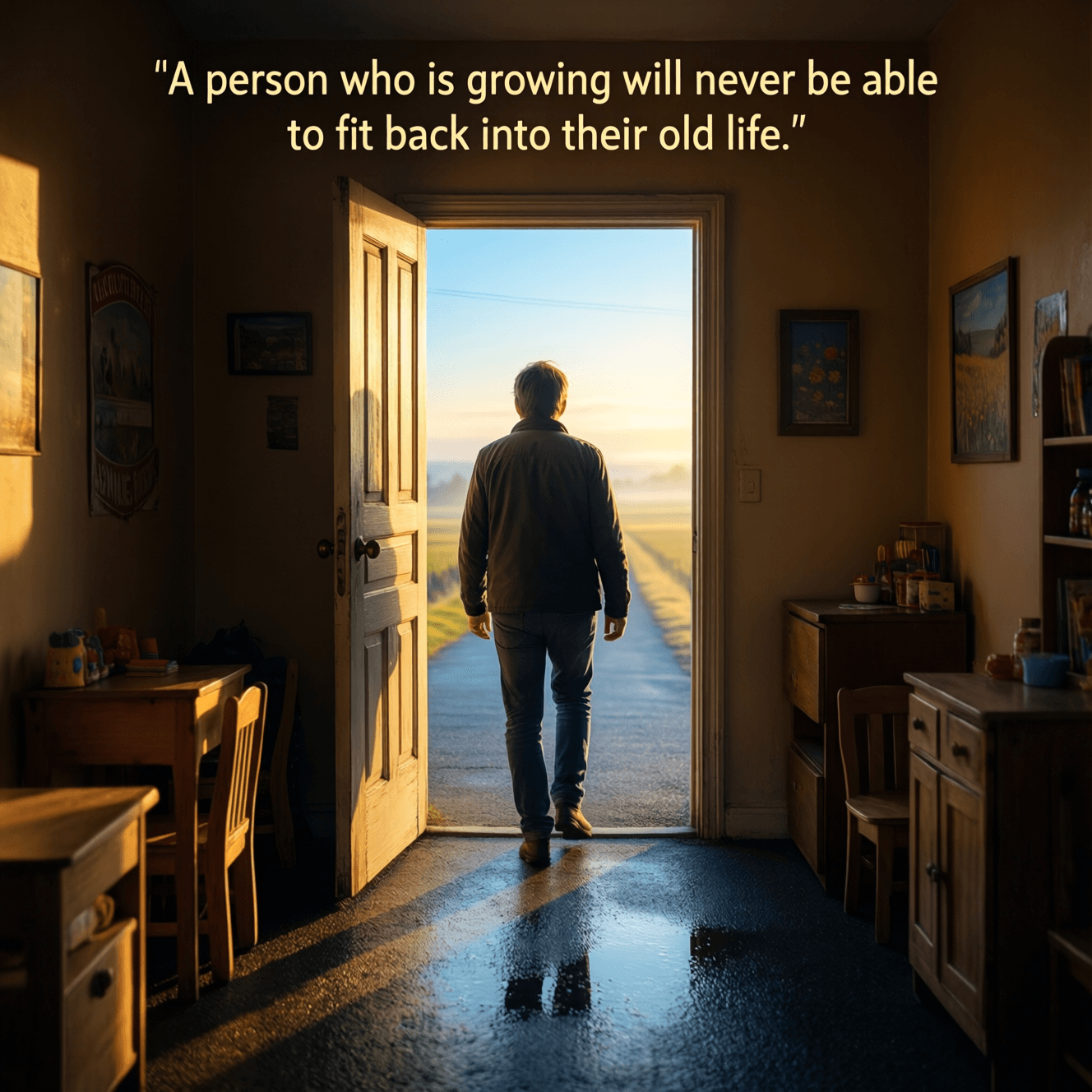
A person who is growing will never be able to fit back into their old life. — Yung Pueblo
—What lingers after this line?
Growth Changes the Shape of the Self
Yung Pueblo’s line frames personal development as a physical transformation: when you grow, you take up more inner space, and the old container can’t hold you. This isn’t arrogance or rejection for its own sake; it’s simply that new boundaries, clearer values, and deeper self-awareness alter what feels livable. As a result, returning to old routines can feel like trying to wear clothing from years ago—familiar, even sentimental, but no longer aligned with who you are. Because growth is cumulative, it often brings new standards for how you want to be treated and how you want to treat others. The “old life” may have worked when you had fewer tools, less clarity, or different needs, but development changes what you can tolerate and what you can genuinely enjoy.
The Myth of Returning to “Normal”
From there, the quote challenges a common hope: that you can evolve and still keep everything else exactly the same. Yet life rarely allows that kind of emotional time travel. Once you learn to communicate directly, for instance, you may find indirect dynamics exhausting; once you prioritize rest, constant busyness can feel like self-betrayal. This is why “going back” can create friction even when nothing external has changed. It’s not that your past was entirely wrong; it’s that your present has different requirements. In that sense, growth quietly dismantles the fantasy of a static normal and replaces it with a moving target: a life that must be updated as you are updated.
Relationships as Mirrors of Your Evolution
Next, the idea becomes most visible in relationships, where old roles tend to persist. Friends or family may unconsciously expect the version of you who over-explained, over-gave, or stayed silent to keep the peace. When you stop performing that role, it can feel to others like you changed suddenly, even if the change took years. However, growth doesn’t automatically mean losing people; it often means renegotiating the relationship’s terms. Some connections adapt and deepen when honesty replaces old patterns. Others depend on you staying smaller, and they strain when you no longer make yourself fit. The quote captures that tension: expansion is real, and it has consequences.
Old Habits Don’t Scale with New Awareness
As the social world shifts, the internal world does too. Habits that once helped you cope—numbing, pleasing, procrastinating, or overworking—may become harder to sustain when you can see what they cost you. This is similar to the psychological concept of cognitive dissonance described by Leon Festinger in “A Theory of Cognitive Dissonance” (1957): once your beliefs and behaviors no longer match, discomfort pushes you toward change. So the old life starts to feel cramped not only because of people or circumstances, but because your mind won’t let you pretend as easily. Increased self-knowledge makes certain choices feel less like options and more like compromises you can finally name.
Grief for the Past Is Part of Growing
Then comes the emotional layer many overlook: outgrowing a life can involve genuine grief. Even unhealthy chapters can carry warmth—shared jokes, familiar streets, a younger self who did the best they could. Letting go can feel like losing a home, even when you’re leaving to save yourself. This grief doesn’t contradict growth; it confirms that your past mattered. The quote implies a bittersweet truth: progress can be both liberating and costly. When you honor what was while accepting what no longer works, you make room to step forward without needing to rewrite history as entirely bad.
Building a Life That Fits Who You Are Now
Finally, the statement points toward a practical task: if the old life won’t fit, you must create a new one that does. That might mean choosing different environments, setting firmer boundaries, seeking relationships rooted in reciprocity, or aligning your work with your values. Growth is not only internal insight; it becomes visible through the structures you choose. Over time, what once felt like loss can turn into coherence. You stop trying to shrink back into old expectations and start designing daily life to match your expanded self. In that way, Yung Pueblo’s message is less a warning than a compass: if you’re growing, discomfort with the old life is often evidence you’re moving in the right direction.
One-minute reflection
What's one small action this suggests?
Related Quotes
6 selectedThe growth you want is on the other side of the habit you're avoiding. — Yung Pueblo
Yung Pueblo
Yung Pueblo’s line frames personal development as a geographic truth: what we most want lies just past what we most resist. The “habit you’re avoiding” is rarely a random task; it is often the precise behavior that would...
Read full interpretation →Real growth is when you no longer feel the need to explain your evolution to people who are committed to understanding you only from their old perspective. — Yung Pueblo
Yung Pueblo
Yung Pueblo frames “real growth” not as a visible milestone but as an internal shift: the moment you stop rehearsing your reasons for changing. At first, many people experience growth as something to justify—new boundari...
Read full interpretation →You do not need to be a finished product to be worthy of grace. You are allowed to be a work in progress. — Yung Pueblo
Yung Pueblo
At its heart, Yung Pueblo’s quote dismantles the harsh belief that value must be earned through perfection. It insists that grace is not a prize reserved for the polished or the fully healed; rather, it belongs equally t...
Read full interpretation →Real growth is when you finally realize that taking care of yourself is a necessity, not a luxury. — Yung Pueblo
Yung Pueblo
Yung Pueblo’s line pivots on a simple but radical reframing: self-care isn’t a reward you earn after everything else is done; it’s the condition that makes everything else sustainable. In many lives, care for the self ge...
Read full interpretation →Consistency is a superpower. — Ryan Holiday
Ryan Holiday
Ryan Holiday’s line begins with a deceptively simple idea: greatness is rarely built through dramatic gestures. More often, it emerges from repeated actions that seem ordinary in isolation but become extraordinary over t...
Read full interpretation →Confidence is silent. Insecurities are loud. — Unknown (Wait—skip/replace with: True nobility is being superior to your former self. — Ernest Hemingway)
Ernest Hemingway
At its core, Hemingway’s line redefines nobility as an inward achievement rather than a social rank. Instead of measuring worth by wealth, pedigree, or dominance over others, it points to a quieter standard: becoming bet...
Read full interpretation →More From Author
More from Yung Pueblo →To move forward, you must first give yourself permission to be still. — Yung Pueblo
At first glance, Yung Pueblo’s line seems contradictory: how can stillness help us move forward? Yet that tension is precisely the point.
Read full interpretation →Your peace is louder than your defense. — Yung Pueblo
At first glance, Yung Pueblo’s line suggests a reversal of what many people assume about power. We often think strength appears in arguments, explanations, or swift rebuttals.
Read full interpretation →You do not need to earn the right to breathe, to rest, or to exist. — Yung Pueblo
At its core, Yung Pueblo’s line dismantles a belief many people quietly carry: that basic human needs must be earned through productivity, perfection, or approval. By saying we do not need to earn the right to breathe, r...
Read full interpretation →You do not need to be a finished product to be worthy of grace. You are allowed to be a work in progress. — Yung Pueblo
At its heart, Yung Pueblo’s quote dismantles the harsh belief that value must be earned through perfection. It insists that grace is not a prize reserved for the polished or the fully healed; rather, it belongs equally t...
Read full interpretation →