
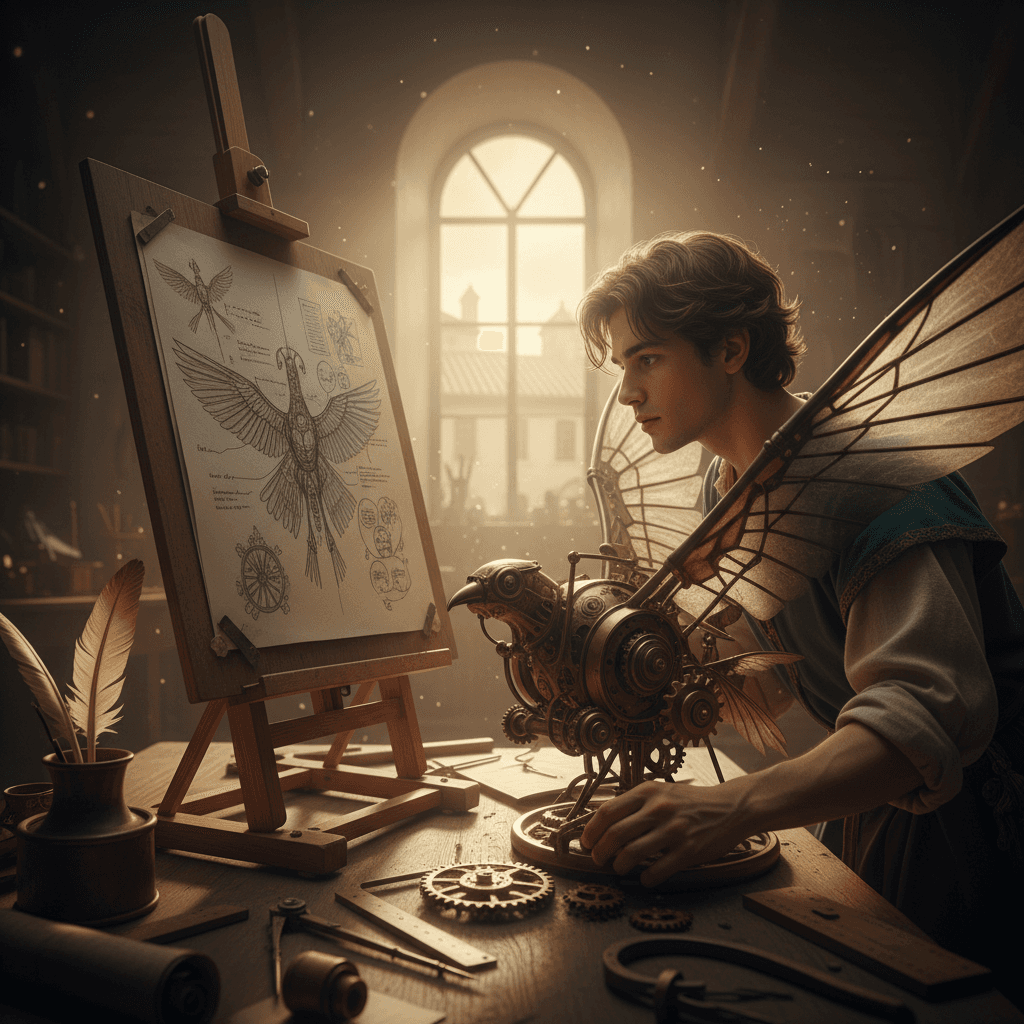
Observe, imagine, then act — invention begins when thought meets motion — Leonardo da Vinci
—What lingers after this line?
A Three-Step Blueprint for Creating
Leonardo’s sequence—observe, imagine, then act—reads like a practical recipe for invention rather than a lofty slogan. It starts with disciplined attention to the world, moves into the mind’s power to reshape what it has seen, and ends with the courage to test an idea in reality. In that sense, invention is not a single flash of genius but a staged progression. From the beginning, the quote insists that creativity is incomplete if it remains purely internal. Thought matters, but it must eventually meet motion—hands, tools, prototypes, experiments—because only action can reveal whether an idea can survive outside the mind.
Observation: Let Reality Supply the Raw Material
First, observation anchors invention in facts, patterns, and constraints. Leonardo’s own notebooks exemplify this habit: he sketched flowing water, human anatomy, and bird wings, treating the world as a living textbook. By looking closely, an inventor gathers the details that later become design ingredients. Just as importantly, observation prevents imagination from floating away into fantasy. When you notice how a hinge actually bears weight or how light actually scatters, you begin to see problems clearly—and clear problems are the ones you can realistically solve.
Imagination: Recombining What You’ve Seen
Next, imagination transforms observation into possibility. Rather than creating from nothing, it often works by recombining elements already encountered—shapes, mechanisms, and behaviors—into new arrangements. This is where analogy and “what if” questions thrive: what if a wing’s structure could inform a machine, or a seedpod’s geometry could inspire a container? Yet Leonardo’s phrasing implies that imagination is a bridge, not a destination. It takes the concrete data of observation and bends it into a hypothesis, preparing the mind for the harder phase: proving the idea through doing.
Action: Testing Ideas in the World
Then comes action, the moment when invention becomes accountable to reality. Sketching, building, measuring, and iterating turn a mental picture into something that can fail—and therefore improve. This is why Leonardo ties invention to “motion”: an idea that isn’t tried cannot be refined, and an unrefined idea rarely becomes a useful invention. Even small actions count as invention’s first steps. A rough model, a quick experiment, or a simplified prototype can reveal hidden constraints—materials that warp, forces that strain, costs that balloon—information no amount of contemplation reliably supplies.
The Feedback Loop: Motion Changes Thought
After action, a subtle reversal occurs: the results of doing reshape what you think. This creates a loop—observe outcomes, imagine improvements, act again—that steadily converts vague inspiration into functioning design. Many breakthroughs arise less from a perfect initial idea than from persistent cycles of adjustment. In this way, the quote suggests invention is a conversation with the world. You propose something through action, the world answers with evidence, and your next thought becomes sharper because it is informed by that response.
A Modern Lesson in Creative Discipline
Finally, Leonardo’s line offers a standard for anyone building anything today, from art to engineering: don’t skip steps and don’t stop early. Observation without imagination becomes mere documentation; imagination without action becomes daydreaming; action without observation becomes trial-and-error without direction. The full sequence produces purposeful experimentation. Seen as a whole, the quote is an argument for embodied creativity: the mind initiates invention, but the body and the world complete it. When thought meets motion, ideas gain friction, and friction is what turns possibility into progress.
One-minute reflection
What's one small action this suggests?
Related Quotes
6 selectedSketch ideas boldly; masterpieces begin as simple lines. — Leonardo da Vinci
Leonardo da Vinci
To begin, the saying—often attributed to Leonardo da Vinci—urges us to start with confidence rather than wait for perfection. A bold sketch transforms the blank page from a judgmental void into a collaborative surface, w...
Read full interpretation →You cannot force ideas. Successful ideas are the result of slow growth. — Alexander Graham Bell
Alexander Graham Bell
Alexander Graham Bell’s statement begins with a quiet warning against impatience: ideas cannot be commanded into maturity simply because we desire results. Like plants, they require conditions, time, and repeated attenti...
Read full interpretation →We will either find a way, or make one. — Hannibal Barca
Hannibal Barca
At its core, Hannibal Barca’s line is a declaration that obstacles do not end the story; they merely change the method. Rather than waiting for ideal conditions, he frames action itself as the answer: if a route exists,...
Read full interpretation →The painting has a life of its own. I try to let it come through. — Jackson Pollock
Jackson Pollock
At first glance, Jackson Pollock’s remark gives the painting an almost independent existence, as though the canvas carries its own pulse before the artist fully understands it. Rather than describing painting as pure con...
Read full interpretation →The creative process is not a straight line, but a labyrinth. To get lost in it is not a failure; it is the only way to find the hidden things worth saying. — M.C. Richards
M.C. Richards
At its core, M.C. Richards rejects the comforting myth that creative work unfolds through orderly steps.
Read full interpretation →To create something new, one must first learn to be comfortable with the mess of the process. — Yayoi Kusama
Yayoi Kusama
At first glance, Yayoi Kusama’s insight reframes creativity as something far less polished than people often imagine. To create something truly new, she suggests, one must stop fearing confusion, failed attempts, and unf...
Read full interpretation →More From Author
More from Leonardo da Vinci →You will never have a greater or lesser dominion than that over yourself. The height of a man's success is gauged by his self-mastery. — Leonardo da Vinci
Leonardo da Vinci’s statement begins by redefining power itself. Rather than pointing to wealth, rank, or influence over others, he insists that the greatest dominion a person can possess is mastery over the self.
Read full interpretation →When the spirit does not work with the hand, there is no art. — Leonardo da Vinci
Leonardo da Vinci’s statement begins with a simple but profound claim: art is never merely the product of manual skill. The hand may shape stone, guide a brush, or draft a line, yet without the animating force of spirit—...
Read full interpretation →You cannot expect the level of excitement of your audience to be greater than your own. If you want a life that is alive, lead it with purpose. — Leonardo da Vinci
Leonardo da Vinci’s insight begins with a simple but demanding truth: people rarely rise above the emotional energy of the person leading them. Whether in art, teaching, or daily life, enthusiasm is contagious precisely...
Read full interpretation →It is not possible to control the outside of yourself until you have mastered your breathing space. — Leonardo da Vinci
At its core, this saying argues that self-governance must begin within. Before a person can hope to influence events, relationships, or circumstances beyond themselves, they must first steady their own internal state.
Read full interpretation →