
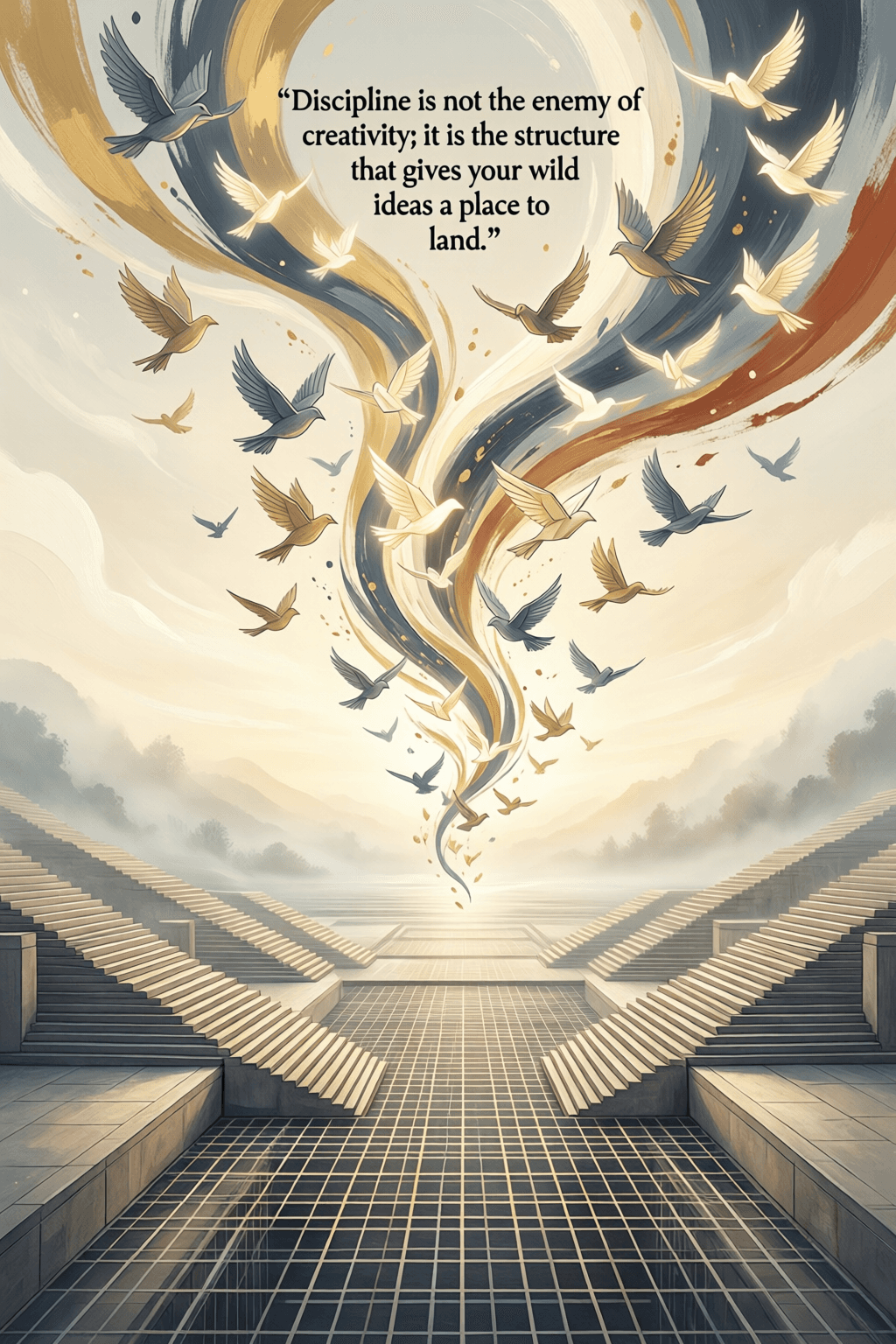
Discipline is not the enemy of creativity; it is the structure that gives your wild ideas a place to land. — Martha Graham
—What lingers after this line?
A False Divide Between Order and Imagination
At first glance, discipline and creativity seem like opposites: one suggests rules, repetition, and restraint, while the other evokes freedom, spontaneity, and risk. Yet Martha Graham’s insight dissolves that false divide by arguing that structure does not suffocate invention; rather, it makes invention usable. Wild ideas may arrive in flashes, but without some form of order, they often disappear as quickly as they came. In this sense, discipline acts less like a cage and more like a landing strip. It gives shape to instinct, timing to inspiration, and continuity to effort. Graham, whose choreography demanded rigorous technique, understood that expressive freedom in dance emerged not from chaos but from trained bodies capable of carrying emotion precisely.
Why Structure Makes Ideas Endure
From that starting point, the quote points to a practical truth: creativity becomes meaningful when it can be developed, refined, and repeated. A novelist may imagine a brilliant scene, but only the discipline of drafting and revision turns it into literature. Likewise, Leonardo da Vinci’s notebooks reveal not only imaginative brilliance but relentless observation and study, showing how disciplined practice preserves inspiration across time. Therefore, structure is what allows ideas to endure beyond the moment of excitement. It creates habits that catch fleeting thoughts before they vanish. What seems wild and original is often sustained by routines so ordinary that they disappear behind the finished work.
The Artist’s Routine as Creative Ground
Moreover, Graham’s statement reflects a pattern seen across artistic history: many celebrated creators relied on disciplined rituals. Igor Stravinsky remarked in Poetics of Music (1942) that limitation and order can actually liberate the artist, because endless freedom can become paralyzing. In other words, boundaries often provoke invention by forcing the mind to work more deeply within a form. This is why routines matter. A dancer returns to the barre, a painter to sketches, a poet to daily lines. These repeated acts may look mechanical from the outside, yet they prepare the ground from which originality grows. Discipline does not replace inspiration; it makes the artist ready when inspiration appears.
Freedom Needs a Form
As the idea develops, Graham’s metaphor of giving ideas “a place to land” becomes especially powerful. A landing requires both openness and preparation: there must be space for descent, but also enough design to prevent collapse. So too with creativity. Raw imagination needs form—whether choreography, sentence structure, musical composition, or architectural design—if it is to be shared with others. Plato’s Ion and later Aristotle’s Poetics suggest, in different ways, that artistic power is not merely ecstatic feeling but crafted expression. Emotion alone can move the creator, but form allows it to move an audience. Thus, discipline becomes the invisible architecture that lets freedom become communicable.
Applying the Insight Beyond the Arts
Finally, Graham’s observation extends well beyond dance studios and writing desks. In business, science, and education, innovation also depends on disciplined systems. Thomas Edison’s famous remark about genius being “one percent inspiration and ninety-nine percent perspiration,” recorded in 1903 interviews, echoes the same principle: ideas matter, but sustained labor makes them real. Seen this way, discipline is not a grim moral command but a creative ally. It protects ideas from remaining unfinished dreams. By building schedules, practices, and standards, people create conditions in which imagination can return again and again—not as accident, but as a durable force capable of shaping work, art, and life.
One-minute reflection
What does this quote ask you to notice today?
Related Quotes
6 selectedCreativity is a wild mind with a disciplined eye. — Jon Acuff
Jon Acuff
Jon Acuff’s remark presents creativity as a union of opposites: the mind must be free enough to wander, yet the eye must remain trained enough to judge what is worth keeping. In that sense, invention does not arise from...
Read full interpretation →Creativity takes courage. — Henri Matisse
Henri Matisse
This quote highlights that being creative often involves exposing one's inner thoughts and feelings, which requires a significant amount of courage as it makes one vulnerable to criticism and judgment.
Read full interpretation →Don't expect to be motivated every day to get out there and make things happen. You won't be. Don't count on motivation. Count on Discipline. — Jocko Willink
Jocko Willink
Jocko Willink’s quote begins with a practical warning: motivation is powerful, but unreliable. Some mornings bring energy, clarity, and ambition; others bring fatigue, distraction, or doubt.
Read full interpretation →Don't think. Thinking is the enemy of creativity. It's self-conscious, and anything self-conscious is lousy. — Ray Bradbury
Ray Bradbury
At first glance, Ray Bradbury’s line sounds almost rebellious: “Don’t think. Thinking is the enemy of creativity.” Yet his target is not intelligence itself, but the paralyzing kind of self-awareness that makes an artist...
Read full interpretation →Champions are champions not because they do anything extraordinary but because they do the ordinary things better than anyone else. — Chuck Noll
Chuck Noll
At first glance, Chuck Noll’s quote strips greatness of glamour. He argues that champions are not defined by rare, theatrical moments, but by how consistently they execute the basics.
Read full interpretation →You can be cautious or you can be creative, but there's no such thing as a cautious creative. — George Lois
George Lois
George Lois draws a sharp line between two mindsets: caution protects what already exists, while creativity risks making something new. At first glance, the statement sounds absolute, yet that severity is exactly its poi...
Read full interpretation →More From Author
More from Martha Graham →What people in the world think of you is really none of your business. — Martha Graham
Martha Graham’s remark cuts directly against a common human habit: measuring ourselves through the eyes of others. At its heart, the quote argues that public opinion is unstable, partial, and often beyond our control.
Read full interpretation →To create is to destroy the old version of yourself that no longer fits the new truth you have found. — Martha Graham
Martha Graham’s statement presents creativity not as decoration, but as a radical act of inner change. To create something genuine, she suggests, a person must let go of an earlier self—the habits, beliefs, and identitie...
Read full interpretation →No artist is ahead of his time. He is his time, it's just that others are behind the times. — Martha Graham
At first glance, Martha Graham’s remark overturns a familiar cultural myth: the artist is not some isolated prophet floating above history, but a person deeply shaped by the energies, anxieties, and possibilities of the...
Read full interpretation →Your life is your art. Create it with passion. — Martha Graham
This quote likens life to a work of art, suggesting that individuals are the artists of their own existence. Every decision, action, and experience is a stroke on the canvas of life.
Read full interpretation →