
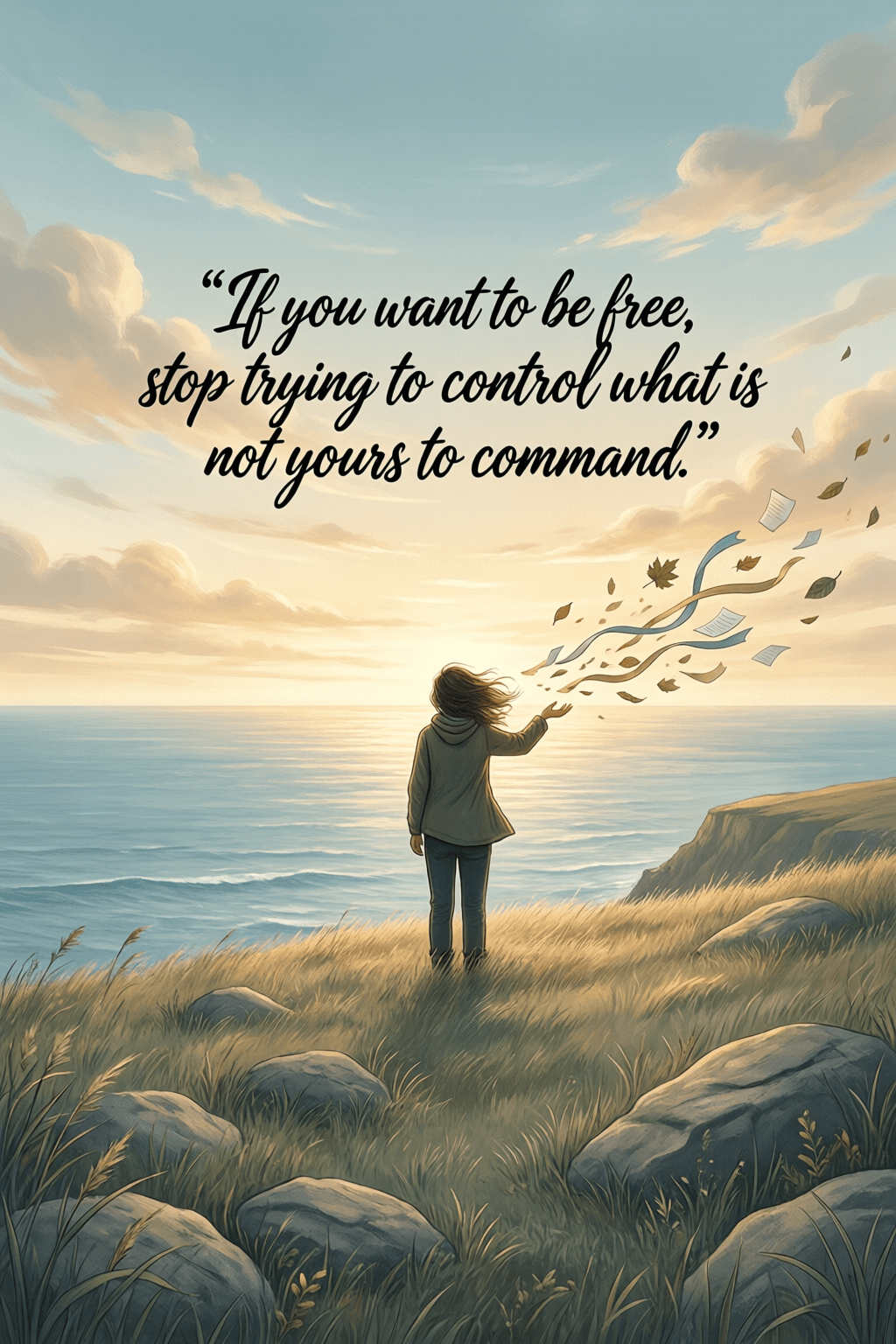
If you want to be free, stop trying to control what is not yours to command. — Seneca
—What lingers after this line?
The Stoic Core of Freedom
At its heart, Seneca’s line expresses a central Stoic principle: freedom does not come from mastering the world, but from mastering one’s response to it. In letters such as the *Epistulae Morales* (c. 65 AD), Seneca repeatedly argues that anxiety grows when we cling to outcomes, reputations, or other people’s choices. By contrast, inner liberty begins when we recognize that many events lie outside our rightful command. This distinction immediately shifts the meaning of power. Rather than viewing freedom as the ability to bend circumstances to our will, Seneca invites us to see it as independence from frustration. In that sense, the less we demand from what is uncontrollable, the less captive we become to disappointment.
What Truly Belongs to Us
From there, the quote leads naturally to the Stoic division between what is ‘ours’ and what is not. Epictetus’ *Enchiridion* (c. 125 AD) famously states that our judgments, desires, and choices are within our control, while the body, status, wealth, and others’ opinions are not fully so. Seneca’s wording echoes this moral boundary: we suffer when we treat external things as personal possessions of the will. Consequently, the quote is not a call to passivity but to accuracy. It asks us to invest effort where agency is real—our character, decisions, and perspective. Once that boundary is clear, emotional energy is no longer wasted on trying to command the weather of life.
Why Control Becomes a Prison
Yet the desire to control everything often disguises itself as responsibility. People try to manage others’ reactions, predict every setback, or force certainty out of an uncertain future. Seneca suggests that this habit, far from making us stronger, turns us into servants of constant vigilance. We become dependent on cooperation from the world, and the world rarely signs such a contract. A simple modern example makes the point: a manager may prepare thoroughly for a presentation, but cannot command the audience’s mood or the market’s response. If peace depends on total control, peace never arrives. Thus, the craving for domination quietly becomes a form of bondage.
Acceptance as Active Strength
For that reason, letting go in the Stoic sense is not surrender but disciplined acceptance. Marcus Aurelius’ *Meditations* (c. 180 AD) repeatedly urges the reader to meet events as they come, while keeping the mind upright and just. The emphasis falls not on liking everything that happens, but on refusing to be internally ruled by it. This makes acceptance an active strength rather than a passive retreat. We still plan, act, and care; however, we release the illusion that effort guarantees command. In doing so, we recover a steadier kind of freedom—one rooted in readiness rather than control.
Freedom in Daily Relationships
Moreover, Seneca’s insight becomes especially practical in relationships. Much unhappiness comes from trying to govern another person’s affection, loyalty, or understanding. We may explain ourselves honestly and act with kindness, yet we cannot force another heart to agree. The more tightly we grip, the more fragile our peace becomes. Seen this way, freedom requires emotional humility. A parent cannot script a child’s entire future; a friend cannot dictate gratitude; a partner cannot command love on demand. What remains ours is the quality of our conduct. By focusing there, relationships become less possessive and more humane.
A Timeless Discipline of Inner Liberty
Ultimately, Seneca’s sentence endures because it offers both diagnosis and cure. The diagnosis is that much human misery arises from confusing influence with ownership. The cure is to stop reaching beyond the limits of agency and to live more faithfully within them. Stoic philosophy, from Seneca to Epictetus, treats this not as resignation but as the beginning of dignity. Therefore, the quote asks for a daily discipline: examine each worry and ask whether it belongs to your will. If it does, act well; if it does not, release it. In that repeated gesture, freedom stops being an abstract ideal and becomes a practiced way of life.
One-minute reflection
What feeling does this quote bring up for you?
Related Quotes
6 selectedThe creative process is often fraught with setbacks, criticism, and rejection. Focus on what you can control and let go of what you cannot. — Seneca
Seneca
At its core, this thought reflects Seneca’s Stoic distinction between what belongs to us and what does not. In the creative process, effort, discipline, and integrity remain within an artist’s control, while public taste...
Read full interpretation →Sow discipline in small things and harvest freedom in great ones. — Seneca
Seneca
Seneca’s line frames discipline as agriculture: what looks minor and repetitive—sowing—quietly determines what becomes possible later—harvesting. The metaphor emphasizes time and accumulation, suggesting that freedom is...
Read full interpretation →Those who are brave are free. — Seneca
Seneca
This quote indicates that bravery is a key component of achieving true freedom. It suggests that those who confront their fears and challenges can liberate themselves from the constraints that hold them back.
Read full interpretation →If you want to be free, stay away from things that are not in your power. — Epictetus
Epictetus
Epictetus begins with a stark but liberating distinction: some things belong to us, and some do not. Our judgments, choices, and responses lie within our power, while reputation, outcomes, and other people’s behavior do...
Read full interpretation →If you want to be free, you must practice self-mastery. — Naval Ravikant
Naval Ravikant
At first glance, Naval Ravikant’s statement reframes freedom as something deeper than external choice or social permission. He implies that liberty is not simply the absence of restraint; rather, it is the ability to gov...
Read full interpretation →Freedom is born of self-discipline. No individual, no nation, can achieve or maintain liberty without self-control. — Alan Valentine
Alan Valentine
At first glance, Alan Valentine’s statement seems paradoxical: freedom is often imagined as the absence of restraint, yet he argues that it begins with restraint of the self. His point is that liberty cannot survive wher...
Read full interpretation →More From Author
More from Seneca →The heart is great which shows moderation in the midst of prosperity. — Seneca
Seneca’s observation begins with a quiet but demanding standard: true greatness is not proven by success itself, but by restraint when success arrives. Prosperity can enlarge appetites, inflate pride, and make excess app...
Read full interpretation →Whatever you are doing, do it with a sense of purpose, not merely to pass the time. — Seneca
Seneca’s counsel begins with a simple but demanding idea: life should not be treated as something to be spent carelessly. For the Stoics, time was not a disposable background to action but the very material of character.
Read full interpretation →The strongest person controls the self, not others. — Seneca
Seneca’s statement turns the usual idea of power inside out. Instead of praising the person who dominates rivals, commands attention, or bends others to their will, he locates real strength in self-command.
Read full interpretation →Quiet people are not empty; they are contained. Their power does not seek attention—it waits. — Seneca
At first glance, Seneca’s line overturns a common social assumption: that quietness signals absence, weakness, or lack of thought. Instead, he frames silence as containment, suggesting that some people hold their ideas,...
Read full interpretation →