
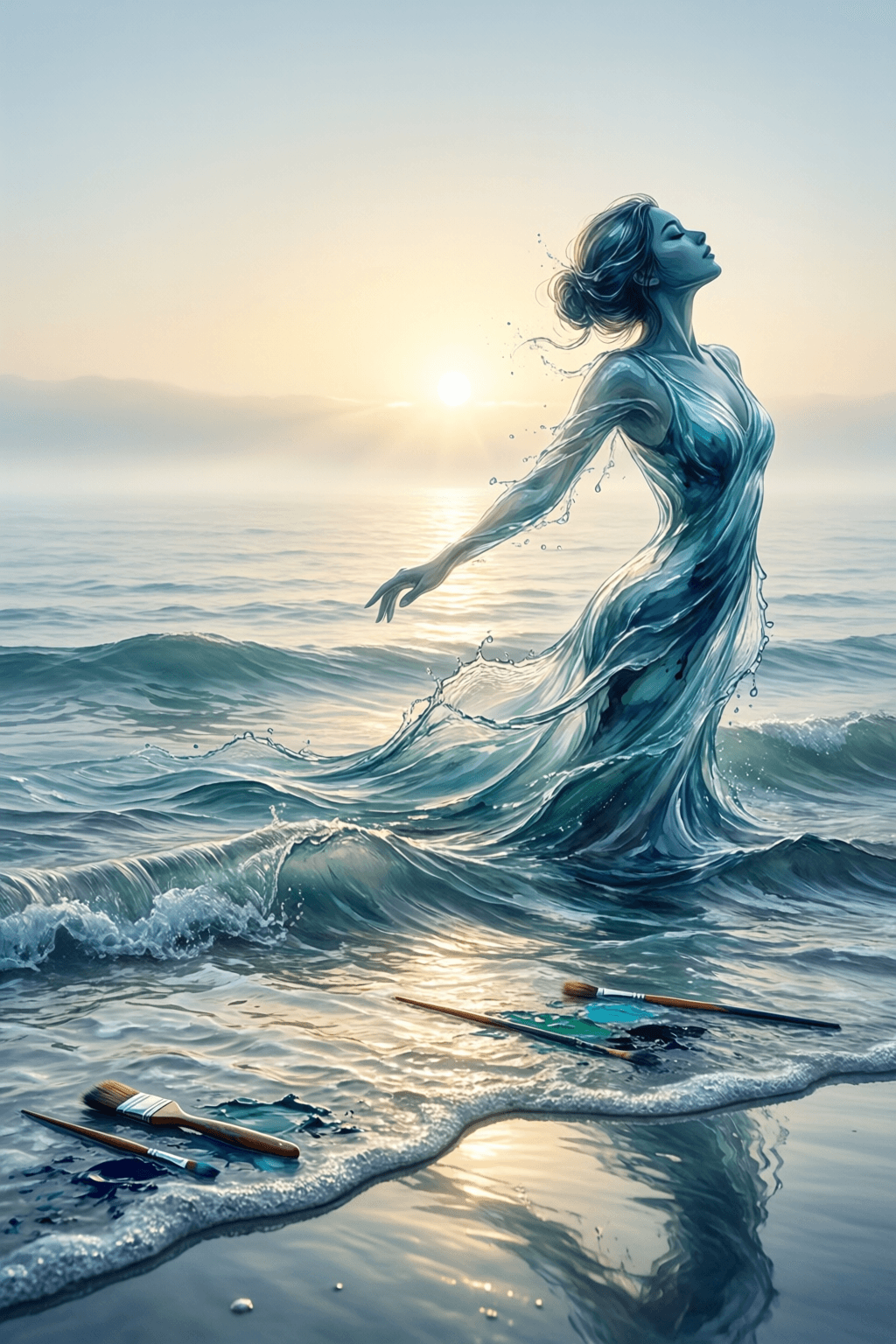
The artist is not a solid, static being. The artist is fluid, like water, moving with the tides and changing form. — James McCrae
—What lingers after this line?
Creativity Beyond Fixed Identity
James McCrae’s image of the artist as fluid immediately challenges the common idea that creative people possess a single, fixed essence. Instead, he suggests that artistry is a process of becoming, not a stable condition of being. In this view, the artist is shaped by emotion, experience, and environment, constantly adjusting rather than simply preserving a defined self. This perspective matters because it frees creativity from rigidity. Rather than demanding consistency at all costs, McCrae’s metaphor allows for contradiction, reinvention, and growth. The artist, then, is not diminished by change; on the contrary, change becomes the very medium through which artistic life unfolds.
Why Water Is the Perfect Metaphor
From there, the comparison to water deepens the meaning of the quote. Water adapts to every container, softens stone over time, and responds to gravity, weather, and terrain without losing its nature. Likewise, artists often move through different styles, mediums, and phases, yet remain recognizably creative in spirit. This metaphor has deep cultural echoes. Laozi’s Tao Te Ching (c. 4th century BC) praises water for its yielding strength, noting how what seems soft can also be powerful. In that sense, McCrae presents the artist not as weakly changeable, but as resilient precisely because of an ability to flow.
The Role of Environment and Tides
McCrae’s mention of tides adds another layer: artists do not create in isolation. Just as tides are governed by forces beyond the water itself, creative lives are influenced by culture, relationships, history, and inner seasons of confidence or doubt. An artist may surge forward in one period and recede in another, yet both movements belong to the same natural rhythm. Seen this way, fluctuation is not failure. Virginia Woolf’s A Room of One’s Own (1929) shows how artistic production depends heavily on surrounding conditions, especially freedom, space, and support. The quote therefore reminds us that artistic change often reflects responsiveness to life itself.
Reinvention as an Artistic Strength
Building on that idea, the quote also honors reinvention. Many of the most compelling artists evolved dramatically over time: Picasso’s Blue Period gave way to Cubism, while David Bowie repeatedly transformed his persona and sound across decades. These shifts were not betrayals of artistic identity but evidence of a living, exploratory practice. As a result, McCrae’s statement resists the pressure to remain legible or predictable. The artist who changes form is not lost; rather, that artist is discovering new ways to speak. Fluidity becomes a sign of courage, since it requires leaving behind what is familiar in order to follow what feels newly true.
The Emotional Reality of Flow
At the same time, fluidity is not always graceful or easy. Water can be calm, turbulent, reflective, or destructive, and the artistic life often carries the same emotional range. Periods of uncertainty, experimentation, and self-doubt may feel unstable, yet they are often inseparable from genuine creative movement. Psychologist Mihaly Csikszentmihalyi’s concept of “flow” in Flow (1990) captures one side of this experience: the artist becomes fully absorbed, moving with rather than against the current of creation. Even so, McCrae’s image leaves room for less serene moments, reminding us that changeable inner weather is part of what makes art human.
A More Generous View of the Artist
Ultimately, the quote invites a more generous understanding of what an artist is. Instead of expecting permanence, certainty, or a polished identity, it asks us to value responsiveness, transformation, and motion. The artist is not a monument to consistency but a living current, shaped by time and still shaping the world in return. In this closing sense, McCrae’s words speak not only to painters, writers, or musicians, but to anyone trying to live creatively. To be fluid is to remain open—open to revision, to influence, and to becoming someone new without losing the impulse to create.
One-minute reflection
What does this quote ask you to notice today?
Related Quotes
6 selectedThe artist is a sort of emotional athlete who is constantly stretching the limits of what is felt and what can be expressed. — Marina Abramović
Marina Abramović
Marina Abramović’s remark recasts the artist not as a passive dreamer but as a disciplined performer of feeling. Just as an athlete trains muscles through repetition, strain, and recovery, the artist repeatedly enters di...
Read full interpretation →The mind adapts and converts to its own purposes the obstacle to our acting. — Marcus Aurelius
Marcus Aurelius
At its heart, Marcus Aurelius’s line expresses a central Stoic conviction: external events do not fully determine our lives; rather, our judgments about them shape what they become. In his Meditations (c.
Read full interpretation →The artist works by locating the world in himself. — Gertrude Stein
Gertrude Stein
At first glance, Gertrude Stein’s line suggests that art does not begin with the outer world alone, but with the artist’s inner ability to absorb and reinterpret it. To ‘locate the world in himself’ means that experience...
Read full interpretation →The artist must be a master of what he rejects. — Carlos Fuentes
Carlos Fuentes
At first glance, Carlos Fuentes’s remark suggests that artistic refusal is not mere negation but an act of deep knowledge. An artist earns the right to reject a style, convention, or influence only after understanding it...
Read full interpretation →The artist's duty is to stay in the fire, to keep the question alive long after the answers have gone cold. — Adrienne Rich
Adrienne Rich
Adrienne Rich presents the artist not as a maker of neat conclusions, but as someone willing to remain inside uncertainty. The image of “staying in the fire” suggests discomfort, risk, and sustained attention; in other w...
Read full interpretation →The artist must elect to fight for the beauty of the work, stitch by patient stitch, against the rush of the world. — Ursula K. Le Guin
Ursula K. Le Guin
Ursula K. Le Guin’s line begins with a deliberate verb: the artist must “elect.” In other words, beauty is not an accident or a luxury but a conscious choice made in resistance to haste.
Read full interpretation →More From Author
More from James McCrae →