
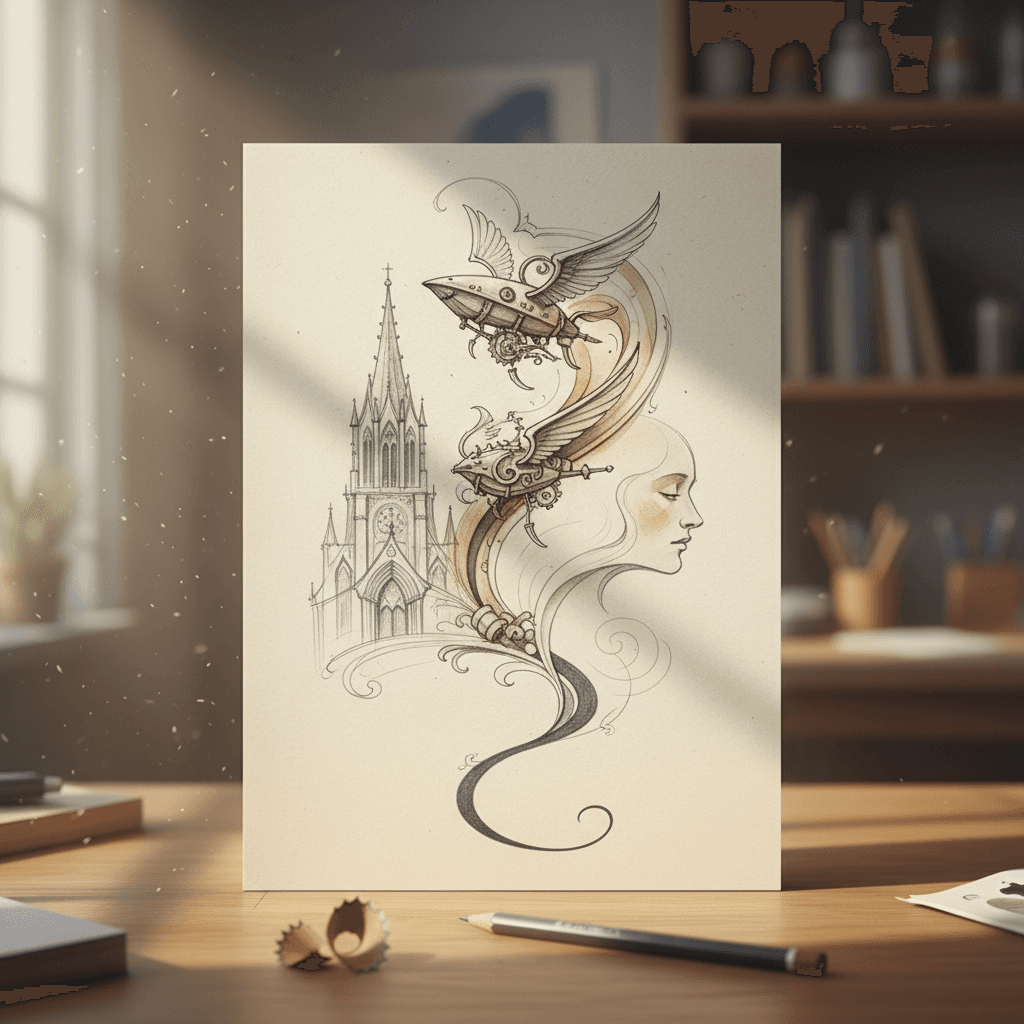
Sketch ideas boldly; masterpieces begin as simple lines. — Leonardo da Vinci
—What lingers after this line?
The Courage of the First Mark
To begin, the saying—often attributed to Leonardo da Vinci—urges us to start with confidence rather than wait for perfection. A bold sketch transforms the blank page from a judgmental void into a collaborative surface, where rough ideas can breathe. In this view, greatness is not a sudden arrival but an accumulation of decisive, imperfect strokes that make thinking visible.
Leonardo’s Pages as Proof
Looking closer at Leonardo’s practice, his notebooks reveal the method behind the mantra. The Codex Atlanticus (c. 1478–1519) shows engines, anatomy, and flying machines assembled from exploratory lines; likewise, the Royal Collection at Windsor preserves studies for figures and horses that prefigure later achievements. Each sheet layers tentative marks into structure, demonstrating that masterpieces are built from scaffolding: light, adjustable, and unapologetically provisional.
From Studio to Design Lab
Extending this principle beyond art, modern design teams begin with low‑fidelity sketches that invite critique before polishing. Bill Buxton’s Sketching User Experiences (2007) argues that early sketches widen the field of possibilities, helping teams choose the right direction before perfecting details. Similarly, IDEO and Stanford’s d.school champion rapid, messy prototypes—an approach echoed by Creativity, Inc. (Ed Catmull, 2014), which protects “ugly babies” so fragile ideas can mature rather than be prematurely judged.
Iteration Across Disciplines
Likewise, other fields echo the same rhythm: start simple, iterate boldly. Beethoven’s sketchbooks show themes rough-hewn before becoming symphonic architecture—early fragments for the Eroica (1803–04) grow through relentless revision. In engineering, the Wright brothers’ kite and glider tests (1900–1902) preceded the 1903 flight, with wing camber and control refined through successive trials. In software, “sketching in code” prototypes core flows first, then hardens them—proof that humble beginnings can carry complex systems to fruition.
Why Bold Starts Work
Psychologically, bold sketches reduce fear by externalizing thought. The “extended mind” thesis (Clark and Chalmers, 1998) explains how offloading ideas onto paper frees working memory for discovery. Moreover, a growth mindset (Carol Dweck, 2006) reframes roughness as learning in motion, while research on procrastination (Piers Steel, 2011) shows that quick, low‑stakes starts lower the barrier to engagement. In short, bold lines create momentum; momentum sustains mastery.
Habits That Turn Lines into Mastery
Finally, the practice must be routinized. Try daily thumbnail pages to generate many options fast; time‑box ten‑minute sprints to overcome inertia; and iterate versions (v0.1, v0.2) to normalize improvement. Pair each sketch with a two‑question critique: What should be amplified? What should be removed? Over time, these small, decisive acts weave a throughline from tentative marks to finished work—just as the first bold line quietly contains the masterpiece to come.
One-minute reflection
What's one small action this suggests?
Related Quotes
6 selectedObserve, imagine, then act — invention begins when thought meets motion — Leonardo da Vinci
Leonardo da Vinci
Leonardo’s sequence—observe, imagine, then act—reads like a practical recipe for invention rather than a lofty slogan. It starts with disciplined attention to the world, moves into the mind’s power to reshape what it has...
Read full interpretation →Embrace the imperfect start; masterpieces begin with a single uneven stroke. — Henri Matisse
Henri Matisse
Matisse’s invitation reframes the first mark—not as a test of genius but as a door that opens the work. By blessing the wobble at the beginning, he liberates us from the paralysis of pristine expectations.
Read full interpretation →The painting has a life of its own. I try to let it come through. — Jackson Pollock
Jackson Pollock
At first glance, Jackson Pollock’s remark gives the painting an almost independent existence, as though the canvas carries its own pulse before the artist fully understands it. Rather than describing painting as pure con...
Read full interpretation →The creative process is not a straight line, but a labyrinth. To get lost in it is not a failure; it is the only way to find the hidden things worth saying. — M.C. Richards
M.C. Richards
At its core, M.C. Richards rejects the comforting myth that creative work unfolds through orderly steps.
Read full interpretation →To create something new, one must first learn to be comfortable with the mess of the process. — Yayoi Kusama
Yayoi Kusama
At first glance, Yayoi Kusama’s insight reframes creativity as something far less polished than people often imagine. To create something truly new, she suggests, one must stop fearing confusion, failed attempts, and unf...
Read full interpretation →The creative process is a sanctuary for healing, a space where resilience is transformed into art that speaks to our shared humanity. — Ben Okri
Ben Okri
At its heart, Ben Okri’s statement imagines the creative process as more than production; it becomes a refuge. A sanctuary is a place of shelter, and by choosing that word, Okri suggests that making art offers protection...
Read full interpretation →More From Author
More from Leonardo da Vinci →You will never have a greater or lesser dominion than that over yourself. The height of a man's success is gauged by his self-mastery. — Leonardo da Vinci
Leonardo da Vinci’s statement begins by redefining power itself. Rather than pointing to wealth, rank, or influence over others, he insists that the greatest dominion a person can possess is mastery over the self.
Read full interpretation →When the spirit does not work with the hand, there is no art. — Leonardo da Vinci
Leonardo da Vinci’s statement begins with a simple but profound claim: art is never merely the product of manual skill. The hand may shape stone, guide a brush, or draft a line, yet without the animating force of spirit—...
Read full interpretation →You cannot expect the level of excitement of your audience to be greater than your own. If you want a life that is alive, lead it with purpose. — Leonardo da Vinci
Leonardo da Vinci’s insight begins with a simple but demanding truth: people rarely rise above the emotional energy of the person leading them. Whether in art, teaching, or daily life, enthusiasm is contagious precisely...
Read full interpretation →It is not possible to control the outside of yourself until you have mastered your breathing space. — Leonardo da Vinci
At its core, this saying argues that self-governance must begin within. Before a person can hope to influence events, relationships, or circumstances beyond themselves, they must first steady their own internal state.
Read full interpretation →