
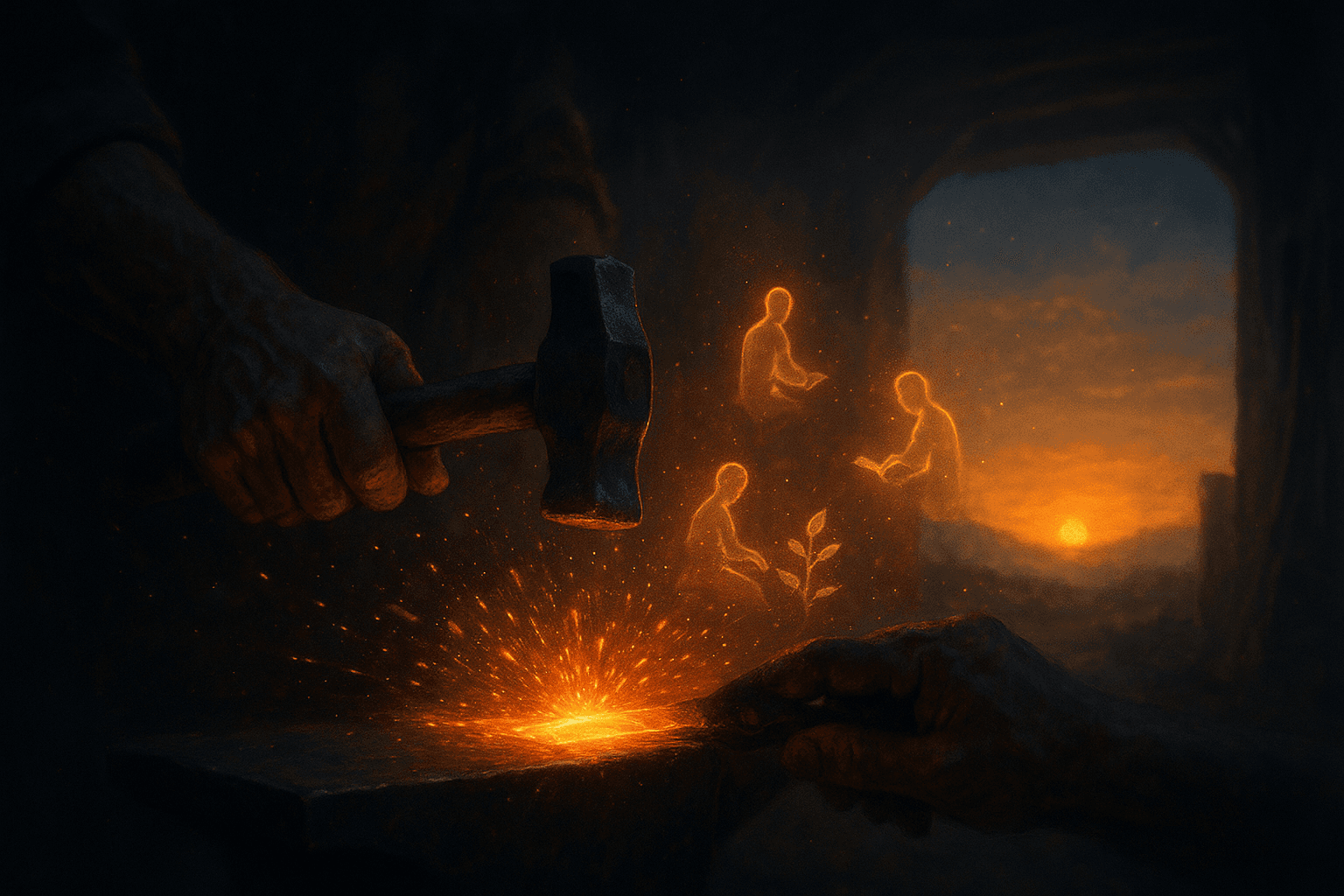
Forge meaning from the raw materials of your life; the maker's hands transform circumstance. — Chinua Achebe
—What lingers after this line?
From Circumstance to Creation
Achebe’s line suggests that life does not arrive as a finished product but as unworked material. Experiences, whether joyful or harsh, are presented as raw ore rather than polished metal. Instead of accepting circumstance as fate, he proposes that meaning must be forged—actively shaped—by human effort. This shift from passive reception to creative engagement mirrors the way blacksmiths turn rough iron into tools: nothing useful appears without the fire of intention and the blows of repeated effort.
The Maker’s Hands as Human Agency
Moving deeper, the “maker’s hands” stand in for human agency, imagination, and responsibility. Achebe, whose novels like “Things Fall Apart” (1958) portray individuals struggling within powerful cultural and historical forces, insists that people are not merely victims of context. Rather, they are artisans of significance, capable of arranging memory, suffering, and hope into coherent patterns. In this sense, every choice—what to remember, what to forgive, what to resist—becomes part of the slow, deliberate craft of self-making.
Transformation Through Story and Interpretation
Achebe’s own career illustrates how transformation happens above all through stories. By retelling colonial history from an African perspective, he reworked inherited circumstances into a new narrative frame. Likewise, when individuals interpret their hardships as lessons instead of final verdicts, they reshape circumstances without changing the facts themselves. Viktor Frankl’s “Man’s Search for Meaning” (1946) echoes this idea: even in extreme suffering, the interpretation we forge becomes the decisive act of making meaning.
Craft, Discipline, and the Slow Work of Meaning
However, to ‘forge’ meaning implies heat, pressure, and time. Achebe’s metaphor rejects quick, ornamental positivity in favor of craft-like discipline. Just as a sculptor chips away stone, we refine our responses to setbacks, gradually revealing a form that was not obvious at the beginning. This process may involve revisiting painful memories, re-evaluating inherited beliefs, or patiently developing skills. Through repetition and revision—hallmarks of any maker’s practice—life’s chaos is slowly organized into a coherent design.
Shared Workshops: Community and Collective Making
Crucially, the maker in Achebe’s vision does not work alone. His novels show villages, families, and nations collectively shaping meaning through rituals, proverbs, and public memory. In the same way, people forge their lives within communities that provide tools: language, values, and traditions. Even resistance to those traditions is a kind of making that relies on them for contrast. Thus, meaning is not merely private inspiration; it is collaborative craftsmanship performed in the shared workshop of culture.
Living as an Ongoing Workbench
Finally, Achebe’s insight invites us to see each day as a workbench rather than a verdict. New experiences keep arriving as raw materials—some unwanted, others eagerly sought. The question becomes not “What has life done to me?” but “What can I fashion from what I have received?” By adopting the stance of the maker, we accept that our lives remain works in progress, continually hammered, reshaped, and refined into forms of meaning that might one day guide others in their own acts of transformation.
One-minute reflection
Where does this idea show up in your life right now?
Related Quotes
6 selectedIf you don't like someone's story, write your own. — Chinua Achebe
Chinua Achebe
Achebe’s admonition is less a rebuke than an invitation: if the narratives around you misrepresent or diminish your experience, you can craft a counter-version that speaks in your voice. Rather than arguing endlessly wit...
Read full interpretation →Meaning is not something you find; it is something you build. Stop waiting for a sign and start laying the bricks of your own purpose. — Viktor Frankl
Viktor Frankl
Frankl’s line overturns a familiar hope—that life’s purpose is hidden somewhere, waiting to be uncovered like a buried artifact. Instead, he frames meaning as something made, assembled through choices and commitments ove...
Read full interpretation →Write the future with steady hands; imagination is the draft of change. — Margaret Atwood
Margaret Atwood
Margaret Atwood’s line splits the work of the future into two complementary tasks: envisioning and building. “Imagination is the draft of change” suggests that transformation begins as a mental sketch—an early version fu...
Read full interpretation →Create what you long to see, then live as its first citizen. — Kahlil Gibran
Kahlil Gibran
Kahlil Gibran’s line begins with a quiet challenge: longing, by itself, is not a plan. Instead of treating desire as a private ache, he reframes it as an instruction—make the thing you want to exist.
Read full interpretation →Choose to act despite uncertainty; meaning grows from the effort itself. — Albert Camus
Albert Camus
Camus’ line begins with a blunt invitation: move first, understand later. Rather than waiting for perfect clarity, he suggests we choose to act despite uncertainty, because uncertainty is not an obstacle to life—it is on...
Read full interpretation →Refuse to be reduced by doubt; write your answer with steady hands. — Toni Morrison
Toni Morrison
Toni Morrison’s line, “Refuse to be reduced by doubt; write your answer with steady hands,” begins as a quiet defiance against an invisible force. Doubt, in her framing, does not merely slow us down; it actively tries to...
Read full interpretation →More From Author
More from Chinua Achebe →It is a common mistake to think that art is a luxury. It is a necessity of the human spirit. — Chinua Achebe
At first glance, Achebe challenges a deeply rooted modern assumption: that art belongs to the realm of extras, something pleasant but dispensable. By calling this belief a “common mistake,” he suggests that reducing art...
Read full interpretation →The sun does not forget a village just because it is small. — Chinua Achebe
Achebe’s line begins with a quietly radical premise: importance is not measured by scale. By imagining the sun as impartial, he suggests that attention, care, and recognition are not rewards reserved for the powerful; th...
Read full interpretation →Rise with the sun of your intentions and work until the horizon answers — Chinua Achebe
Achebe’s line opens with a vivid image: rising “with the sun of your intentions.” Intention here isn’t a vague wish—it’s something bright, scheduled, and unavoidable, like sunrise itself. By pairing waking with purpose,...
Read full interpretation →An army of sheep led by a lion can defeat an army of lions led by a sheep. — Chinua Achebe
Achebe’s line hinges on a startling reversal: the weaker group can prevail if guided by a forceful, capable leader, while the stronger group can squander its natural advantages under timid direction. By contrasting sheep...
Read full interpretation →