
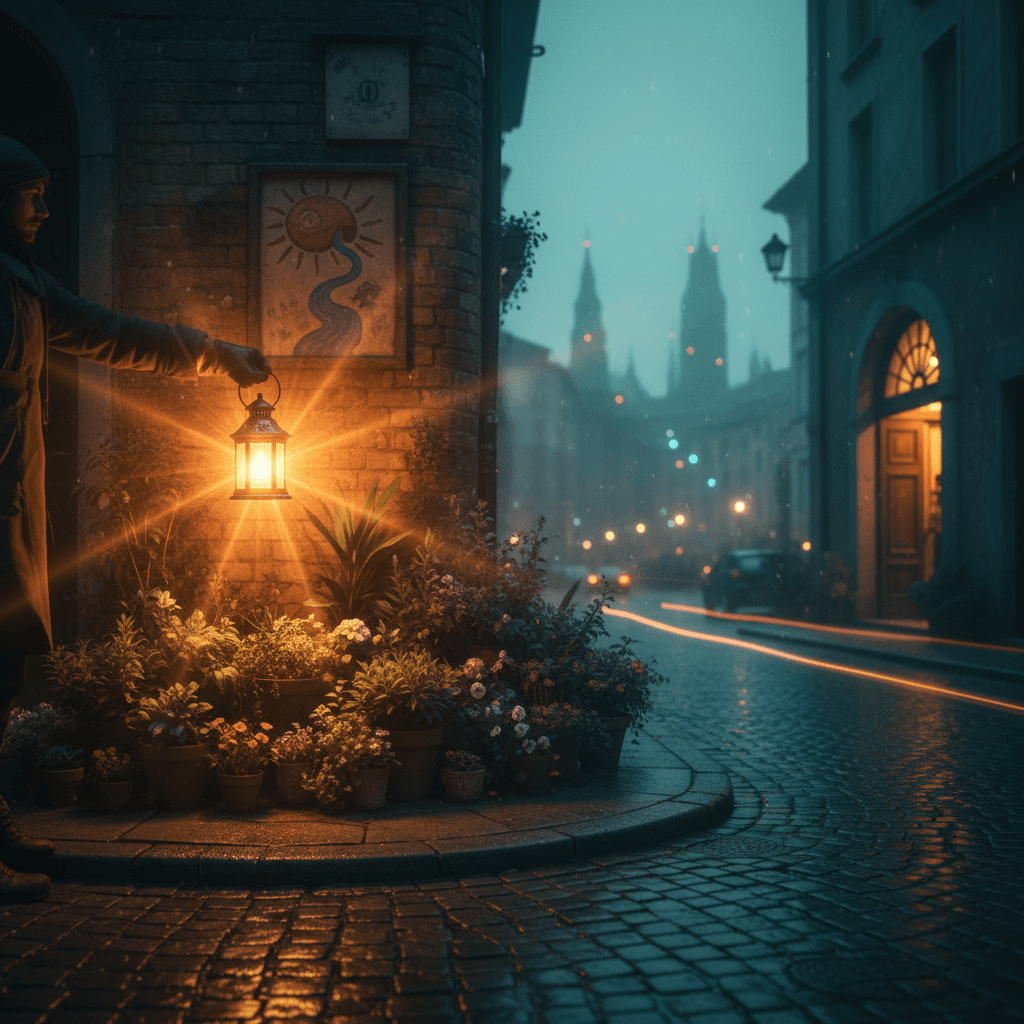
Light up a corner of the world with whatever gift you carry. — Frida Kahlo
—What lingers after this line?
The Call to Local Brilliance
Kahlo’s invitation is modest and radical at once: do not attempt to flood the earth with light—brighten a corner. By narrowing the field, the quote reframes impact as proximity, intimacy, and consistency. A lit corner is a space where someone can read, rest, or be seen; it is proof that attention, not scale, creates change. And because corners accumulate into rooms and rooms into homes, the smallness is strategic rather than timid. The statement suggests that your particular gift—no matter how ordinary it seems—is sufficient when faithfully exercised. Thus framed, the question shifts from “How big?” to “Where now?” which prepares us to consider how one artist lived this principle.
Frida Kahlo’s Luminous Particularity
Frida Kahlo did not paint to conquer continents; she rendered a universe on canvas-sized stages. After the 1925 bus accident that shattered her spine, she painted from bed, turning constraint into a studio. Works like The Broken Column (1944) transform private pain into shared recognition, lighting a corner many inhabit but few name. Moreover, her home, Casa Azul, became a salon where conversation, color, and care intertwined. At her 1953 Mexico City solo exhibition, she greeted visitors from a hospital bed, converting a medical ordeal into community. Rather than chase bigness, she made the near radiant—an approach that models how personal gifts kindle public warmth.
Why Small Lights Matter
Once a corner glows, others see by it and begin to act. Research on social networks shows that emotions and cooperative behaviors can cascade through ties, amplifying local sparks into wider patterns (see Christakis and Fowler, 2008–2010). In short, a single steady light can set off a chain of beacons. Psychology also hints at why this feels good and lasts: prosocial acts elevate well-being, creating a feedback loop that sustains effort. Dunn, Aknin, and Norton (Science, 2008) found that spending on others increases happiness, a finding echoed in studies of the “helper’s high.” Thus, tending one corner is both humane and sustainable.
Finding Your Gift, Naming Your Corner
Start where aptitude meets aliveness. Inventory moments when you lose track of time, skills friends seek you for, and experiences you’ve metabolized into empathy. This triangulation reveals a gift that is both learned and lived. Then, designate a corner: a classroom, a block, a guild, or a digital niche where your gift addresses a real need. To keep scope wise, phrase the aim with a verb and a noun—“mentor first-gen interns,” “translate clinic forms,” “host quiet writing hours.” By making the who and what explicit, you turn vague goodwill into a lantern you can actually lift.
Turning Talent into Service
Next, design the smallest viable offering. A pilot workshop for five people, a monthly call, or a two-page guide can outshine grand plans that never start. Creative constraints—time-boxed sessions, modest budgets, clear boundaries—focus energy the way a lampshade intensifies light. Treat this like craft: set a cadence, gather gentle feedback, and iterate. Borrow a “lighthouse strategy”: shine consistently from one place so those who need it can find you. Over time, document what works—templates, checklists, stories—so your light is not only bright but repeatable.
Navigating Shadows: Doubt, Pain, and Limits
Inevitably, uncertainty creeps in. The impostor phenomenon, first described by Clance and Imes (1978), whispers that your gift is insufficient. Counter it with evidence: small wins, gratitude notes, and the faces of those helped. When perfectionism stalls you, Herbert Simon’s idea of “satisficing” (1956) offers a path—choose the good enough that moves the work forward. Kahlo’s example reminds us that pain can inform rather than define. When energy dips, narrow the beam; when capacity returns, widen it. Boundaries are not dimmers but switches that keep the light from burning out.
Keeping the Flame Alive
Sustained light depends on renewal. Build rituals—prep on Sundays, debrief on Fridays—that make generosity a habit rather than a heroic surge. Invite co-lighters: collaborators diversify fuel sources and steady the glow. Measure what matters—attendance, solved problems, or even one sentence of relief—so progress is visible and motivating. Finally, tell the story of the lit corners. Not to boast, but to map pathways others can traverse. As more people recognize their gifts and claim their corners, illumination spreads—quietly, resolutely—until what began as a candle becomes a neighborhood of stars.
One-minute reflection
What does this quote ask you to notice today?
Related Quotes
6 selectedCreativity is the way I share my soul with the world. — Brené Brown
Brené Brown
The quote highlights that creativity is a unique way to express one's inner thoughts, feelings, and identity.
Read full interpretation →Carry your colors into unfamiliar streets; they might brighten someone’s day. — Isabel Allende
Isabel Allende
Isabel Allende’s invitation to “carry your colors” asks us to bring our full, vibrant selves into spaces that do not yet recognize us. Colors stand for accents, customs, quirks, and quiet kindnesses—the palette of identi...
Read full interpretation →There is no must in art because art is free. — Wassily Kandinsky
Wassily Kandinsky
At its core, Kandinsky’s statement rejects the idea that art must obey fixed obligations. By saying there is no ‘must’ in art, he frees creation from rigid formulas, academic demands, and social expectation.
Read full interpretation →Often what the artist expresses is unconscious, but we can learn to decode the story by collaboratively finding the pieces to the puzzle that create new possibilities for innovation. — Ben Okri
Ben Okri
At the heart of Ben Okri’s statement is the idea that art often says more than the artist consciously intends. A poem, painting, or song may carry hidden fears, cultural memories, or emotional truths that emerge without...
Read full interpretation →Remake the world, a little at a time, each in your own corner of the world. — Rick Riordan
Rick Riordan
At first glance, Rick Riordan’s line rejects the fantasy of instant, sweeping change. Instead, it proposes a quieter revolution: the world is remade gradually, through countless personal efforts carried out in ordinary p...
Read full interpretation →I think that when you create something, you leave a part of yourself in it. — Henri Matisse
Henri Matisse
At its core, Matisse’s reflection suggests that making anything—a painting, a poem, a song, even a room—inevitably transfers something inward into outward form. Creation is not merely the arrangement of materials; rather...
Read full interpretation →More From Author
More from Frida Kahlo →I paint flowers so they will not die. — Frida Kahlo
Frida Kahlo’s line reads like a gentle spell: by painting flowers, she resists the most ordinary tragedy—things fading despite our care. A bouquet wilts, a season ends, a beloved moment slips away; the canvas, however, o...
Read full interpretation →I tried to drown my sorrows, but the bastards learned how to swim. — Frida Kahlo
Frida Kahlo’s line opens with the familiar promise of escape—“I tried to drown my sorrows”—and then snaps into a punchline that refuses sentimentality. The sudden insult, “the bastards,” is more than comic shock; it’s a...
Read full interpretation →I used to think I was the strangest person in the world, but there must be someone just like me who feels bizarre and flawed. — Frida Kahlo
Frida Kahlo’s reflection begins in a familiar loneliness: the belief that one’s inner life is uniquely strange, even irredeemably flawed. That kind of self-story can make ordinary differences feel like permanent exile.
Read full interpretation →Embrace risk as the price of progress; comfort keeps the clock of your life frozen. — Frida Kahlo
Frida Kahlo’s line frames progress as a purchase: you pay for it with risk. In that sense, “embrace” is not a motivational flourish but an instruction to stop treating uncertainty as an error and start treating it as a t...
Read full interpretation →