
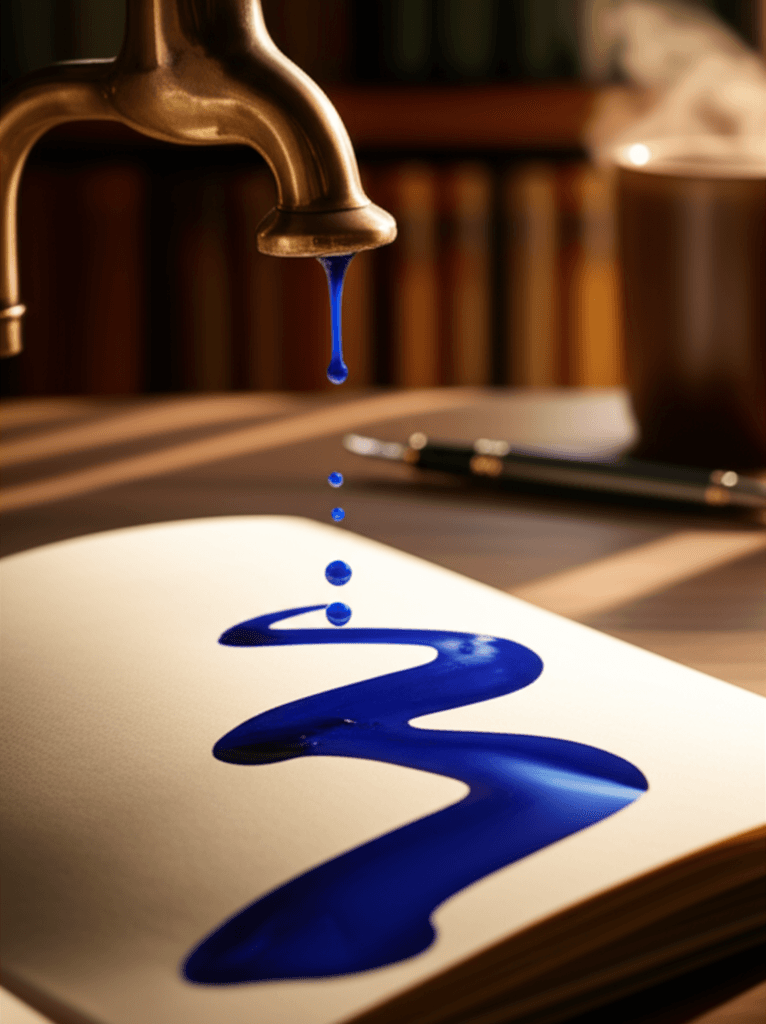
Start writing, no matter what. The water does not flow until the faucet is turned on. — Louis L'Amour
—What lingers after this line?
From Stagnation to Stream
Louis L’Amour’s image is disarmingly simple: water does not flow until the faucet is turned. Likewise, words rarely arrive before we begin to write. The act of starting—however clumsy—pressurizes the system; ideas that felt inaccessible begin to move. Waiting for inspiration, then, is like waiting for water without turning the handle: a posture of hope without the small decisive motion that makes hope useful.
Momentum Over Motivation
From this starting point, psychology suggests that action precedes enthusiasm. Behavioral activation research shows that doing a small, concrete task reduces avoidance and builds momentum. The Zeigarnik effect (Bluma Zeigarnik, 1927) adds another lever: once we open a task loop, our minds itch to complete it. Even better, if-then plans—implementation intentions (Peter Gollwitzer, 1999)—convert “someday” into triggers: if it’s 8 a.m., then I write one sentence. Momentum, not mood, carries the day.
Rituals That Open the Valve
Translating psychology into practice, creators use rituals that make starting nearly automatic. Julia Cameron’s Morning Pages (The Artist’s Way, 1992) invite three uncensored pages to warm the pipes. Peter Elbow’s freewriting (Writing Without Teachers, 1973) suspends judgment so words can arrive unblocked. Francesco Cirillo’s Pomodoro Technique (late 1980s) sets a modest timer, lowering the threshold. And Anne Lamott’s “shitty first drafts” (Bird by Bird, 1994) grant permission to write badly first so you can write well later.
Artists Who Began Before They Believed
History backs this up with workaday habits. In A Moveable Feast (1964), Ernest Hemingway describes stopping when he knew what came next, ensuring the next session began with momentum. Picasso’s oft-quoted maxim—“Inspiration exists, but it has to find you working”—echoes L’Amour’s tap. Likewise, Maya Angelou told The Paris Review (1990) she rented a bare room and reported to it daily, regardless of how she felt, trusting that the flow would follow the ritual.
Flow Emerges After the First Drip
In turn, the coveted state of immersion typically follows initiation. Mihaly Csikszentmihalyi’s Flow (1990) shows that clear goals and immediate feedback foster deep focus; both are hard to achieve before we begin. Once we put down a sentence, the next one provides feedback, and micro-goals appear. What starts as a reluctant drip becomes a steady stream, then a river, as attention narrows and challenge matches skill.
Incubation Without Avoidance
Yet action coexists with rest. Graham Wallas’s stages of creativity (The Art of Thought, 1926) include incubation, where stepping away enables insight. The key is sequencing: turn the tap first, then pause strategically. Hemingway’s practice of stopping mid-sentence is incubation with a bookmark. Breaks that follow genuine engagement refresh the current; breaks that precede it merely delay the flow.
Beyond Writing: A General Law of Doing
Finally, L’Amour’s counsel scales beyond literature. In entrepreneurship, Eric Ries’s Lean Startup (2011) emphasizes build-measure-learn: progress begins with a minimal version, not a perfect plan. Thomas Edison’s adage—“1% inspiration, 99% perspiration”—frames the same principle. Whether shipping code, drafting a policy, or composing an email, the handle is always within reach. Turn it, and let the stream teach you where the river wants to go.
One-minute reflection
What feeling does this quote bring up for you?
Related Quotes
6 selectedIf you want to be a writer, you must write every day. It is the only way to master your craft. — Stephen King
Stephen King
Stephen King’s statement strips writing down to its most practical truth: mastery begins with repetition, not occasional brilliance. In this view, the aspiring writer cannot wait for inspiration to arrive like a rare gue...
Read full interpretation →Write your courage into the ordinary hours; the page will remember and reward you. — Langston Hughes
Langston Hughes
Hughes frames courage not as a single grand gesture but as something we “write” into the most unremarkable parts of life—the ordinary hours that tend to blur together. In that phrasing, bravery becomes a habit of attenti...
Read full interpretation →Write one honest sentence today; a thousand pages will follow — Nayyirah Waheed
Nayyirah Waheed
Nayyirah Waheed’s quote centers on a deceptively simple act: writing one honest sentence. Rather than demanding brilliance, length, or perfection, it asks only for truth.
Read full interpretation →If you wish to be a writer, write. — Epictetus
Epictetus
This quote emphasizes that wanting to be a writer is not enough. To achieve the goal of becoming a writer, one must take action and actually engage in writing.
Read full interpretation →Creation begins where hesitation ends. — Haruki Murakami
Haruki Murakami
In many creative pursuits, the initial spark of inspiration is too often snuffed out by hesitation. Murakami’s insight cuts to the heart of this dilemma, reminding us that indecision and overthinking form invisible barri...
Read full interpretation →Gather your small sparks into a bonfire that can be seen from the next town. — Maya Angelou
Maya Angelou
Maya Angelou’s image invites us to treat minor efforts as kindling, not as ends in themselves. A spark is fleeting, but gathered with care it becomes a bonfire—large enough to orient others at a distance.
Read full interpretation →More From Author
More from Louis L'Amour →