
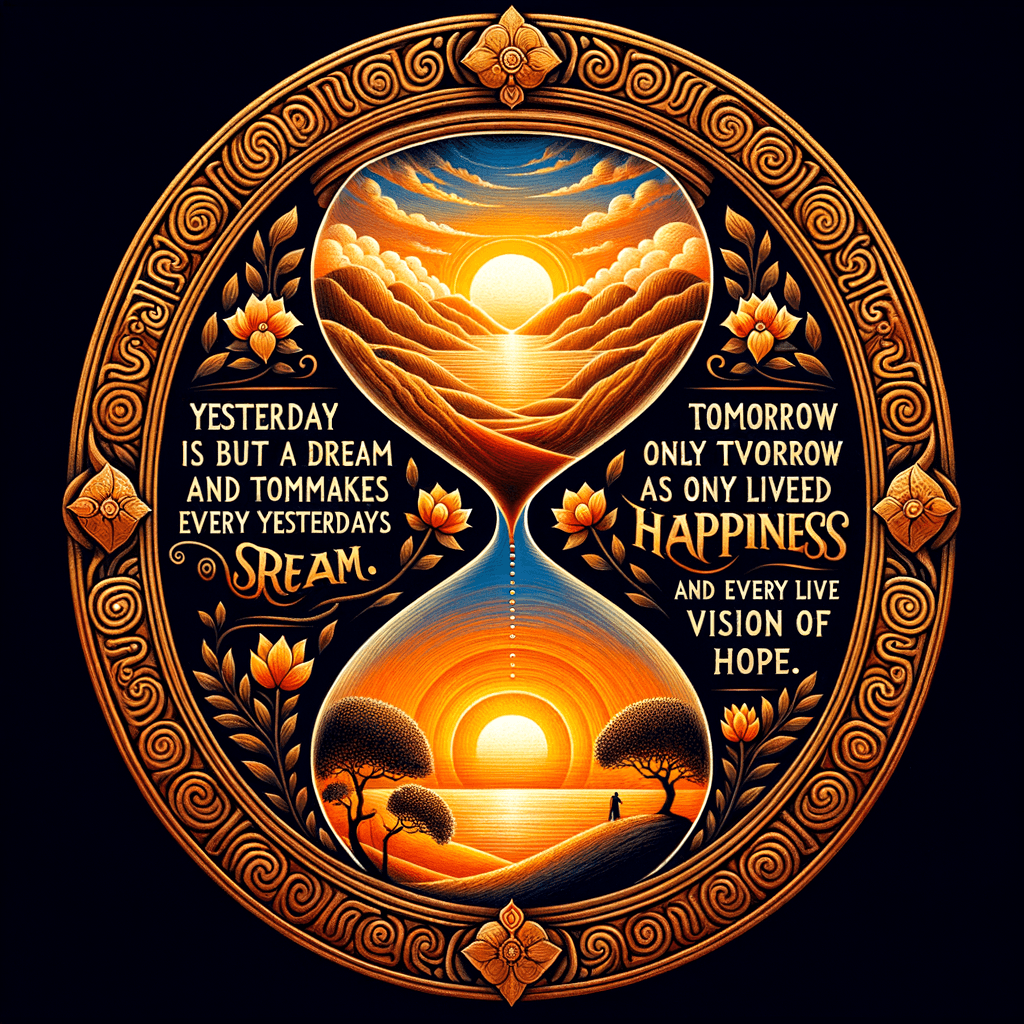
Yesterday is but a dream, and tomorrow is only a vision. But today well-lived makes every yesterday a dream of happiness and every tomorrow a vision of hope. — Kalidasa, India.
—What lingers after this line?
Value of the Present
This quote emphasizes the significance of living in the present moment. It suggests that focusing on today can transform past experiences into joyful memories and future aspirations into sources of hope.
Perspective on Time
Kalidasa contrasts the fleeting nature of yesterday and tomorrow, framing them as intangible 'dreams' and 'visions,' highlighting the ephemeral qualities of time and the importance of our current experiences.
Living Well
The quote implies that a well-lived day enriches our lives. The actions and choices we make today determine the happiness we derive from our past and the hope we hold for our future.
Hope and Happiness
By underscoring 'happiness' and 'hope,' the quote suggests that a fulfilling present life can lead to a contented past and an optimistic future, encouraging a positive outlook on life.
Kalidasa's Context
Kalidasa, a revered classical Sanskrit writer from ancient India, is known for his poetry and plays that explore themes of love, nature, and philosophy, often infusing profound insights into the human experience.
One-minute reflection
What's one small action this suggests?
Related Quotes
6 selectedEach morning we are born again. What we do today is what matters most. - Buddha
Buddha
This quote suggests that each day offers a fresh start, an opportunity to begin anew, free from the burdens of past mistakes or achievements.
Read full interpretation →Do not dwell in the past, do not dream of the future, concentrate the mind on the present moment. - Buddha
Buddha
This quote emphasizes the practice of mindfulness, which involves being fully present and engaged in the current moment, rather than getting lost in thoughts about the past or the future.
Read full interpretation →Just because your light flickers does not mean it is about to go out. — Yohancé Salimu
Yohancé Salimu
At first glance, Yohancé Salimu’s line separates appearance from reality. A flicker suggests instability, fatigue, or interruption, yet it does not automatically signal extinction.
Read full interpretation →Today's tears water tomorrow's gardens. — Matshona Dhliwayo
Matshona Dhliwayo
At first glance, Matshona Dhliwayo’s line transforms grief into something unexpectedly fertile. Tears, usually seen as signs of pain or loss, become water for a future garden, suggesting that suffering is not merely endu...
Read full interpretation →Bringing awareness to our breathing, we remind ourselves that we are here now, so we might as well be fully awake for whatever is happening. — Jon Kabat-Zinn
Zinn
Jon Kabat-Zinn’s reflection begins with something deceptively ordinary: the breath. By bringing awareness to inhaling and exhaling, we anchor ourselves in the immediate moment rather than drifting into regret about the p...
Read full interpretation →Hope is passion for the possible. — Søren Kierkegaard
Søren Kierkegaard
At first glance, Kierkegaard’s line transforms hope from a passive feeling into an active force. To call hope “passion for the possible” means that hope is not mere daydreaming; rather, it is an inward energy that leans...
Read full interpretation →More From Author
More from Kalidasa, India. →