
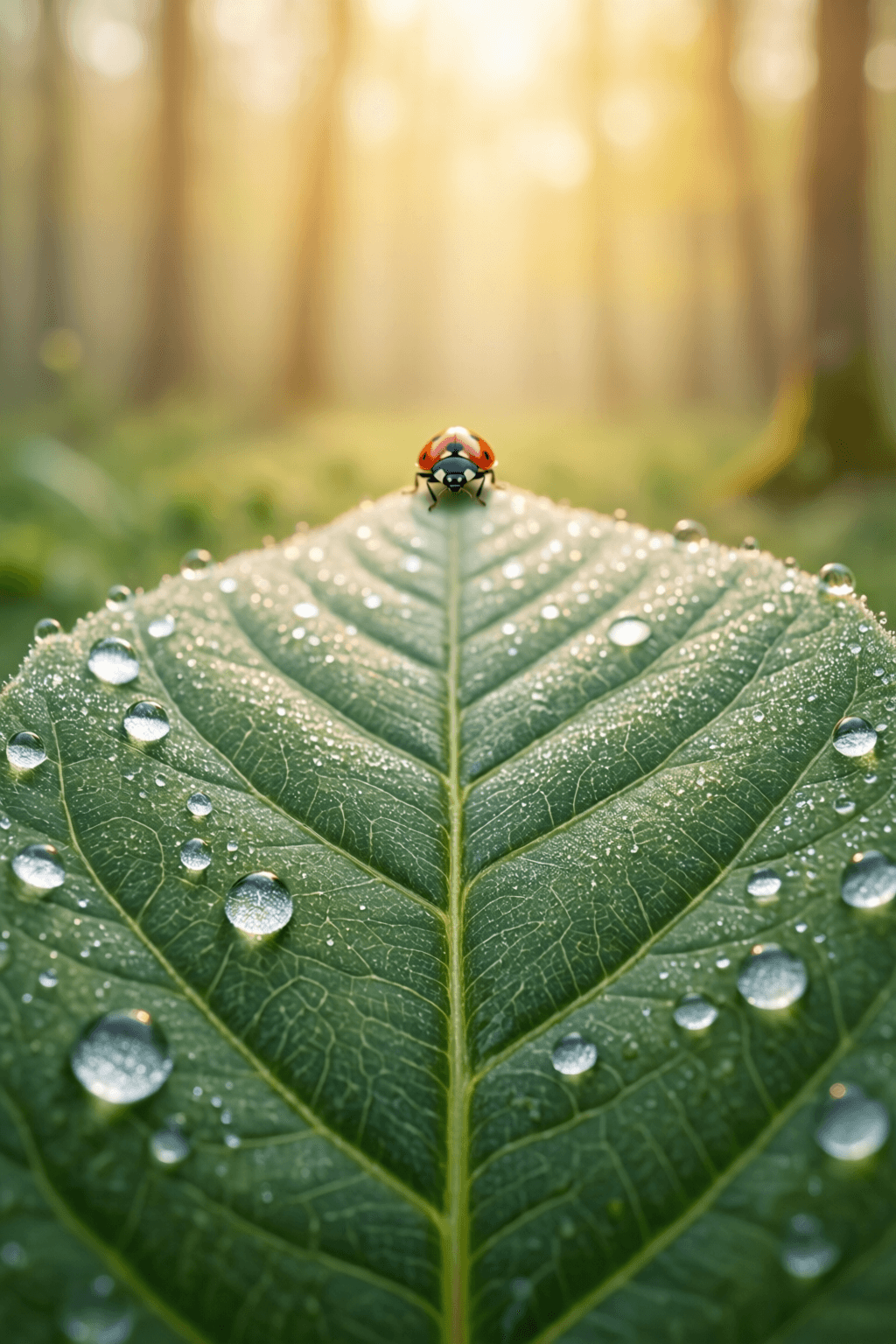
Nature will bear the closest inspection. She invites us to lay our eye level with her smallest leaf, and take an insect view of its plain. — Henry David Thoreau
—What lingers after this line?
The Discipline of Looking Near
Thoreau’s words begin with a quiet challenge: nature does not merely tolerate scrutiny; it rewards it. By saying that she “will bear the closest inspection,” he suggests that the natural world grows richer, not smaller, when examined carefully. A leaf, a vein, a wing, or a patch of moss becomes a landscape in itself.
Humility Before the Small
From there, the phrase “lay our eye level with her smallest leaf” shifts the observer’s posture. Thoreau asks us to lower ourselves, physically and imaginatively, so that we stop looking down on nature and begin meeting it on its own terms. This humility is central to his vision in *Walden* (1854), where ordinary ponds, beans, and birds become sources of philosophical insight.
The Insect’s Perspective
Next, the “insect view” transforms a simple leaf into a vast plain. What appears minor from a human height becomes expansive from another scale of life. In this reversal, Thoreau reminds us that perception is not fixed; the world changes according to the patience, angle, and sympathy we bring to it.
Science and Wonder Together
Moreover, the quote joins observation with reverence rather than opposing them. Like early naturalists who studied plants and insects with both precision and awe, Thoreau implies that close inspection need not drain nature of mystery. Instead, attention deepens wonder, because details reveal forms of order and beauty that casual seeing misses.
A Lesson Against Hurry
This invitation also resists the haste of ordinary life. To inspect a leaf closely requires stillness, time, and a willingness to be absorbed by what seems insignificant. In that sense, Thoreau’s sentence becomes a practical ethic: slow down enough for the small world to become visible.
Seeing the Whole Through the Part
Finally, Thoreau’s image suggests that the smallest fragment of nature can disclose the character of the whole. A single leaf contains patterns of growth, adaptation, fragility, and resilience. By learning to see one small thing completely, we become better prepared to recognize the depth and dignity of the living world around us.
One-minute reflection
Why might this line matter today, not tomorrow?
Related Quotes
6 selectedThere is nothing pleasanter than spading when the ground is soft and damp. — John Steinbeck
John Steinbeck
At first glance, Steinbeck’s line seems almost modest, yet its pleasure is precise and deeply felt. Spading soft, damp ground turns labor into something nearly sensual: the tool enters easily, the earth yields without re...
Read full interpretation →Nature is not only all that is visible to the eye, it also includes the inner pictures of the soul. — Edvard Munch
Edvard Munch
At first glance, Munch’s statement expands the ordinary idea of nature beyond forests, skies, and seas. He argues that nature is not limited to what the eye can measure; it also includes the emotional and imaginative ima...
Read full interpretation →The glory of gardening: hands in the dirt, head in the sun, heart with nature. — Alfred Austin
Alfred Austin
Alfred Austin’s line condenses the appeal of gardening into one vivid scene: the body grounded in soil, the mind lifted by sunlight, and the emotions attuned to the natural world. At once physical and poetic, the quote s...
Read full interpretation →It is not the language of painters but the language of nature which one should listen to. — Pablo Picasso
Pablo Picasso
At first glance, Picasso’s remark challenges the authority of artistic convention. By contrasting ‘the language of painters’ with ‘the language of nature,’ he suggests that art should not merely imitate established techn...
Read full interpretation →Great art picks up where nature ends. — Marc Chagall
Marc Chagall
At its core, Marc Chagall’s remark suggests that art does not compete with nature but continues its unfinished conversation. Nature gives us raw forms—color, light, movement, emotion—while art reshapes them into meaning.
Read full interpretation →Your home is your larger body. It grows in the sun and sleeps in the stillness of the night. — Kahlil Gibran
Kahlil Gibran
At first glance, Gibran transforms the idea of home from a mere structure into something intimate and organic: “your larger body.” In this image, a dwelling is not separate from the person who inhabits it, but an outward...
Read full interpretation →More From Author
More from Henry David Thoreau →In the long run, men hit only what they aim at. Therefore, they had better aim at something high. — Henry David Thoreau
Thoreau’s statement begins with a simple but demanding truth: over time, people tend to arrive where their intentions point them. In other words, even imperfect effort has a direction, and that direction matters.
Read full interpretation →Me thinks that the minute my legs begin to move my thoughts begin to flow. — Henry David Thoreau
At first glance, Thoreau’s remark seems simple: as soon as his body starts moving, his mind comes alive. Yet the line captures a deeper truth about the intimate bond between physical motion and mental clarity.
Read full interpretation →It is not enough to be industrious; so are the ants. What are you being industrious about? — Henry David Thoreau
Thoreau’s remark begins by puncturing a common illusion: activity is not the same as purpose. Ants are famously industrious, yet their labor is automatic, instinctive, and unquestioned.
Read full interpretation →A man is rich in proportion to the number of things which he can afford to let alone. — Henry David Thoreau
Thoreau’s line turns the usual definition of wealth inside out. Instead of measuring richness by what someone owns, he measures it by what someone can ignore without feeling deprived.
Read full interpretation →