
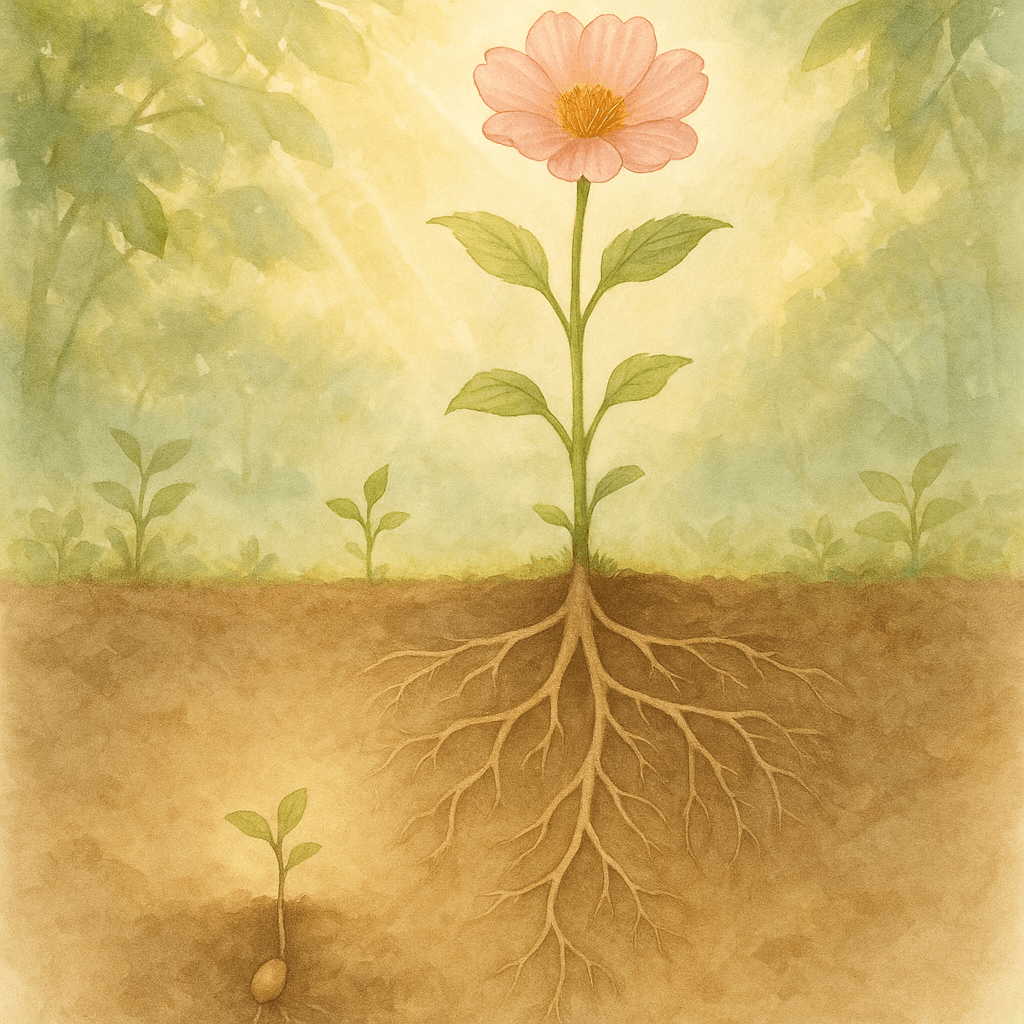
True strength blooms quietly from the seeds of patience. — Thich Nhat Hanh
—What lingers after this line?
The Subtle Emergence of Strength
Thich Nhat Hanh’s words invite us to reconsider the nature of strength—not as a loud or forceful display, but as something that develops quietly over time. Like seeds planted deep within the soil, real resilience and fortitude often unfold out of sight, born out of waiting and gentle persistence rather than momentary bursts of power.
Patience as the Gardener’s Virtue
Building on this organic metaphor, consider how gardeners know that rushing growth can harm rather than help a plant. In *Peace Is Every Step* (1991), Thich Nhat Hanh describes peace and strength as qualities that must be nurtured with mindfulness and time. In this sense, patience is not passive—it is an active tending, a deliberate choice to allow roots to deepen before blossoms appear.
Lessons from Nature’s Cycles
Transitioning to nature, the slow unfolding of a tree’s growth embodies this wisdom. Rings accumulate year by year, invisible until revealed but crucial to the tree’s endurance. Similarly, in *Walden* (1854), Henry David Thoreau wrote that ‘nature does not hurry, yet everything is accomplished.’ True strength, like the oaks in Thoreau’s woods, is a gradual accumulation.
Patience and Inner Transformation
Moreover, on the path to personal growth, patience acts as a stabilizing force. Thich Nhat Hanh’s mindfulness teachings show that facing difficulties calmly allows resilience to mature beneath the surface. Each challenge met with patience becomes a seedling of inner strength, ready to support us through greater storms.
Cultivating Calm in a Hasty World
Finally, in a culture often obsessed with immediate results, Thich Nhat Hanh reminds us of the quiet power in waiting. By sowing patience in our interactions and aspirations, we allow true strength to blossom organically, crafting lives rooted in steadiness and quiet confidence—much like a tree that endures generations because its growth was never rushed.
One-minute reflection
What feeling does this quote bring up for you?
Related Quotes
6 selectedPatience is not passive waiting; it is the courage to stand in the middle of a process and trust that the bloom is coming. — Mary Oliver
Mary Oliver
At first glance, patience is often mistaken for mere delay or resignation, yet Mary Oliver overturns that assumption immediately. In her view, patience is not passive waiting but an active inner stance: a decision to rem...
Read full interpretation →But patience can't be acquired overnight. It's just like building up a muscle. Every day you need to work on it, to push its limits. — Eknath Easwaran
Eknath Easwaran
Eknath Easwaran frames patience not as a fixed personality trait but as a capacity that develops over time. From the outset, his comparison to building muscle changes the way we think about self-control: instead of waiti...
Read full interpretation →Slow progress today is often stable progress tomorrow. Fast growth collapses easily. Slow growth holds. — Timeless Type
Timeless Type
At first glance, slow progress can feel discouraging, especially in a culture that praises speed, sudden breakthroughs, and visible success. Yet the quote reminds us that what seems unimpressive today may become the foun...
Read full interpretation →Sometimes you have to slow down to go fast. — Jeff Olson
Jeff Olson
Jeff Olson’s line begins with a practical paradox: speed is not always created by rushing. Sometimes the quickest path forward requires pausing long enough to see the road clearly, correct mistakes early, and choose acti...
Read full interpretation →Instead of trying to build the perfect life in which to dwell, we can fortify and master the vehicle through which we traverse it. — Designing the Mind
Designing the Mind
The quote from Designing the Mind begins by challenging a common assumption: that peace depends on arranging life into ideal conditions. Rather than waiting for the perfect home, career, relationship, or routine, it redi...
Read full interpretation →Everything that is great in life is the product of slow growth; the newer, and greater, and higher, and nobler the work, the slower is its growth. — William George Jordan
William George Jordan
William George Jordan’s reflection begins with a quiet but demanding truth: the most meaningful achievements rarely arrive quickly. He suggests that greatness is not manufactured in sudden bursts but cultivated through t...
Read full interpretation →More From Author
More from Thich Nhat Hanh →If we are facing in the right direction, all we have to do is keep walking. — Thích Nhất Hạnh
Thích Nhất Hạnh’s words begin with a simple but profound premise: progress depends first on direction, not speed. If a person is turned toward compassion, clarity, healing, or truth, then each modest step becomes meaning...
Read full interpretation →You must love in such a way that the person you love feels free. — Thich Nhat Hanh
At its core, Thich Nhat Hanh’s statement redefines love as an act of care that does not confine. To love someone so that they feel free means offering affection without turning it into control, guilt, or dependence.
Read full interpretation →We are not islands; we are threads in a tapestry. To pull away from the weave is to lose the very texture that makes life hold together. — Thich Nhat Hanh
At its core, Thich Nhat Hanh’s image of threads in a tapestry rejects the fantasy of total self-sufficiency. A single thread may exist on its own, yet it gains meaning, strength, and beauty only through its relation to o...
Read full interpretation →When you learn how to suffer, you suffer far less. Resilience is not about avoiding the fire; it is about becoming fireproof. — Thich Nhat Hanh
At first glance, Thich Nhat Hanh’s quote appears paradoxical: how could learning to suffer make suffering lighter? Yet his point is that pain intensifies when we resist it, fear it, or treat it as a personal failure.
Read full interpretation →