
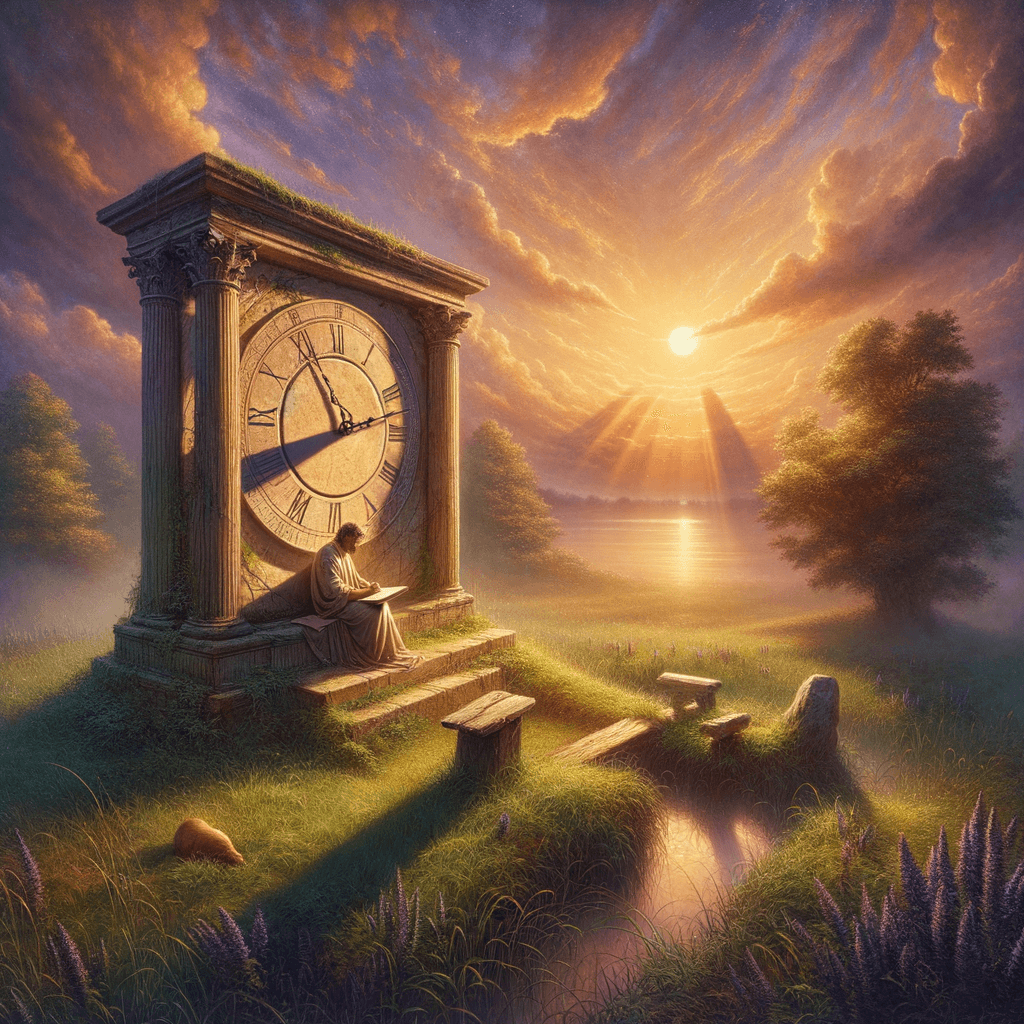
Time stays long enough for anyone who will use it. — Leonardo da Vinci
—What lingers after this line?
Effective Use of Time
Leonardo da Vinci suggests that time itself is not the problem; rather, it's how we use our time that determines its sufficiency. If we make effective use of our time, we will find it is enough.
Time Management
This quote emphasizes the value of time management. It encourages people to prioritize tasks, make conscious decisions, and utilize every moment in a meaningful way.
Sense of Abundance
Rather than feeling that time is fleeting or scarce, the quote implies that there is always 'enough' time for meaningful pursuits if we approach it with intention and purpose.
Personal Responsibility
Da Vinci's message implies personal responsibility. It encourages individuals to take control of their time and make sure they are actively using it to achieve their goals rather than passively letting time slip away.
Philosophical View of Time
The quote hints at a philosophical perspective: time, in essence, is neutral. It is neither long nor short on its own; it is our interaction with it that gives it meaning and shape.
Historical Context
As one of the greatest polymaths in history, Leonardo da Vinci deeply understood the necessity of time management in mastering multiple fields such as art, science, anatomy, and engineering. This quote reflects his discipline and holistic approach to achievement.
One-minute reflection
What does this quote ask you to notice today?
Related Quotes
6 selectedThe most productive thing you can do is learn to manage your energy, not just your time. — Arianna Huffington
Arianna Huffington
Arianna Huffington’s quote reframes productivity at its foundation. Instead of treating time as the only scarce resource, she points to energy as the real force that determines whether hours become meaningful work or mer...
Read full interpretation →Instead of saying 'I don't have time,' try saying 'it's not a priority,' and see how that feels. — Laura Vanderkam
Laura Vanderkam
Laura Vanderkam’s quote works by replacing a familiar excuse with a more revealing truth. “I don’t have time” sounds objective, as if the day itself has failed us; however, “it’s not a priority” returns the matter to cho...
Read full interpretation →Don't count the years. Make every year count. — Medium Collective
Medium Collective
At its core, “Don’t count the years. Make every year count” challenges the habit of measuring life by duration alone.
Read full interpretation →Self-discipline is the ability to do what you should do, when you should do it. — Brian Tracy
Brian Tracy
Brian Tracy’s definition strips self-discipline down to its practical essence: not merely knowing the right thing, but doing it at the right moment. In other words, discipline is less about inspiration than about obedien...
Read full interpretation →The moment you begin apologizing for how you manage your time, you are essentially apologizing for your priorities. — Cal Newport
Cal Newport
Cal Newport’s line reframes a common social reflex: saying “sorry I’m so busy” or “sorry I didn’t reply sooner” often isn’t about time at all—it’s about what we chose to do with it. Because time is the medium through whi...
Read full interpretation →Lack of direction, not lack of time, is the problem. — Zig Ziglar
Zig Ziglar
Zig Ziglar’s line flips a common complaint on its head: most people don’t actually lack time; they lack a clear aim for the time they already have. When direction is missing, hours get spent reacting—scrolling, answering...
Read full interpretation →More From Author
More from Leonardo da Vinci →You will never have a greater or lesser dominion than that over yourself. The height of a man's success is gauged by his self-mastery. — Leonardo da Vinci
Leonardo da Vinci’s statement begins by redefining power itself. Rather than pointing to wealth, rank, or influence over others, he insists that the greatest dominion a person can possess is mastery over the self.
Read full interpretation →When the spirit does not work with the hand, there is no art. — Leonardo da Vinci
Leonardo da Vinci’s statement begins with a simple but profound claim: art is never merely the product of manual skill. The hand may shape stone, guide a brush, or draft a line, yet without the animating force of spirit—...
Read full interpretation →You cannot expect the level of excitement of your audience to be greater than your own. If you want a life that is alive, lead it with purpose. — Leonardo da Vinci
Leonardo da Vinci’s insight begins with a simple but demanding truth: people rarely rise above the emotional energy of the person leading them. Whether in art, teaching, or daily life, enthusiasm is contagious precisely...
Read full interpretation →It is not possible to control the outside of yourself until you have mastered your breathing space. — Leonardo da Vinci
At its core, this saying argues that self-governance must begin within. Before a person can hope to influence events, relationships, or circumstances beyond themselves, they must first steady their own internal state.
Read full interpretation →