
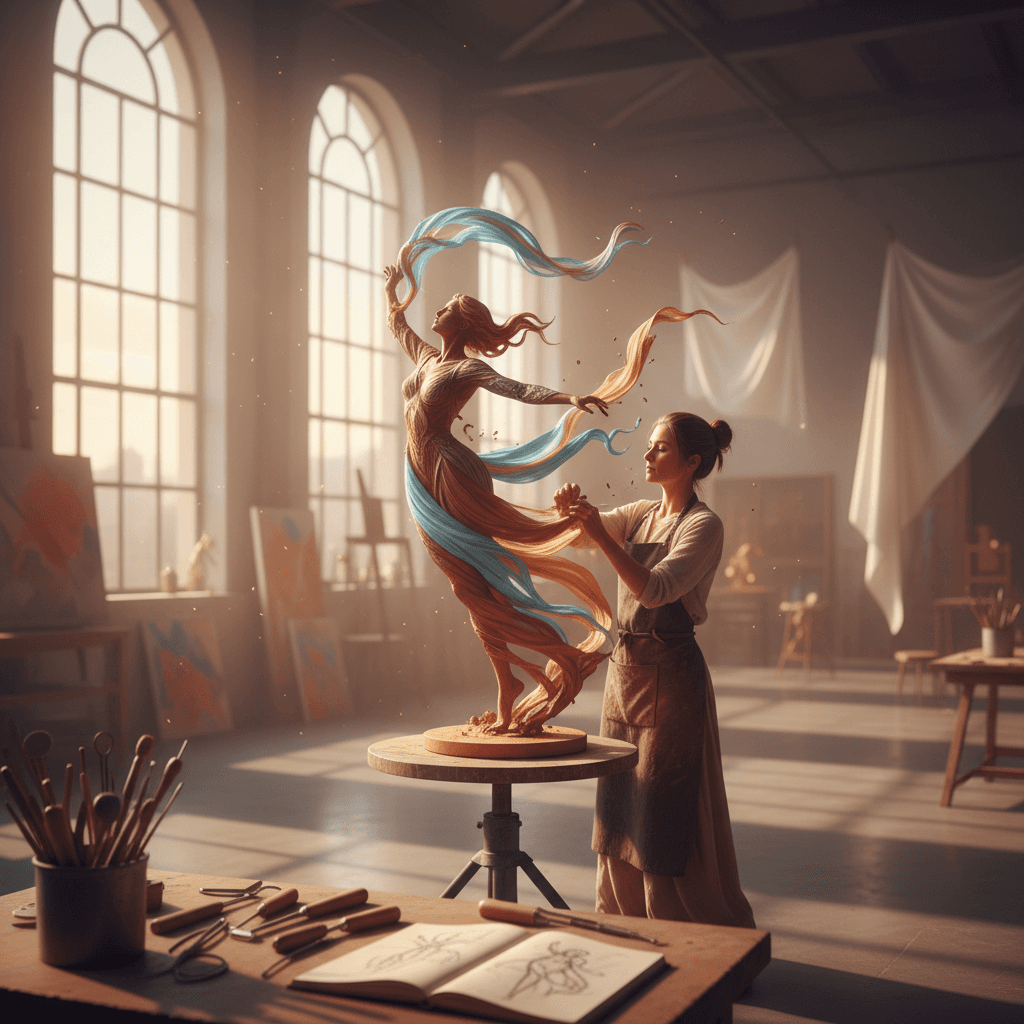
Step into the studio of life and sculpt meaning from motion — Pablo Picasso
—What lingers after this line?
Life as a Working Studio
Picasso’s line begins by relocating creativity from the gallery into daily experience: life itself becomes the studio. In that space, nothing is fully finished or perfectly arranged; instead, each moment arrives like raw material—messy, textured, and full of possibility. By framing existence this way, the quote suggests we don’t wait for inspiration or ideal conditions, because the ordinary day already provides the tools and the scene. From there, the metaphor quietly shifts responsibility onto the individual. A studio implies work: showing up, experimenting, and returning again when the first attempt fails. Meaning, then, is not a discovery tucked away somewhere else, but something made through ongoing practice.
Meaning Is Crafted, Not Found
Building on the studio image, “sculpt meaning” emphasizes intentional shaping rather than passive interpretation. Sculpture is subtractive and additive: you carve away what doesn’t belong and reinforce what does. Likewise, personal meaning often emerges when we choose what to prioritize, what to abandon, and what to refine—habits, relationships, aims, and values. This aligns with a long philosophical current: Viktor Frankl’s *Man’s Search for Meaning* (1946) argues that humans can create meaning even amid suffering by choosing their stance and purpose. Picasso’s phrasing echoes that idea, but with an artist’s practicality—meaning is something your hands make, not something your eyes merely spot.
Motion as the Medium of Growth
The quote’s second half—“from motion”—adds a crucial twist: the material we sculpt is not stone but change. Motion includes routines, disruptions, travel, aging, conflict, learning, and the small momentum of decisions. Instead of treating movement as a distraction from clarity, Picasso implies motion is precisely where meaning can be formed. In that sense, the advice is anti-static. If you wait for life to hold still so you can understand it, you may wait forever. Yet if you work with what’s moving—adapting your craft as circumstances shift—you can shape coherence from flux, much as an artist responds to accidents and revisions mid-process.
Practice, Iteration, and Creative Courage
Once meaning is tied to motion, iteration becomes essential. A sculptor rarely arrives at the final form in one pass; the work evolves through trial, correction, and renewed vision. Picasso’s own career illustrates this: the continual reinvention across Blue Period works (1901–1904), Cubism with Georges Braque (c. 1907–1914), and later experiments suggests an identity built through repeated making rather than fixed certainty. Consequently, the quote encourages creative courage—treating mistakes as material. If motion includes missteps, then errors are not proof of failure but part of the medium. The task is to keep shaping, letting the process educate the maker.
Turning Daily Choices into Art
Following that logic, the quote can be read as a call to aesthetic living: not in the sense of being decorative, but in bringing attention, composition, and intention to everyday choices. The “studio of life” includes conversations, work, rest, and how one responds under pressure. Each becomes a gesture that either clarifies or blurs the emerging form. A simple anecdote captures this: someone who starts walking each morning to manage grief may initially feel they’re merely passing time. Months later, the motion has carved out a new identity—steadier, more connected to the world, capable of hope. Meaning didn’t arrive as a revelation; it was sculpted by repeated movement.
From Self-Expression to Responsibility
Finally, sculpting meaning from motion implies responsibility to both self and others. Art is not only expression; it is also discipline and ethics—what you choose to make visible, what you refuse to normalize, and what you build in community. As motion carries you through changing roles and relationships, your “sculpture” inevitably affects others who share the space of your life. In that closing sense, Picasso’s line is less a romantic slogan than a practical orientation: keep moving, keep working, and keep shaping. The goal is not a perfectly still masterpiece, but a life whose evolving form reflects deliberate attention and lived intention.
One-minute reflection
What feeling does this quote bring up for you?
Related Quotes
6 selectedTo know what you are going to draw, you have to begin drawing. — Pablo Picasso
Pablo Picasso
This quote highlights the organic and exploratory nature of creativity. It suggests that clarity and direction often emerge through the act of doing rather than planning everything in advance.
Read full interpretation →Without great solitude, no serious work is possible. — Pablo Picasso
Pablo Picasso
This quote emphasizes that being alone is essential for deep creative work and innovation.
Read full interpretation →The painting has a life of its own. I try to let it come through. — Jackson Pollock
Jackson Pollock
At first glance, Jackson Pollock’s remark gives the painting an almost independent existence, as though the canvas carries its own pulse before the artist fully understands it. Rather than describing painting as pure con...
Read full interpretation →The creative process is not a straight line, but a labyrinth. To get lost in it is not a failure; it is the only way to find the hidden things worth saying. — M.C. Richards
M.C. Richards
At its core, M.C. Richards rejects the comforting myth that creative work unfolds through orderly steps.
Read full interpretation →To create something new, one must first learn to be comfortable with the mess of the process. — Yayoi Kusama
Yayoi Kusama
At first glance, Yayoi Kusama’s insight reframes creativity as something far less polished than people often imagine. To create something truly new, she suggests, one must stop fearing confusion, failed attempts, and unf...
Read full interpretation →The creative process is a sanctuary for healing, a space where resilience is transformed into art that speaks to our shared humanity. — Ben Okri
Ben Okri
At its heart, Ben Okri’s statement imagines the creative process as more than production; it becomes a refuge. A sanctuary is a place of shelter, and by choosing that word, Okri suggests that making art offers protection...
Read full interpretation →More From Author
More from Pablo Picasso →It is not the language of painters but the language of nature which one should listen to. — Pablo Picasso
At first glance, Picasso’s remark challenges the authority of artistic convention. By contrasting ‘the language of painters’ with ‘the language of nature,’ he suggests that art should not merely imitate established techn...
Read full interpretation →The chief enemy of creativity is good sense. — Pablo Picasso
At first glance, Picasso’s claim sounds like a provocation against reason itself. Yet his point is subtler: ‘good sense’ often means the habits, rules, and social expectations that keep people from taking imaginative ris...
Read full interpretation →The artist is a receptacle for emotions that come from all over the place: from the sky, from the earth, from a scrap of paper, from a passing shape, from a spider's web. — Pablo Picasso
At the heart of Picasso’s remark is a striking redefinition of creativity: the artist is not merely a maker, but a receiver. Rather than inventing emotion from nothing, the artist absorbs impressions that drift in from t...
Read full interpretation →Computers are useless. They can only give you answers. — Pablo Picasso
Pablo Picasso’s jab—“Computers are useless. They can only give you answers.”—is less a literal dismissal than a provocation about what humans value.
Read full interpretation →