
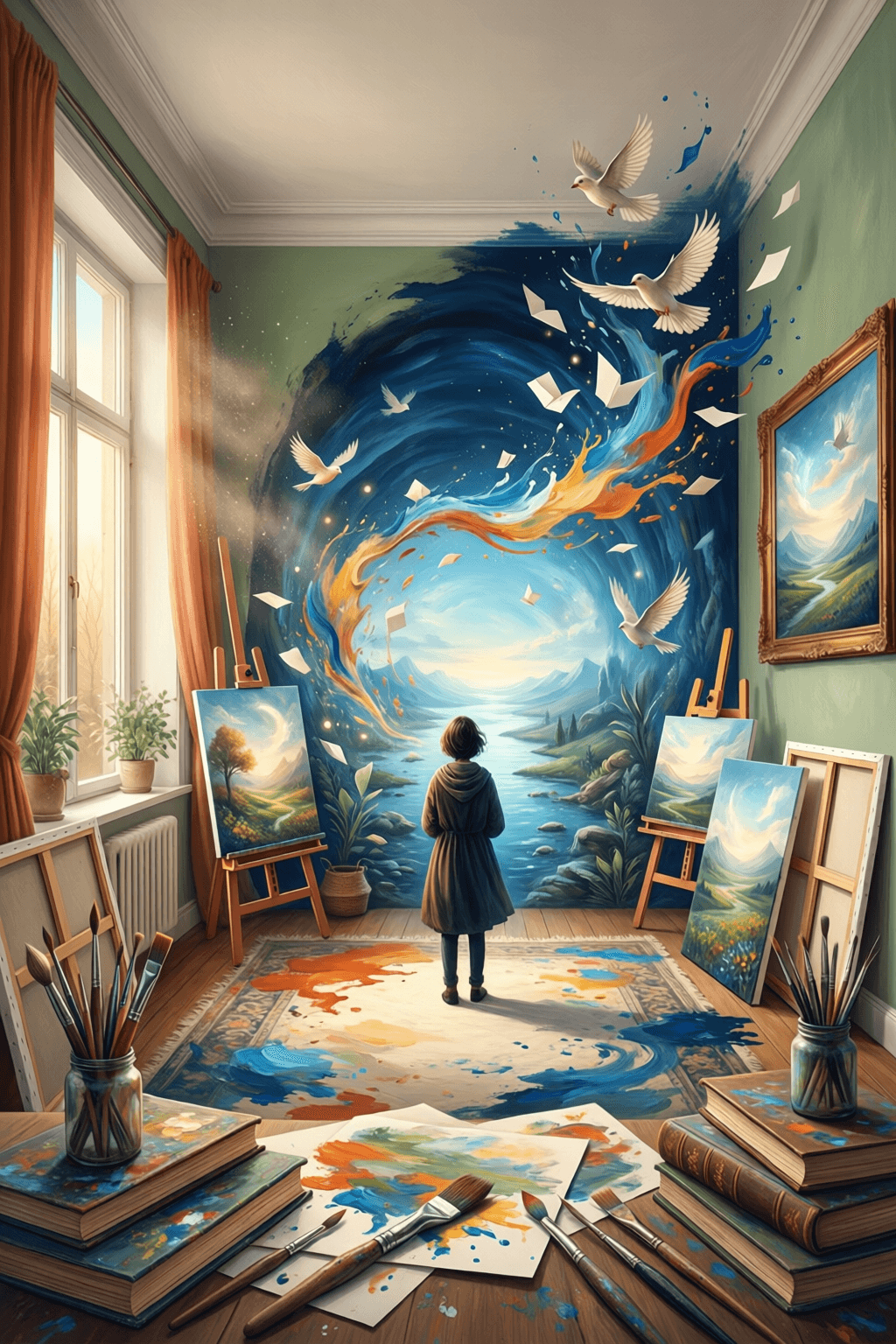
Art is the only way to run away without leaving home. — Twyla Tharp
—What lingers after this line?
The Paradox of Staying and Leaving
Twyla Tharp’s remark turns escape into a creative paradox: one can flee the limits of ordinary life without crossing a threshold. At first glance, running away suggests distance, disruption, and disappearance; however, art offers a subtler form of departure. Through music, painting, dance, film, or fiction, the mind travels while the body remains still. In this sense, Tharp reframes home itself. Rather than a fixed place that confines us, home becomes the launching point for imaginative movement. Consequently, art is not merely decoration or entertainment; it is a means of inner migration, allowing people to revisit memory, invent new worlds, and momentarily live beyond circumstance.
Imagination as a Private Passport
From that paradox, the quote naturally leads to the power of imagination. Art functions like a passport that requires no border crossing, granting access to experiences otherwise unreachable. A reader opening Toni Morrison’s Beloved (1987) or a listener absorbed in a Chopin nocturne can be transported into emotional landscapes far removed from the immediate room. Moreover, this journey is deeply personal. Two people may encounter the same poem and travel to different inner destinations because art collaborates with memory and desire. Thus, Tharp’s insight rests on the idea that escape is not always avoidance; sometimes it is a necessary expansion of consciousness.
Why Escape Can Be Restorative
Yet Tharp’s line does not celebrate mere withdrawal. Instead, it hints that art provides a restorative form of escape, one that returns us to life with renewed clarity. Virginia Woolf’s A Room of One’s Own (1929) suggests that creative space allows the mind to gather itself, and that gathering can be a form of survival rather than indulgence. For someone overwhelmed by routine, sketching for an hour or losing oneself in a film may not solve every problem, but it can loosen the grip of pressure. In that way, artistic escape resembles sleep or prayer: a pause that heals, reorganizes feeling, and makes endurance possible.
Art Keeps Us Present to Ourselves
At the same time, the quote carries an important irony: art helps us run away, yet it often brings us closer to ourselves. When people dance alone in a kitchen, journal after grief, or stand before a Mark Rothko canvas, they may seem to be leaving reality behind. Nevertheless, they are often meeting hidden parts of their own experience with unusual honesty. This is why artistic escape differs from numbness. Rather than erasing feeling, it gives feeling form. As Plato’s Ion and later Romantic writers both suggest in different ways, artistic experience can feel like possession or transport, but what emerges is often recognition—of longing, fear, hope, or joy that everyday language could not fully hold.
Home Reimagined Through Creation
Following that insight, Tharp’s statement also honors the act of making art, not just consuming it. A person who writes songs in a small apartment or practices choreography in a living room transforms domestic space into a site of freedom. The walls do not vanish, but their meaning changes: home becomes studio, stage, and frontier at once. Twyla Tharp’s own career in dance reflects this principle, since choreography turns disciplined movement into a vehicle for boundless expression. Therefore, art does not require exotic distance to produce liberation. It reveals that freedom can begin exactly where one stands, provided imagination is given form.
A Humane Vision of Everyday Transcendence
Ultimately, the beauty of the quote lies in its democratic promise. Not everyone can afford travel, reinvention, or physical escape, but nearly everyone can enter a song, a story, a gesture, or an image. In that respect, art becomes one of the most humane forms of transcendence, available within ordinary life rather than beyond it. By the end, Tharp’s idea suggests that the deepest departures are not always geographical. They are emotional, imaginative, and spiritual movements that let us breathe differently for a while. We leave home nowhere, and yet through art we return changed.
One-minute reflection
What feeling does this quote bring up for you?
Related Quotes
6 selectedThe goal of life is rapture. Art is the way we experience it. — Joseph Campbell
Joseph Campbell
Joseph Campbell’s statement begins with a bold claim: life is not merely about survival, achievement, or social approval, but about rapture—a heightened state of wonder, intensity, and felt aliveness. By placing rapture...
Read full interpretation →All the arts we practice are apprenticeship. The big art is our life. — M.C. Richards
M.C. Richards
M.C. Richards turns the usual hierarchy upside down by suggesting that painting, music, poetry, and craft are not ultimate achievements but forms of preparation.
Read full interpretation →Craftsmanship is the visible edge of art. — David Bayles
David Bayles
At first glance, David Bayles’s line suggests that craftsmanship is the point where inner vision becomes outward form. Art may begin in imagination, intuition, or feeling, but it only enters the world through skillful ex...
Read full interpretation →Art is not a thing; it is a way. — Elbert Hubbard
Elbert Hubbard
Elbert Hubbard’s line immediately shifts attention away from paintings, sculptures, or books as isolated products. Instead, he suggests that art lives in the manner of seeing, choosing, and shaping experience.
Read full interpretation →It is not the language of painters but the language of nature which one should listen to. — Pablo Picasso
Pablo Picasso
At first glance, Picasso’s remark challenges the authority of artistic convention. By contrasting ‘the language of painters’ with ‘the language of nature,’ he suggests that art should not merely imitate established techn...
Read full interpretation →Art is man's expression of his joy in labor. — Henry Kissinger
Henry Kissinger
At first glance, Henry Kissinger’s remark suggests that art does not arise apart from work but grows directly out of it. In this view, labor is not merely toil or obligation; it becomes meaningful when human beings impri...
Read full interpretation →More From Author
More from Twyla Tharp →When you are in the middle of a creative block, remember that the work is not the point; the point is the practice of showing up. — Twyla Tharp
Twyla Tharp’s quote shifts attention away from the finished product and toward the habit that makes creation possible in the first place. In the middle of a creative block, it is easy to believe that nothing matters unle...
Read full interpretation →It is through the process of creating that we discover who we are, not by waiting for a finished masterpiece to tell us. — Twyla Tharp
Twyla Tharp’s insight begins with a reversal of a common assumption: we often imagine that identity arrives fully formed and then expresses itself through art, work, or achievement. Instead, she argues that we come to kn...
Read full interpretation →Creativity is a habit, and the best creativity is the result of good work habits. — Twyla Tharp
At first glance, Twyla Tharp’s quote challenges the popular myth that creativity arrives as a sudden flash of genius. Instead, she reframes it as something built through repetition, structure, and deliberate effort.
Read full interpretation →The artist is a filter; they must be alone with themselves, not the algorithm, to hear what is actually worth saying. — Twyla Tharp
Twyla Tharp’s remark begins with a striking image: the artist as a filter rather than a loudspeaker. In that view, creative work does not emerge from sheer output but from a disciplined inward process that separates nois...
Read full interpretation →