
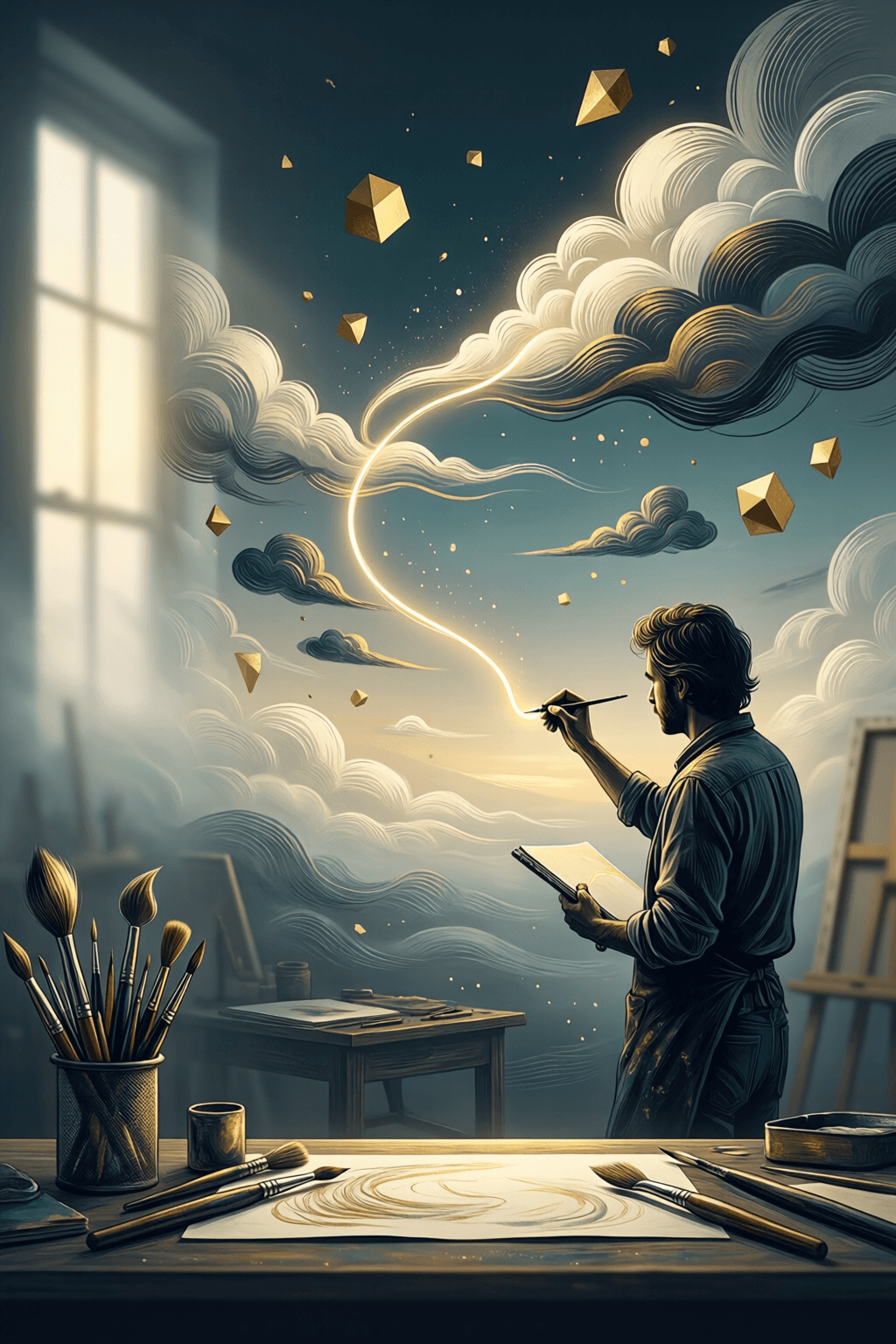
Art is a line around your thoughts. — Gustav Klimt
—What lingers after this line?
Thought Made Tangible
At first glance, Klimt’s remark turns art into a simple but powerful image: a line drawn around thought itself. In other words, ideas are often shapeless, fleeting, and private until art gives them form. A sketch, melody, poem, or painting does not merely decorate thinking; rather, it outlines what the mind struggles to hold still. Because of that, art becomes a bridge between inner life and outer reality. What was once vague emotion or half-formed reflection acquires edges, rhythm, and presence. Klimt’s metaphor suggests that creation is not separate from thought but the very act that allows thought to become visible.
The Meaning of the Line
Moving from thought to form, the word “line” carries special weight. A line can define, separate, connect, or guide the eye, and so Klimt implies that art organizes mental chaos without erasing its richness. Even the simplest contour in drawing determines what matters, what recedes, and what emerges from the background. This idea is especially fitting for Gustav Klimt, whose works such as The Kiss (1907–08) rely on decorative pattern and precise outline to hold intense feeling within a visual structure. Thus, the line is not merely technical; it is intellectual and emotional, shaping the invisible into something communicable.
Art as Clarification
From there, Klimt’s insight also suggests that art helps people understand themselves. Many creators begin not with certainty but with confusion: a sensation, memory, or tension they cannot yet explain. Yet through painting, writing, or music, they gradually discover what they think by giving it form. As E. M. Forster famously asked, “How do I know what I think until I see what I say?”—a sentiment that closely echoes Klimt’s view. Consequently, art is not just expression after understanding; it is often the path toward understanding. The line around thought does not imprison the mind but reveals its shape, allowing both artist and audience to recognize what was previously hidden.
A Shared Inner Language
Once thought is given shape, it can be shared. This is where Klimt’s metaphor becomes social as well as personal: art translates private mental life into a form others can enter. A viewer standing before a painting or a reader absorbed in a poem may never know the artist’s exact thought, but the artistic “line” creates enough contour for resonance, empathy, and interpretation. For example, Vincent van Gogh’s letters and paintings, especially The Starry Night (1889), show how intensely personal vision can still speak across generations. In that sense, art does not transfer thought like data; instead, it invites others to trace its outline and feel its force in their own way.
Limits That Liberate
Finally, Klimt’s statement hints at a creative paradox: limits make expression possible. A line is a boundary, yet without boundaries, thought can remain diffuse and inaccessible. Artistic form—meter in poetry, composition in painting, harmony in music—gives discipline to imagination, allowing freedom to become intelligible rather than merely chaotic. Seen this way, art is neither a cage nor a loose outpouring. It is the careful act of framing experience so that meaning can emerge. Klimt therefore reminds us that the artist’s task is not simply to feel deeply, but to draw the necessary line that lets thought become something others can see, sense, and remember.
One-minute reflection
What feeling does this quote bring up for you?
Related Quotes
6 selectedAll the arts we practice are apprenticeship. The big art is our life. — M.C. Richards
M.C. Richards
M.C. Richards turns the usual hierarchy upside down by suggesting that painting, music, poetry, and craft are not ultimate achievements but forms of preparation.
Read full interpretation →Craftsmanship is the visible edge of art. — David Bayles
David Bayles
At first glance, David Bayles’s line suggests that craftsmanship is the point where inner vision becomes outward form. Art may begin in imagination, intuition, or feeling, but it only enters the world through skillful ex...
Read full interpretation →Art is not a thing; it is a way. — Elbert Hubbard
Elbert Hubbard
Elbert Hubbard’s line immediately shifts attention away from paintings, sculptures, or books as isolated products. Instead, he suggests that art lives in the manner of seeing, choosing, and shaping experience.
Read full interpretation →It is not the language of painters but the language of nature which one should listen to. — Pablo Picasso
Pablo Picasso
At first glance, Picasso’s remark challenges the authority of artistic convention. By contrasting ‘the language of painters’ with ‘the language of nature,’ he suggests that art should not merely imitate established techn...
Read full interpretation →Art is man's expression of his joy in labor. — Henry Kissinger
Henry Kissinger
At first glance, Henry Kissinger’s remark suggests that art does not arise apart from work but grows directly out of it. In this view, labor is not merely toil or obligation; it becomes meaningful when human beings impri...
Read full interpretation →Great art picks up where nature ends. — Marc Chagall
Marc Chagall
At its core, Marc Chagall’s remark suggests that art does not compete with nature but continues its unfinished conversation. Nature gives us raw forms—color, light, movement, emotion—while art reshapes them into meaning.
Read full interpretation →More From Author
More from Gustav Klimt →