
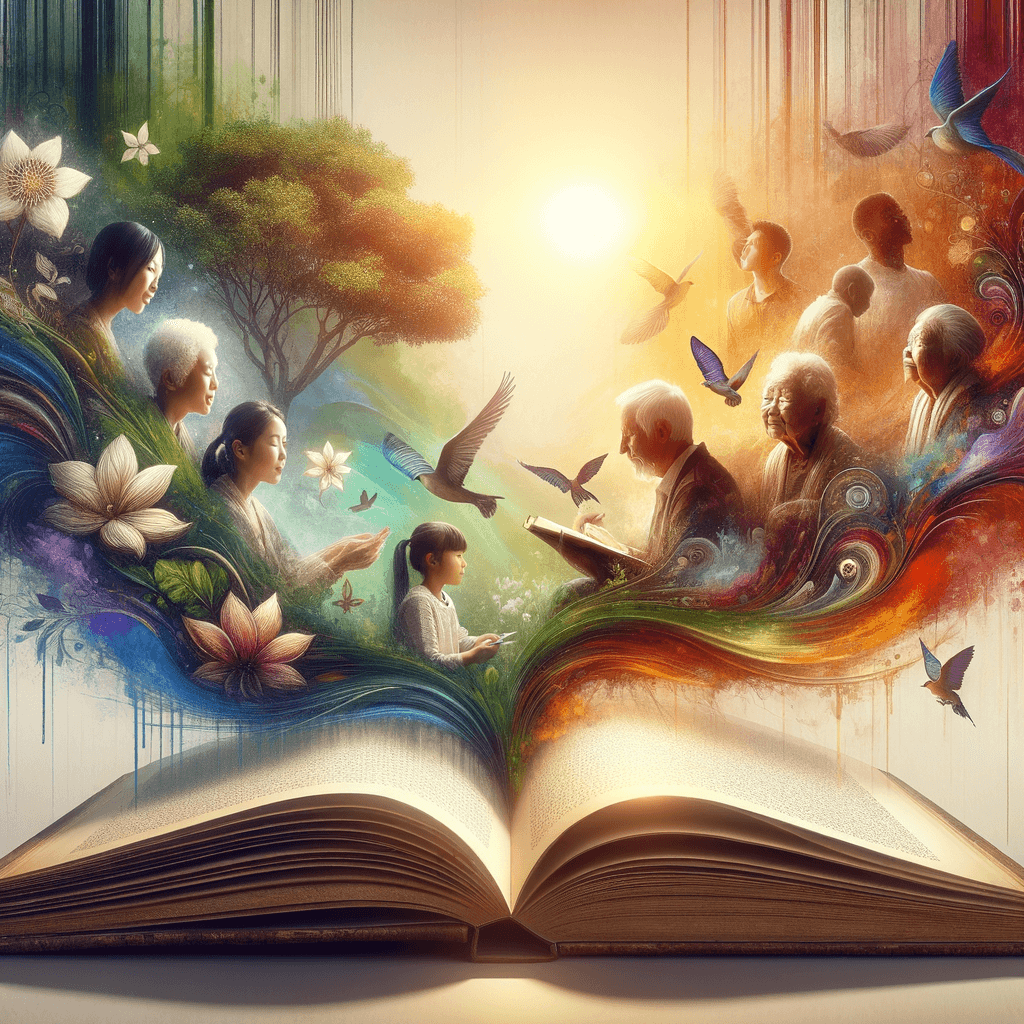
What will your verse be? — Robin Williams
—What lingers after this line?
Call to Individual Expression
This quote encourages people to find and embrace their unique voice or contribution in life. It challenges individuals to reflect on their purpose and what lasting impact or ‘verse’ they will leave behind in the grand narrative of the world.
Life as a Story or Poem
The metaphor of ‘verse’ suggests that life is like a poem with each person writing their own part. It emphasizes the beauty of singular contributions in a collective human experience.
Inspiration for Creativity
Robin Williams, often associated with the arts, urges people to pursue creative ventures or passions. This quote speaks to awakening artistic inspiration, whether through words, actions, or personal endeavors.
Reference to ‘Dead Poets Society’
In the movie 'Dead Poets Society,' Robin Williams, playing Mr. Keating, delivers this line to inspire his students. His character stresses the importance of seizing the day (‘Carpe Diem’) and making meaningful choices in life.
Philosophical Question
On a deeper level, it touches on existential questions: What will be the purpose of your life? What will stand out about your choices and journey? The quote leads to self-reflection about personal goals and meaning.
One-minute reflection
What feeling does this quote bring up for you?
Related Quotes
6 selectedThere is no must in art because art is free. — Wassily Kandinsky
Wassily Kandinsky
At its core, Kandinsky’s statement rejects the idea that art must obey fixed obligations. By saying there is no ‘must’ in art, he frees creation from rigid formulas, academic demands, and social expectation.
Read full interpretation →Often what the artist expresses is unconscious, but we can learn to decode the story by collaboratively finding the pieces to the puzzle that create new possibilities for innovation. — Ben Okri
Ben Okri
At the heart of Ben Okri’s statement is the idea that art often says more than the artist consciously intends. A poem, painting, or song may carry hidden fears, cultural memories, or emotional truths that emerge without...
Read full interpretation →I think that when you create something, you leave a part of yourself in it. — Henri Matisse
Henri Matisse
At its core, Matisse’s reflection suggests that making anything—a painting, a poem, a song, even a room—inevitably transfers something inward into outward form. Creation is not merely the arrangement of materials; rather...
Read full interpretation →There is a deep peace that comes from creating something that didn't exist before. It is your way of telling the universe that you were here, and you felt something. — Maya Angelou
Maya Angelou
At its heart, Maya Angelou’s reflection suggests that creation is not merely productive but restorative. To make something that did not exist before—a poem, a garden, a melody, even a repaired room—is to experience a rar...
Read full interpretation →The creative act is not an escape from reality, but a way to encounter it more deeply. — bell hooks
bell hooks
At first glance, creative work can look like withdrawal: a painter disappears into a studio, a writer vanishes into pages, a musician closes the door and listens inward. Yet bell hooks reverses that assumption.
Read full interpretation →The best use of imagination is creativity. The worst use of imagination is anxiety. — Deepak Chopra
Deepak Chopra
Deepak Chopra frames imagination as a neutral force whose value depends on its direction. In one sense, imagination is the mind’s simulator: it can invent possibilities that do not yet exist, letting us rehearse outcomes...
Read full interpretation →More From Author
More from Robin Williams →I used to think that the worst thing in life was to end up alone. It's not. The worst thing in life is to end up with people who make you feel alone. — Robin Williams
Robin Williams begins with a confession many people recognize: the dread of solitude as life’s deepest failure. Yet the quote pivots quickly, overturning that assumption and forcing a sharper distinction between physical...
Read full interpretation →What's right is what's left if you do everything else wrong. — Robin Williams
This quote highlights the idea that mistakes are a natural part of life and learning. By doing things wrong, you eliminate unsuccessful options, leaving you with what’s right and effective.
Read full interpretation →You're only given one little spark of madness. You mustn't lose it. — Robin Williams
This quote encourages the celebration of one’s unique quirks and eccentricities. It reminds us that our personal 'madness,' or distinct qualities, are what make us special.
Read full interpretation →