
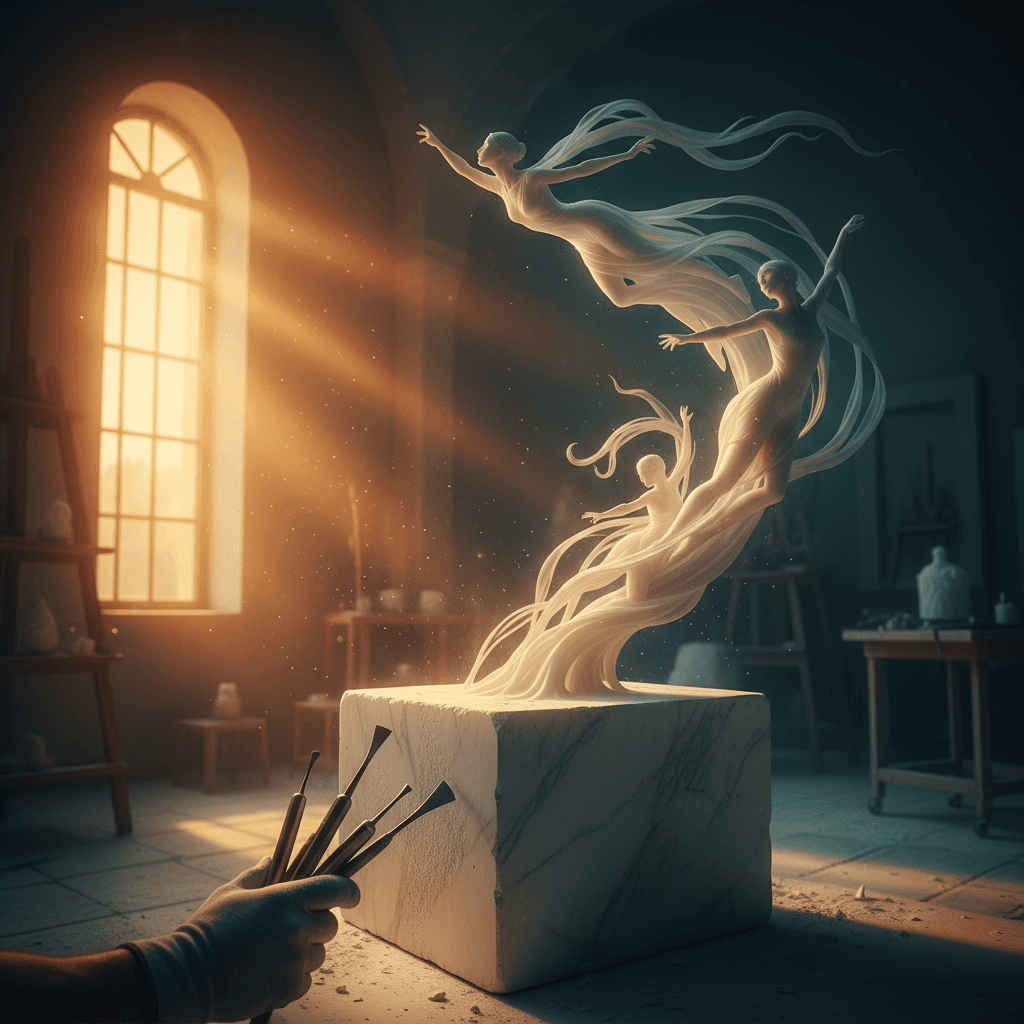
Turn memory into motion; what you feel can be sculpted into deeds. — Pablo Neruda
—What lingers after this line?
Neruda’s Imperative to Act
Neruda’s line urges a transformation: not to let memory sit as a static relic, but to let it move the body and shape the world. By pairing “sculpted” with “deeds,” he treats feeling like clay—malleable, resistant, yet capable of taking form. Thus, remorse can become an apology, gratitude a letter, awe a tree planted. And because motion begets further motion, the first small action—dialing a number, opening a notebook—often becomes the hinge on which a new life swings.
Biography as Proof: The Poet in Action
To see this principle at work, consider Neruda himself. His grief over civil war becomes a public reckoning in “I Explain a Few Things,” within Spain in Our Hearts (1937), where shattered houses and red blood turn into luminous accusation. Later, Canto General (1950) sculpts Latin America’s memory—miners, forests, revolts—into an epic of solidarity. Even his odes to onions and socks in Elemental Odes (1954) elevate humble feelings into dignifying acts of attention. Across exile and senate speeches, Neruda’s emotions refused privacy; they crossed into history.
The Body Remembers: From Feeling to Movement
Extending this, neuroscience suggests that feelings are not mere vapor; they prime the body for action. Antonio Damasio’s The Feeling of What Happens (1999) shows how emotion marks bodily states that guide choice, while William James (1884) argued that bodily changes and emotion interweave. In practice, a remembered lullaby can shape choreography, just as a veteran’s recollection can inform a craft, ritual, or route walked at dawn. When memory is rehearsed in muscle—what we call procedural memory—motion stops being symbolic and becomes second nature.
Techniques for Sculpting Feelings into Habits
In practical terms, translation requires tools. Peter Gollwitzer’s ‘implementation intentions’ (1999) turn vague desire into if–then scripts: If I feel anxious at 8 p.m., then I will walk for ten minutes. Likewise, Gabriele Oettingen’s WOOP method (2014) links wish, outcome, obstacle, and plan to convert hope into choreography. Even one tactile cue—a sticky note on the door, shoes laid out—gives memory a handle. Over days, small, reliable motions accrete into character, the way steady chiseling reveals a figure hidden in stone.
Art as Deed: Monuments of Memory
Likewise, public art shows how collective feeling can solidify into shared movement. Maya Lin’s Vietnam Veterans Memorial (1982) channels national memory into a reflective procession, where walking the wall and tracing a name becomes an embodied ritual. The AIDS Memorial Quilt (begun 1987) turns grief into communal labor, each stitched panel a portable act of witness. Such forms do not merely signify; they organize bodies in space, guiding steps, touches, and gatherings that keep remembrance alive by making it active.
Civic Motion: From Witness to Change
On the civic stage, memory often inaugurates momentum. In Chile—Neruda’s homeland—arpilleras (1970s–80s) smuggled stitched testimonies of the disappeared into public view, transforming private anguish into visible dissent. The Mothers of the Plaza de Mayo (late 1970s) marched circles of remembrance that reshaped Argentine history through weekly, relentless motion. Later, South Africa’s Truth and Reconciliation Commission (1996–1998) translated testimony into a national praxis of repair. In each case, remembrance steps forward, and the step itself revises what a society can become.
Recommended Reading
As an Amazon Associate, we earn from qualifying purchases.
One-minute reflection
What's one small action this suggests?
Related Quotes
6 selectedThe artist is a sort of emotional athlete who is constantly stretching the limits of what is felt and what can be expressed. — Marina Abramović
Marina Abramović
Marina Abramović’s remark recasts the artist not as a passive dreamer but as a disciplined performer of feeling. Just as an athlete trains muscles through repetition, strain, and recovery, the artist repeatedly enters di...
Read full interpretation →Translate your pain into color and let it teach the world how to feel. — Kahlil Gibran
Kahlil Gibran
Kahlil Gibran, a poet who was also a painter, urges us to convert what wounds us into a visual language that others can feel. In The Prophet (1923), he often translates interior storms into elemental images, and here he...
Read full interpretation →It’s all right to cry when you’re happy. - Naruto Uzumaki
Naruto Uzumaki
At first glance, “It’s all right to cry when you’re happy” feels contradictory, yet Naruto’s line names a common human truth: powerful emotions rarely arrive in neat boxes. Joy often carries traces of relief, awe, and re...
Read full interpretation →Poetry is when an emotion has found its thought and the thought has found words. — Robert Frost
Robert Frost
This quote highlights the poetic process, where emotions first need to be understood through clear thought, and only then can they be expressed through words. It emphasizes the intricate relationship between feelings and...
Read full interpretation →Colors, like features, follow the changes of the emotions. — Pablo Picasso
Pablo Picasso
Pablo Picasso’s statement that “Colors, like features, follow the changes of the emotions” draws attention to the profound relationship between visual art and inner experience. With this observation, he implies that just...
Read full interpretation →If I create from the heart, nearly everything works; if from the head, almost nothing. — Marc Chagall
Marc Chagall
Marc Chagall’s well-known insight draws a line between intellectual calculation and authentic emotional expression in the creative arts. By asserting that art succeeds when it emerges from the heart, Chagall privileges i...
Read full interpretation →More From Author
More from Pablo Neruda →Let the rain kiss you. Let the rain beat upon your head with silver liquid drops. — Pablo Neruda
Neruda’s lines open as a gentle imperative: instead of bracing against bad weather, we are asked to welcome it. “Let the rain kiss you” reframes rain as a gesture offered to the body rather than an inconvenience imposed...
Read full interpretation →Build a bridge of resolve and walk across it one brave step at a time. — Pablo Neruda
Neruda’s image begins with a striking implication: resolve is not merely a feeling you wait for, but a structure you build. A bridge doesn’t appear because the river is intimidating; it exists because someone decided to...
Read full interpretation →Let each sunrise find you leaning toward action. — Pablo Neruda
Neruda’s line frames each sunrise as more than scenery; it’s a daily reset that gently pressures us to move. “Leaning” matters because it suggests a posture, not a perfect performance—an inclination toward doing, even be...
Read full interpretation →Make your hands busy with making—words, gardens, music—and life answers back. — Pablo Neruda
Neruda’s line frames creativity less as self-expression and more as initiation: when you keep your hands busy making, you open a channel through which the world can respond. The emphasis on “hands” matters, because it gr...
Read full interpretation →