
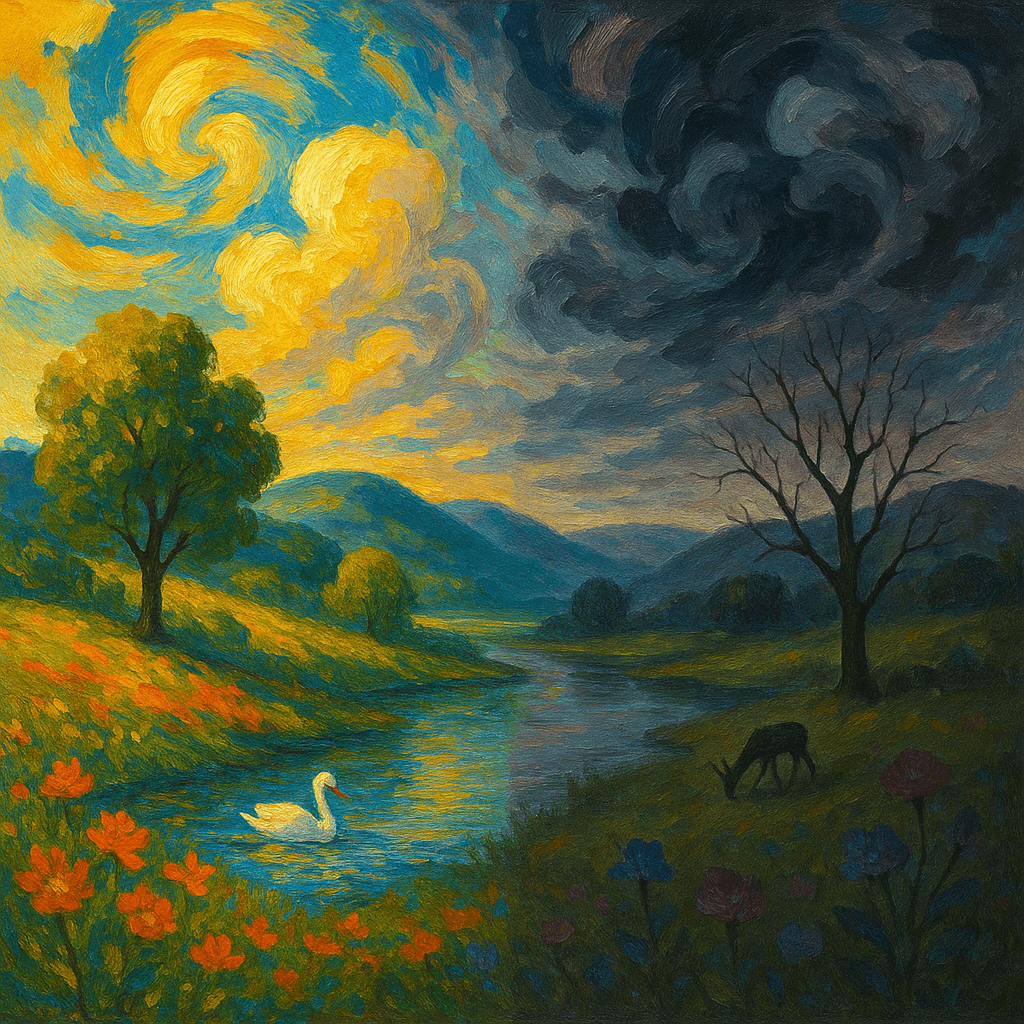
Colors, like features, follow the changes of the emotions. — Pablo Picasso
—What lingers after this line?
Picasso’s Insight into Color and Emotion
Pablo Picasso’s statement that “Colors, like features, follow the changes of the emotions” draws attention to the profound relationship between visual art and inner experience. With this observation, he implies that just as our facial expressions reflect our mood, so too do the hues we gravitate toward or depict in art. This understanding sets the foundation for exploring how colors serve as a visual language for the spectrum of human emotion.
Historical Use of Color Symbolism
Throughout art history, artists have harnessed color to represent and evoke emotion. For instance, in the medieval era, colors like blue symbolized spirituality and serenity, while red was linked to passion and intensity. The Renaissance further advanced color theory, as seen in the works of Titian, who used warm palettes to evoke sensuality. Thus, Picasso’s view resonates with a centuries-old tradition of connecting the psychology of color to human feeling.
Picasso’s Blue and Rose Periods
Delving into Picasso’s own body of work, we notice a striking manifestation of his philosophy during his Blue and Rose Periods (1901–1907). In moments of sorrow, Picasso’s canvases were dominated by cool blues and muted tones, conveying melancholy and despair—as in ‘La Vie’ (1903). Later, his transition to warmer, pinkish hues aligned with a more hopeful and tender emotional state. This artistic evolution exemplifies how an artist's palette can serve as a barometer for their evolving emotions.
Contemporary Psychology and Color Theory
Modern research corroborates Picasso’s intuition. Psychologists such as Eva Heller have shown in studies like ‘Psychology of Color’ (2000) that colors can reliably influence and express human mood. Warm colors like red and yellow are found to energize or evoke happiness, whereas cooler shades correlate with calm or sadness. This scientific perspective bridges the gap between artistic intuition and measurable emotional responses, reinforcing the universality of Picasso’s statement.
Color in Everyday Expression
Finally, the interplay between emotion and color extends beyond the realm of fine art into daily life. People choose clothing, design spaces, and create objects with colors that align with their feelings or desired mood—think of dressing in vibrant hues for celebration or softer tones for solace. The language of color—such as feeling ‘blue’ or being ‘in the pink’—permeates conversation, underscoring our collective understanding that, as Picasso asserted, colors truly mirror our internal landscapes.
One-minute reflection
Why might this line matter today, not tomorrow?
Related Quotes
6 selectedThe artist is a sort of emotional athlete who is constantly stretching the limits of what is felt and what can be expressed. — Marina Abramović
Marina Abramović
Marina Abramović’s remark recasts the artist not as a passive dreamer but as a disciplined performer of feeling. Just as an athlete trains muscles through repetition, strain, and recovery, the artist repeatedly enters di...
Read full interpretation →Translate your pain into color and let it teach the world how to feel. — Kahlil Gibran
Kahlil Gibran
Kahlil Gibran, a poet who was also a painter, urges us to convert what wounds us into a visual language that others can feel. In The Prophet (1923), he often translates interior storms into elemental images, and here he...
Read full interpretation →It’s all right to cry when you’re happy. - Naruto Uzumaki
Naruto Uzumaki
At first glance, “It’s all right to cry when you’re happy” feels contradictory, yet Naruto’s line names a common human truth: powerful emotions rarely arrive in neat boxes. Joy often carries traces of relief, awe, and re...
Read full interpretation →Poetry is when an emotion has found its thought and the thought has found words. — Robert Frost
Robert Frost
This quote highlights the poetic process, where emotions first need to be understood through clear thought, and only then can they be expressed through words. It emphasizes the intricate relationship between feelings and...
Read full interpretation →If I create from the heart, nearly everything works; if from the head, almost nothing. — Marc Chagall
Marc Chagall
Marc Chagall’s well-known insight draws a line between intellectual calculation and authentic emotional expression in the creative arts. By asserting that art succeeds when it emerges from the heart, Chagall privileges i...
Read full interpretation →Turn memory into motion; what you feel can be sculpted into deeds. — Pablo Neruda
Pablo Neruda
Neruda’s line urges a transformation: not to let memory sit as a static relic, but to let it move the body and shape the world. By pairing “sculpted” with “deeds,” he treats feeling like clay—malleable, resistant, yet ca...
Read full interpretation →More From Author
More from Pablo Picasso →It is not the language of painters but the language of nature which one should listen to. — Pablo Picasso
At first glance, Picasso’s remark challenges the authority of artistic convention. By contrasting ‘the language of painters’ with ‘the language of nature,’ he suggests that art should not merely imitate established techn...
Read full interpretation →The chief enemy of creativity is good sense. — Pablo Picasso
At first glance, Picasso’s claim sounds like a provocation against reason itself. Yet his point is subtler: ‘good sense’ often means the habits, rules, and social expectations that keep people from taking imaginative ris...
Read full interpretation →The artist is a receptacle for emotions that come from all over the place: from the sky, from the earth, from a scrap of paper, from a passing shape, from a spider's web. — Pablo Picasso
At the heart of Picasso’s remark is a striking redefinition of creativity: the artist is not merely a maker, but a receiver. Rather than inventing emotion from nothing, the artist absorbs impressions that drift in from t...
Read full interpretation →Computers are useless. They can only give you answers. — Pablo Picasso
Pablo Picasso’s jab—“Computers are useless. They can only give you answers.”—is less a literal dismissal than a provocation about what humans value.
Read full interpretation →