
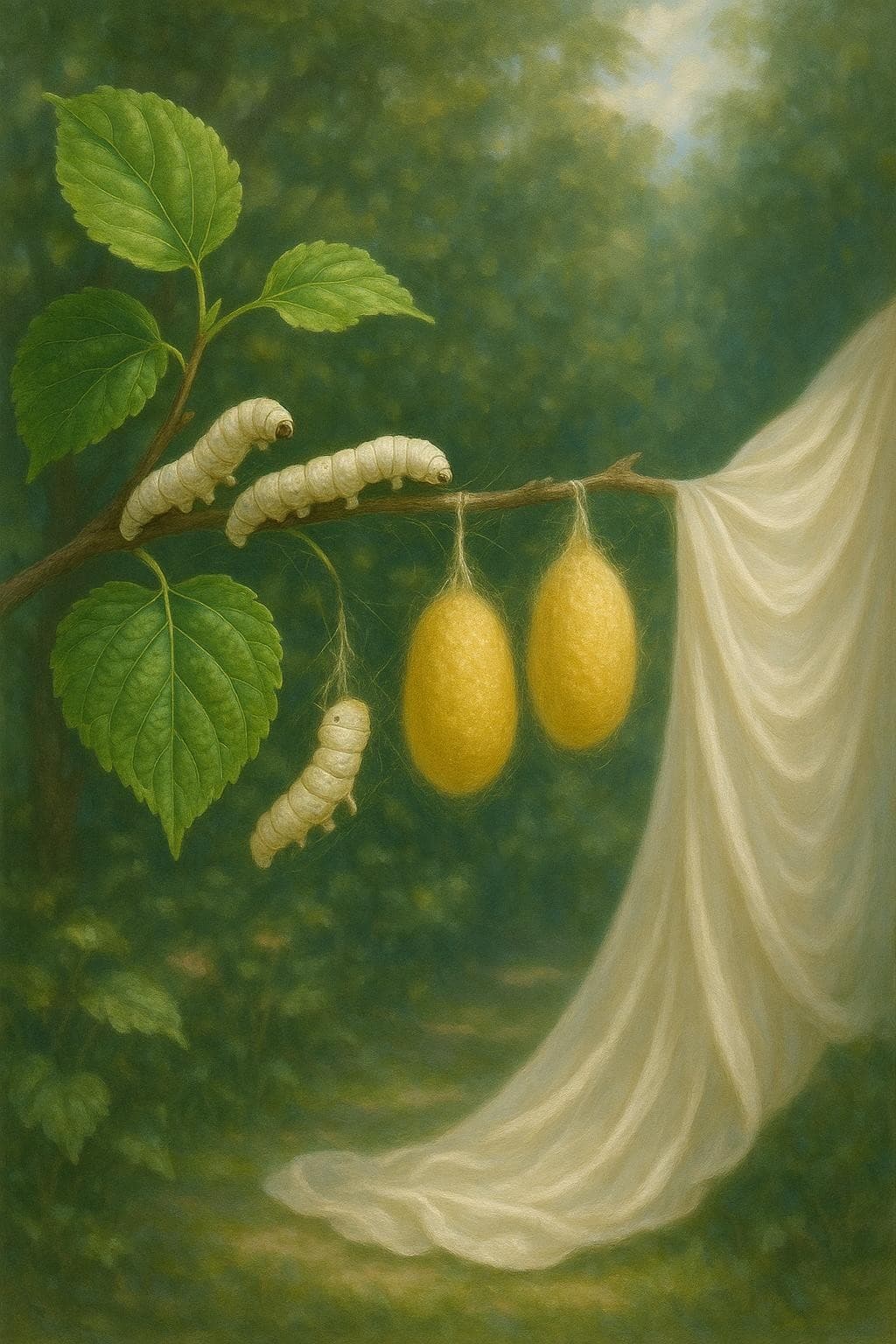
With patience, the mulberry leaf becomes a silk gown. — Chinese Proverb
—What lingers after this line?
Value of Patience
The proverb highlights that patience is essential for achieving transformation or success.
Natural Progression
It shows that significant change or growth often happens gradually, not instantly.
Symbolism of the Mulberry Leaf and Silk
The mulberry leaf, which silkworms eat, eventually leads to the creation of luxurious silk garments, symbolizing humble beginnings leading to impressive results.
Application in Personal Development
It encourages persistence and steady effort in personal growth or learning new skills.
Cultural Wisdom
Expresses traditional Chinese values of perseverance and long-term vision.
One-minute reflection
Where does this idea show up in your life right now?
Related Quotes
6 selectedOne moment of patience may ward off great disaster. One moment of impatience may ruin a whole life. — Chinese Proverb
Chinese Proverb
This proverb highlights how a brief moment of patience can prevent significant negative outcomes. Exercising patience can avert disasters or avoidable troubles.
Read full interpretation →Slow progress today is often stable progress tomorrow. Fast growth collapses easily. Slow growth holds. — Timeless Type
Timeless Type
At first glance, slow progress can feel discouraging, especially in a culture that praises speed, sudden breakthroughs, and visible success. Yet the quote reminds us that what seems unimpressive today may become the foun...
Read full interpretation →Sometimes you have to slow down to go fast. — Jeff Olson
Jeff Olson
Jeff Olson’s line begins with a practical paradox: speed is not always created by rushing. Sometimes the quickest path forward requires pausing long enough to see the road clearly, correct mistakes early, and choose acti...
Read full interpretation →Everything that is great in life is the product of slow growth; the newer, and greater, and higher, and nobler the work, the slower is its growth. — William George Jordan
William George Jordan
William George Jordan’s reflection begins with a quiet but demanding truth: the most meaningful achievements rarely arrive quickly. He suggests that greatness is not manufactured in sudden bursts but cultivated through t...
Read full interpretation →You cannot force ideas. Successful ideas are the result of slow growth. — Alexander Graham Bell
Alexander Graham Bell
Alexander Graham Bell’s statement begins with a quiet warning against impatience: ideas cannot be commanded into maturity simply because we desire results. Like plants, they require conditions, time, and repeated attenti...
Read full interpretation →The moments between your milestones are not filler. — Nelou Keramati
Nelou Keramati
Nelou Keramati’s line challenges the habit of treating life as a sequence of major checkpoints: graduations, promotions, weddings, moves, and visible successes. At first glance, everything between these events can seem l...
Read full interpretation →More From Author
More from Chinese Proverb →Tension is who you think you should be. Relaxation is who you are. — Chinese Proverb
The proverb draws a clean line between two inner experiences: tension and relaxation. Tension arises when a person is braced against themselves, trying to meet an imagined standard—what you think you should be—rather tha...
Read full interpretation →One joy scatters a hundred griefs. - Chinese Proverb
This proverb suggests that a single moment of joy or happiness has the power to diminish or overshadow numerous moments of sadness or grief. It emphasizes the impact of positive emotions on our overall well-being.
Read full interpretation →He who has never been to the Great Wall is not a true man. - Chinese Proverb
The quote reflects the immense pride that Chinese culture holds for the Great Wall. It represents the idea that experiencing this monumental structure is crucial to truly understanding and appreciating Chinese heritage a...
Read full interpretation →Keep a green tree in your heart and perhaps a singing bird will come. - Chinese Proverb
This proverb suggests that maintaining hope and positivity within oneself can attract joy and good fortune.
Read full interpretation →