
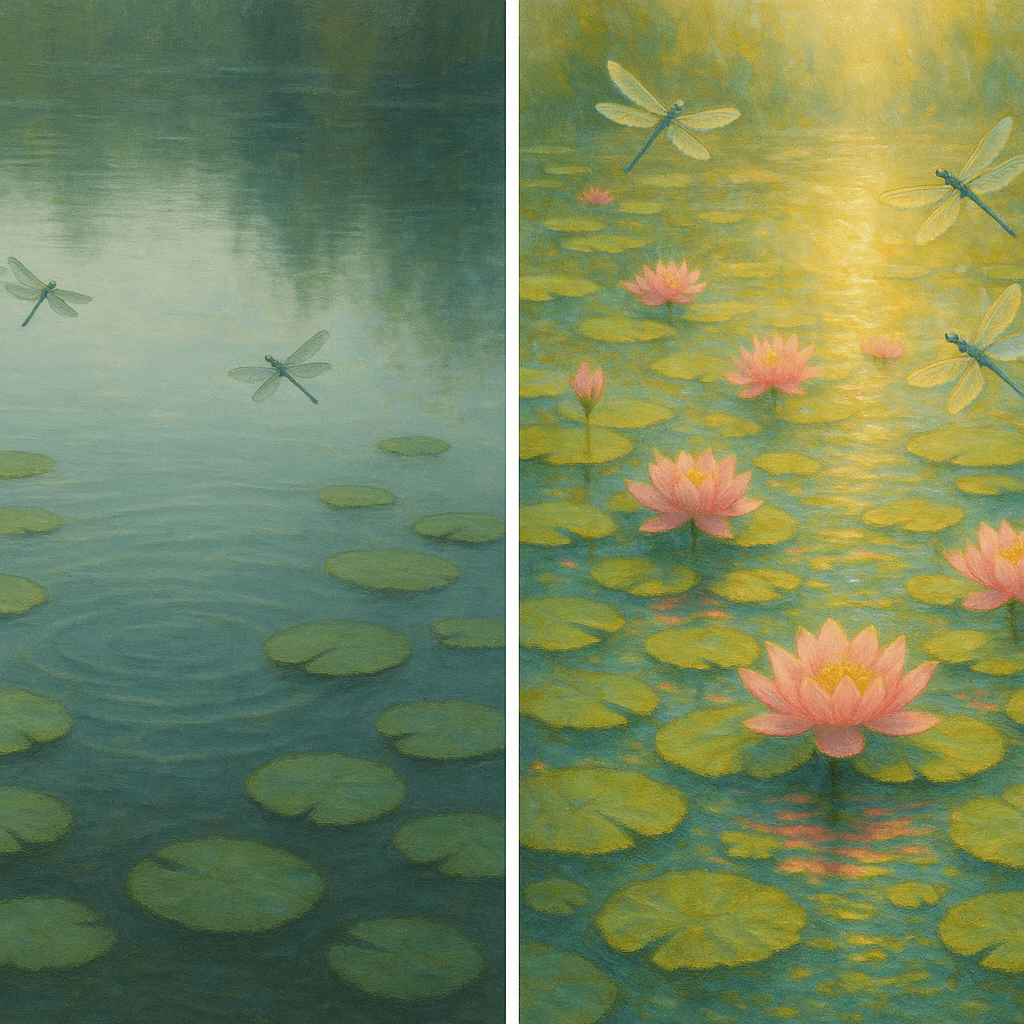
To nourish creativity, one must cultivate stillness. — Thich Nhat Hanh
—What lingers after this line?
The Quiet Source of Inspiration
Thich Nhat Hanh’s insight highlights the often-overlooked role of quiet in creative growth. In our frenetic world, creativity is usually equated with bursts of productivity or moments of sudden brilliance. However, Hanh proposes that genuine inspiration arises from stillness—a state in which distractions are hushed and the mind becomes a fertile ground for fresh ideas.
Mindfulness as Fertile Ground
Building on this idea, mindfulness cultivates the inner calm necessary for creativity to flourish. Practices such as meditation, as described in Jon Kabat-Zinn’s Mindfulness-Based Stress Reduction (MBSR), enable practitioners to slow their thoughts and attune to subtler currents of inspiration. Through regular mindfulness, the mind becomes like rich soil, ready for seeds of originality to take root.
Creativity in Historical Practice
Historical figures provide further evidence of this connection. Leonardo da Vinci, renowned for his inventive genius, routinely sought solitude and contemplation to generate his groundbreaking ideas. Likewise, Virginia Woolf’s essays emphasize the creative benefit of ‘moments of being’—instances of reflective stillness amidst daily life—demonstrating that artistic breakthroughs are often born in silence.
Modern Challenges to Inner Silence
Yet, in the digital age, achieving stillness poses new challenges. Continuous notifications, social media, and the cult of busyness fragment attention, making it difficult to access the inner reserves necessary for creative thought. This underscores Hanh's message: stillness must be deliberately cultivated, not passively awaited, especially amid modern noise.
Cultivating Stillness for Creative Renewal
Ultimately, integrating stillness into daily routines allows for sustainable creative renewal. Whether through meditation, mindful walks, or quiet reflection, these moments create space for ideas to surface and mature. As Hanh suggests, nurturing this inner calm does not stifle creativity—it nourishes and sustains it, providing the wellspring from which truly original work can flow.
One-minute reflection
What feeling does this quote bring up for you?
Related Quotes
6 selectedTo nourish creativity, one must cultivate stillness. — Thich Nhat Hanh
Thich Nhat Hanh
At its core, Thich Nhat Hanh’s insight posits that creativity does not spring from chaos, but from moments of profound stillness. This serenity, rather than being a void, becomes fertile soil wherein original ideas take...
Read full interpretation →Many of us have been running all our lives. Practice stopping. — Thich Nhat Hanh
Thich Nhat Hanh
Thich Nhat Hanh’s line begins by naming a shared condition: many people live as if propelled forward by invisible pressure. “Running” is more than physical hurry; it describes the inner velocity of worry, planning, self-...
Read full interpretation →Creativity takes courage. — Henri Matisse
Henri Matisse
This quote highlights that being creative often involves exposing one's inner thoughts and feelings, which requires a significant amount of courage as it makes one vulnerable to criticism and judgment.
Read full interpretation →Imperfection inspires invention, imagination, and creativity. — Mary Sharratt
Mary Sharratt
Mary Sharratt’s insight begins with a reversal of ordinary expectations: imperfection is not merely something to fix, but something that awakens possibility. When a plan fails, a surface cracks, or an idea refuses to fit...
Read full interpretation →Don't think. Thinking is the enemy of creativity. It's self-conscious, and anything self-conscious is lousy. — Ray Bradbury
Ray Bradbury
At first glance, Ray Bradbury’s line sounds almost rebellious: “Don’t think. Thinking is the enemy of creativity.” Yet his target is not intelligence itself, but the paralyzing kind of self-awareness that makes an artist...
Read full interpretation →You can be cautious or you can be creative, but there's no such thing as a cautious creative. — George Lois
George Lois
George Lois draws a sharp line between two mindsets: caution protects what already exists, while creativity risks making something new. At first glance, the statement sounds absolute, yet that severity is exactly its poi...
Read full interpretation →More From Author
More from Thich Nhat Hanh →You must love in such a way that the person you love feels free. — Thich Nhat Hanh
At its core, Thich Nhat Hanh’s statement redefines love as an act of care that does not confine. To love someone so that they feel free means offering affection without turning it into control, guilt, or dependence.
Read full interpretation →We are not islands; we are threads in a tapestry. To pull away from the weave is to lose the very texture that makes life hold together. — Thich Nhat Hanh
At its core, Thich Nhat Hanh’s image of threads in a tapestry rejects the fantasy of total self-sufficiency. A single thread may exist on its own, yet it gains meaning, strength, and beauty only through its relation to o...
Read full interpretation →When you learn how to suffer, you suffer far less. Resilience is not about avoiding the fire; it is about becoming fireproof. — Thich Nhat Hanh
At first glance, Thich Nhat Hanh’s quote appears paradoxical: how could learning to suffer make suffering lighter? Yet his point is that pain intensifies when we resist it, fear it, or treat it as a personal failure.
Read full interpretation →Slow down, and you will find that the rhythm of your own heart becomes the master of your work. — Thich Nhat Hanh
At first glance, Thich Nhat Hanh’s words seem to offer simple advice about working more slowly, yet they point to something deeper: a different relationship with time itself. To slow down is not merely to reduce speed, b...
Read full interpretation →