
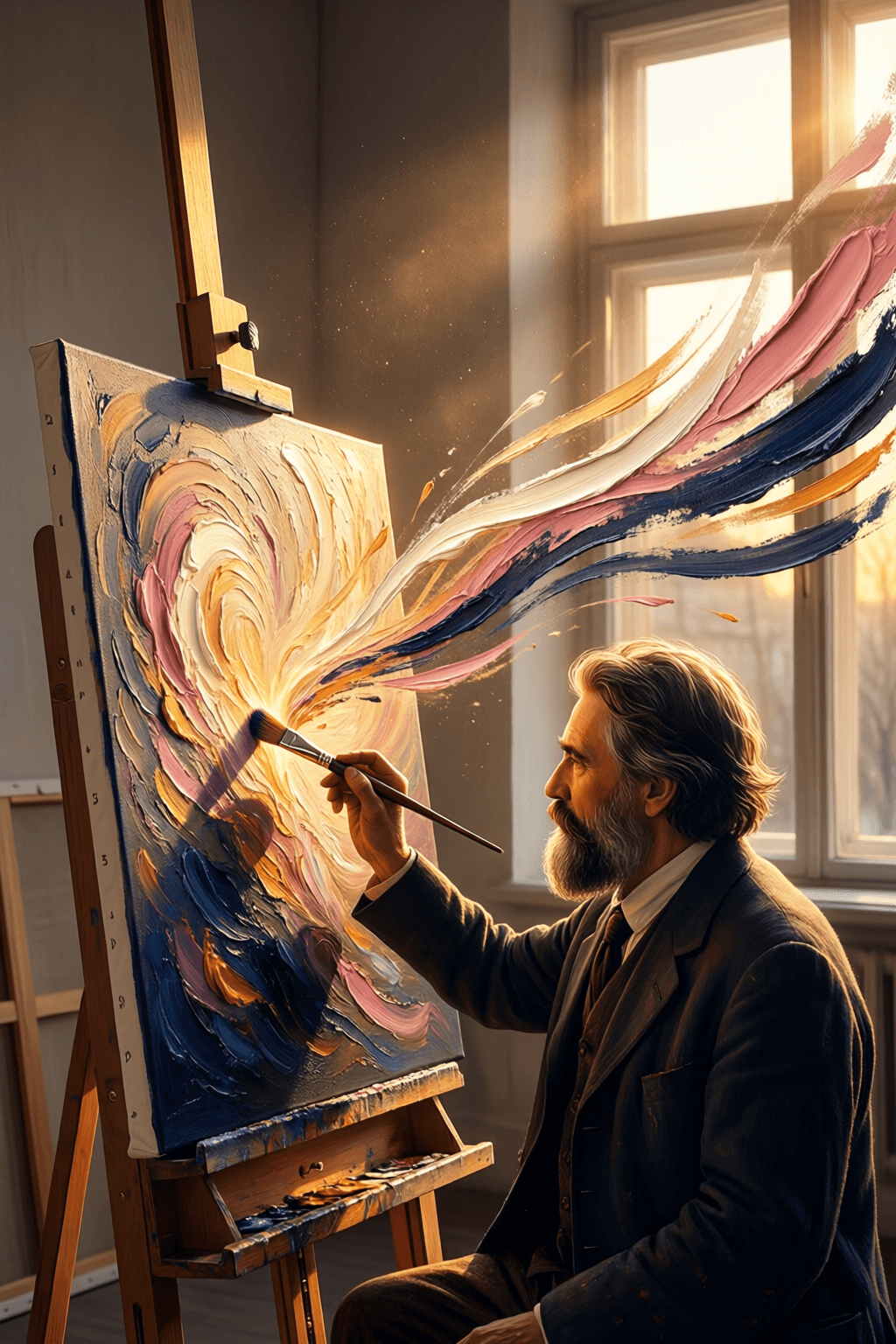
Art is not a handicraft, it is the transmission of feeling the artist has experienced. — Leo Tolstoy
—What lingers after this line?
Beyond Skill and Decoration
Tolstoy begins by drawing a sharp line between art and handicraft. A handicraft may display patience, precision, and technical mastery, but for him these qualities alone do not make something art. Art begins when the maker communicates an inner experience so vividly that another person can feel it too. This distinction shifts attention from the object to the emotional exchange it creates. A painting, song, poem, or performance matters not merely because it is well made, but because it carries a human feeling across the distance between creator and audience.
The Artist as Emotional Witness
From this perspective, the artist is not simply a producer of beautiful things, but a witness to experience. Tolstoy’s essay What Is Art? (1897) argues that genuine art ‘infects’ others with the feeling first lived by the artist, whether that feeling is grief, joy, awe, tenderness, or moral urgency. Thus, the artist’s task is deeply personal before it becomes public. The emotion must first be sincerely known, not merely imitated. Only then can the work become more than ornament and serve as a bridge between private experience and shared human recognition.
Why Technique Is Not Enough
Continuing this idea, Tolstoy does not dismiss technique altogether; rather, he refuses to treat it as the heart of art. A beautifully carved chair, a flawless portrait, or an elegantly structured poem may still feel empty if it transmits no living emotion. Craft can support expression, but it cannot replace it. This is why some simple works endure while more polished ones fade. A folk song with plain words may move generations because it carries sorrow or hope directly, while a technically brilliant performance may leave listeners untouched if it lacks emotional truth.
Shared Feeling as Human Connection
Tolstoy’s view also gives art a social purpose. When an artist successfully transmits feeling, the audience is no longer isolated in its own inner life. For a moment, strangers participate in the same emotional reality. In this sense, art becomes a form of communion. This explains why works created in distant times and places can still affect us. Homer’s Iliad (c. 8th century BC), for example, continues to communicate rage, grief, honor, and loss because those emotions remain intelligible across centuries. Art survives when feeling survives.
Sincerity as the Measure of Art
Moving further, Tolstoy’s claim implies that sincerity is one of art’s central standards. If a work is made only to impress, flatter, or conform to fashion, it may possess elegance but lack necessity. True art, in his view, arises when the artist has something felt and urgent to communicate. This does not mean art must always be autobiographical or dramatic. Even quiet works can be sincere. A small still life, a modest melody, or a restrained poem can transmit deep attention, calm, loneliness, or gratitude if those feelings have genuinely passed through the artist.
The Living Purpose of Creation
Finally, Tolstoy’s statement invites us to judge art less by luxury, rarity, or technical display and more by its power to awaken feeling. Art is alive when it moves from one consciousness into another, making the audience feel what the artist once felt. In that sense, the value of art lies in transmission. It carries emotion through form, turning private experience into a shared human event. Tolstoy’s insight remains compelling because it reminds us that art is not merely something made by hand; it is something passed from soul to soul.
One-minute reflection
What does this quote ask you to notice today?
Related Quotes
6 selectedNo great artist ever sees things as they really are. If he did, he would cease to be an artist. — Oscar Wilde
Oscar Wilde
Oscar Wilde’s remark turns artistic perception into an act of transformation rather than transcription. To see things “as they really are” would mean accepting the world as a fixed surface of facts, but Wilde suggests th...
Read full interpretation →The goal of life is rapture. Art is the way we experience it. — Joseph Campbell
Joseph Campbell
Joseph Campbell’s statement begins with a bold claim: life is not merely about survival, achievement, or social approval, but about rapture—a heightened state of wonder, intensity, and felt aliveness. By placing rapture...
Read full interpretation →Gratitude is a divine emotion: it fills the heart, but not to bursting; it warms it, but not to fever. — Charlotte Brontë
Charlotte Brontë
Charlotte Brontë presents gratitude as both elevated and restrained, calling it a “divine emotion” that enriches the heart without overwhelming it. From the start, her phrasing suggests that true thankfulness is powerful...
Read full interpretation →All the arts we practice are apprenticeship. The big art is our life. — M.C. Richards
M.C. Richards
M.C. Richards turns the usual hierarchy upside down by suggesting that painting, music, poetry, and craft are not ultimate achievements but forms of preparation.
Read full interpretation →Spaces absorb emotion before aesthetics. — Farah Agarwal
Farah Agarwal
Farah Agarwal’s line suggests that our first encounter with a room is not visual judgment but emotional registration. Before we admire a color palette, a chair, or a carefully chosen object, we sense whether a place feel...
Read full interpretation →Craftsmanship is the visible edge of art. — David Bayles
David Bayles
At first glance, David Bayles’s line suggests that craftsmanship is the point where inner vision becomes outward form. Art may begin in imagination, intuition, or feeling, but it only enters the world through skillful ex...
Read full interpretation →More From Author
More from Leo Tolstoy →Talk is cheap. It is infinitely easier to write a manifesto about success than to practice one principle of self-mastery. — Leo Tolstoy
Tolstoy’s remark begins with a blunt contrast: speaking about success is easy, while living with discipline is hard. In a few words, he exposes a familiar human habit—mistaking eloquent intentions for actual achievement.
Read full interpretation →A single act of truth can topple the tallest doubt. — Leo Tolstoy
Tolstoy’s line treats truth not as a static possession but as an event—“a single act”—that moves through the world with consequence. Doubt, in contrast, is depicted like a towering structure: impressive, persistent, and...
Read full interpretation →A day of sincere effort outshines a year of idle dreaming. — Leo Tolstoy
Tolstoy’s line weighs human worth not by what we imagine but by what we actually attempt. A “day of sincere effort” suggests focused, honest work—imperfect perhaps, but real—while “a year of idle dreaming” evokes plans t...
Read full interpretation →The secret of happiness is not always doing what you want, but always wanting what you do. - Leo Tolstoy
This quote redefines happiness as a state of contentment that comes from cultivating a positive attitude toward one's actions rather than always striving to do exactly what one desires.
Read full interpretation →