
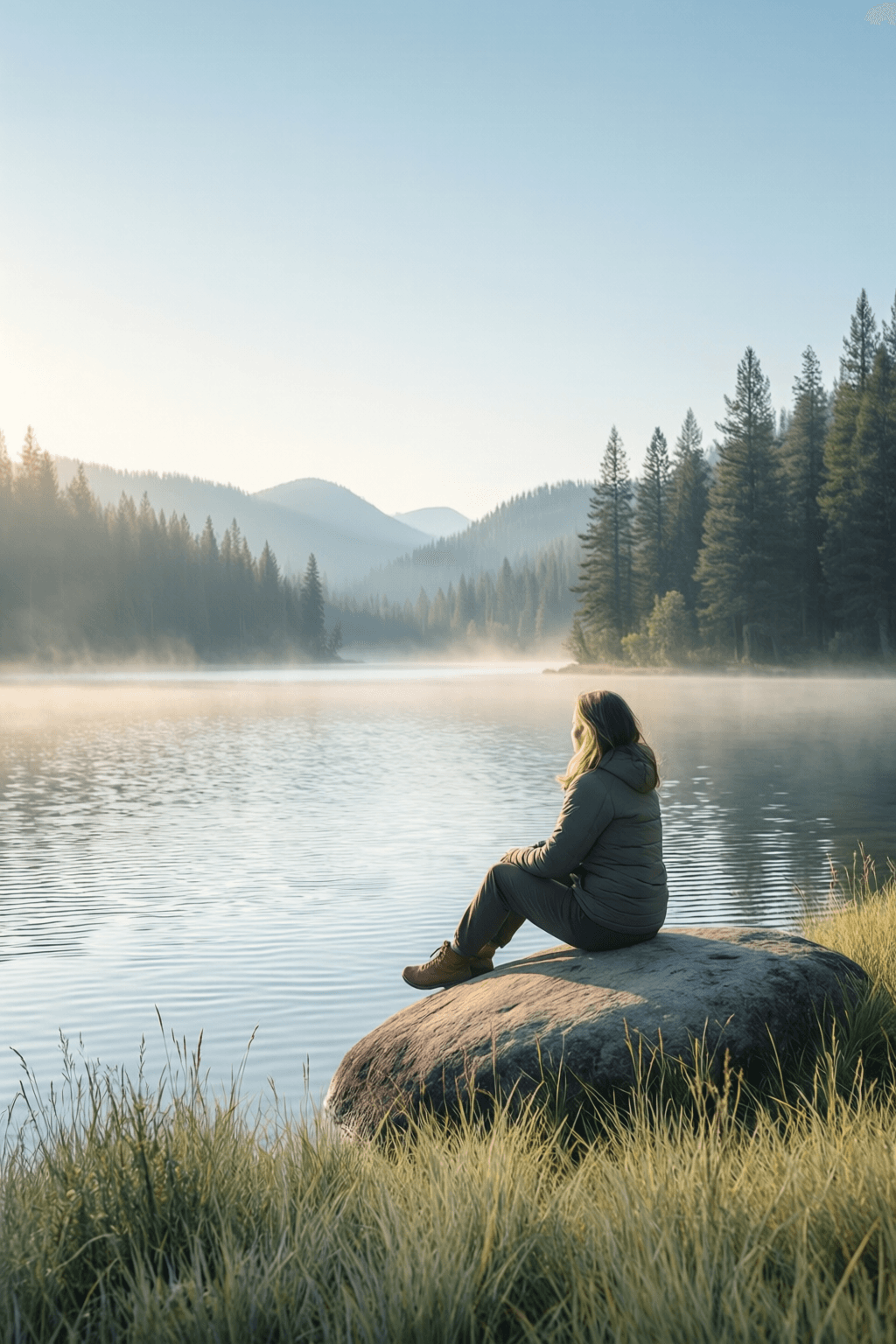
To move forward, you must first give yourself permission to be still. — Yung Pueblo
—What lingers after this line?
The Paradox of Progress
At first glance, Yung Pueblo’s line seems contradictory: how can stillness help us move forward? Yet that tension is precisely the point. He suggests that progress is not always born from constant motion; sometimes it begins when we stop forcing outcomes long enough to hear what our mind, body, and emotions are trying to say. In this way, stillness becomes an act of permission rather than passivity. Instead of treating rest as failure, the quote reframes it as preparation. By pausing, we create the inner space needed to act with greater clarity, making forward movement more deliberate and less reactive.
Permission as Self-Compassion
Just as important as stillness is the phrase “give yourself permission.” This wording implies that many people already crave rest but feel guilty claiming it. Yung Pueblo, whose reflective writing often centers on healing and self-awareness, points to a quieter truth: growth frequently requires kindness toward oneself before any external change can take hold. Consequently, the quote speaks to the emotional habits of overwork and self-pressure. To grant yourself permission is to loosen the belief that worth depends on constant productivity. Once that harsh internal demand softens, stillness no longer feels like surrender; it begins to feel like care.
Stillness as Inner Listening
From there, the quote opens into a deeper practice: stillness allows us to listen. In a noisy world filled with demands, distractions, and endless comparison, silence can reveal what urgency often conceals. Buddhist traditions, which influence much of Yung Pueblo’s thought, often emphasize meditation as a way to observe the mind rather than be ruled by it. As a result, being still is not merely about doing nothing. It is about noticing patterns—fear, exhaustion, desire, resentment—before they harden into automatic choices. Once we can hear ourselves more honestly, the path ahead often becomes simpler, even if not easier.
A Response to Modern Busyness
Seen in a broader cultural light, the quote also challenges the modern glorification of busyness. Contemporary life often rewards speed, multitasking, and visible hustle, leaving little room for reflection. Yet thinkers from Blaise Pascal’s Pensées (1670) to modern mindfulness teachers have warned that people often lose themselves by never sitting quietly in a room alone. Therefore, Yung Pueblo’s message feels both personal and social. It resists the idea that relentless activity is the same as meaningful advancement. Sometimes we are not stuck because we have paused; rather, we remain stuck because we have never paused long enough to discern the right direction.
Healing Before Action
Furthermore, the quote implies that unresolved pain can distort movement. People often rush into decisions, relationships, or ambitions not from clarity but from discomfort with being still. In this sense, stillness becomes a threshold where grief, fear, or longing can finally be acknowledged instead of outrun. This idea appears across contemporary healing literature, including Yung Pueblo’s own work on emotional growth. Before genuine change can happen, there is often a period of quiet reckoning. Only then does movement cease to be escape and become something steadier: a conscious step rooted in self-understanding.
Forward Motion with Greater Clarity
Ultimately, the quote does not glorify stillness for its own sake; it treats stillness as a beginning. The pause matters because it prepares wiser action, much like a breath before speech or a moment of balance before a leap. What looks like inactivity from the outside may actually be deep internal alignment. In the end, Yung Pueblo reminds us that the most sustainable progress often starts invisibly. When we allow ourselves to be still, we are not abandoning the journey. Rather, we are choosing to move forward with intention, groundedness, and a truer sense of where we need to go.
One-minute reflection
Why might this line matter today, not tomorrow?
Related Quotes
6 selectedDon't underestimate the value of Doing Nothing, just going along, listening to all the things you can't hear, and not bothering. — A.A. Milne
A. A. Milne
At first glance, A.A. Milne’s line sounds playful, almost like permission to be lazy.
Read full interpretation →Quiet is a superpower in a world that thrives on noise. — Susan Cain
Susan Cain
At first glance, Susan Cain’s remark elevates something easily overlooked: quiet. In cultures that often reward speed, volume, and constant self-display, silence can seem passive.
Read full interpretation →Stillness is not the absence of energy. It is the consolidation of it. — Seneca
Seneca
At first glance, Seneca’s line challenges a common assumption: that stillness means passivity, emptiness, or retreat from life. Instead, he reframes it as a disciplined state in which energy is not scattered but drawn in...
Read full interpretation →Stillness is the birthplace of strength. — Epictetus
Epictetus
At first glance, Epictetus turns a common assumption upside down: strength does not begin in noise, force, or visible struggle, but in stillness. The Stoic philosopher suggests that real power is born when the mind becom...
Read full interpretation →You do not need to leave your room. Remain sitting at your table and listen. Do not even listen, simply wait, be quiet, still and solitary. The world will freely offer itself to you to be unmasked. — Franz Kafka
Franz Kafka
Kafka begins with a striking command: do not chase the world, but remain in place. At first, this seems to reject ordinary habits of ambition and movement, yet that reversal is precisely his point.
Read full interpretation →Stillness reveals what noise hides. — Marcus Aurelius
Marcus Aurelius
At its core, Marcus Aurelius’ line suggests that silence is not emptiness but a way of seeing. In the rush of constant chatter, distraction, and reaction, important truths are often drowned out.
Read full interpretation →More From Author
More from Yung Pueblo →Your peace is louder than your defense. — Yung Pueblo
At first glance, Yung Pueblo’s line suggests a reversal of what many people assume about power. We often think strength appears in arguments, explanations, or swift rebuttals.
Read full interpretation →You do not need to earn the right to breathe, to rest, or to exist. — Yung Pueblo
At its core, Yung Pueblo’s line dismantles a belief many people quietly carry: that basic human needs must be earned through productivity, perfection, or approval. By saying we do not need to earn the right to breathe, r...
Read full interpretation →You do not need to be a finished product to be worthy of grace. You are allowed to be a work in progress. — Yung Pueblo
At its heart, Yung Pueblo’s quote dismantles the harsh belief that value must be earned through perfection. It insists that grace is not a prize reserved for the polished or the fully healed; rather, it belongs equally t...
Read full interpretation →A real sign of progress is when we stop trying to outrun our past and start learning how to sit with it, breathe through it, and let it go. — Yung Pueblo
Yung Pueblo reframes progress as something quieter than achievement or constant motion. Instead of measuring growth by how far we’ve run from painful memories, he points to a more intimate metric: our ability to remain p...
Read full interpretation →