
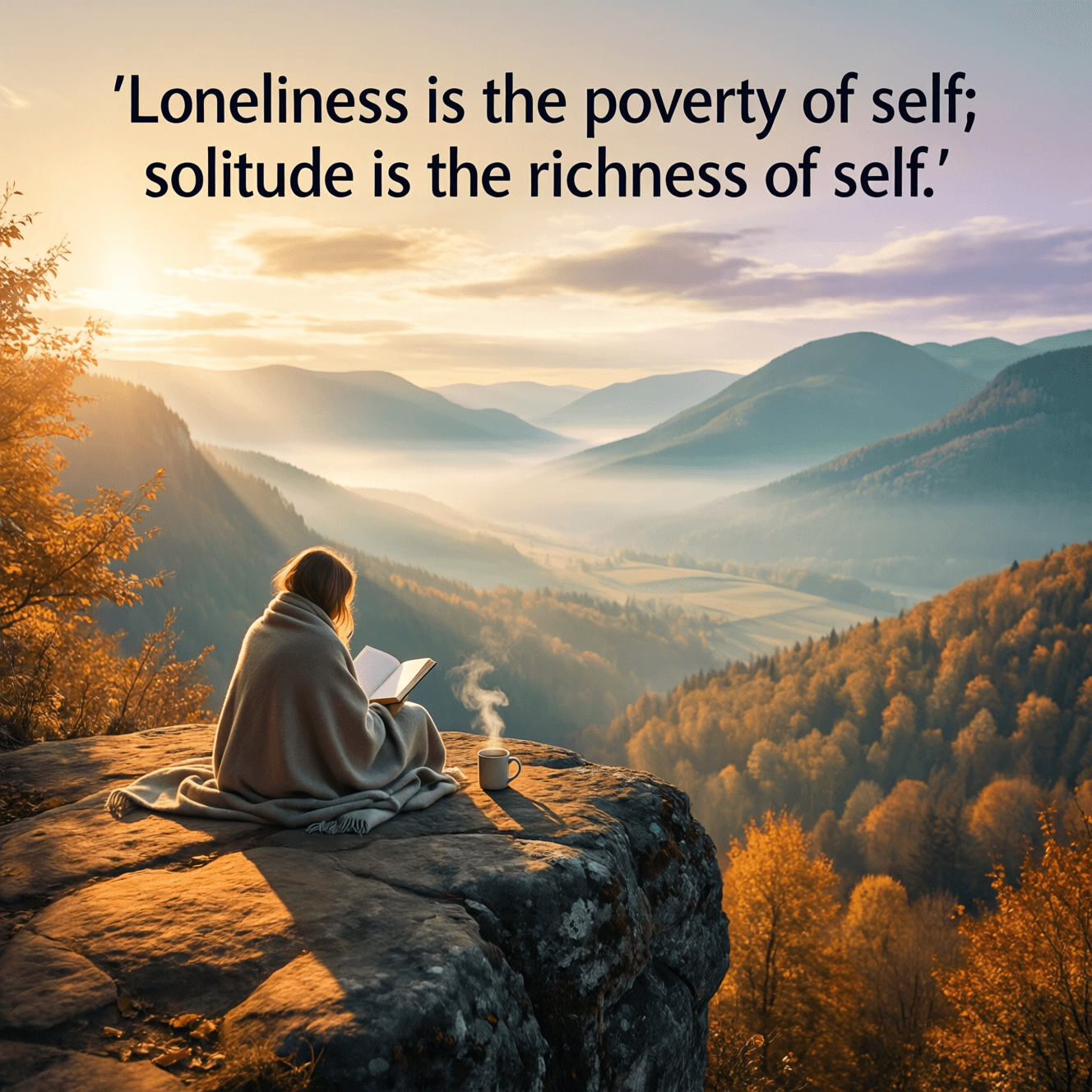
Loneliness is the poverty of self; solitude is the richness of self. — May Sarton
—What lingers after this line?
A Sharp Distinction in One Sentence
May Sarton’s line turns two often-confused states into opposites: loneliness as lack, solitude as abundance. Although both may look like being “alone,” she suggests the inner experience is what matters—whether the self feels depleted or expanded. From this starting point, the quote invites a shift from measuring aloneness by external company to assessing it by internal connection. In other words, the same quiet room can feel like a punishment when the self is neglected, or like a sanctuary when the self is well-tended.
Loneliness as a Kind of Inner Scarcity
Calling loneliness “the poverty of self” implies more than missing people; it points to a thinning of meaning, confidence, and self-regard. When identity depends heavily on affirmation, absence can feel like empty cupboards—nothing nourishing to draw on when no one is there to reflect us back. This is why loneliness can persist even in crowds: the outward presence of others doesn’t automatically translate into inward belonging. As research syntheses such as Holt-Lunstad’s work on social connection and health (2010s) emphasize, it’s the felt quality of connection—often tied to self-worth and safety—that determines whether we feel isolated.
Solitude as Self-Possession and Depth
By contrast, Sarton frames solitude as “the richness of self,” suggesting an ability to inhabit one’s own mind without collapse or craving. Solitude becomes a place where attention returns—where thoughts can complete themselves, emotions can be heard, and values can surface without being edited for an audience. Historically, this view echoes contemplative traditions that treat aloneness as formative rather than deficient; Marcus Aurelius’ *Meditations* (2nd century AD), for example, repeatedly returns to the idea that a person can retreat inward and find steadiness. The richness here is not luxury but self-sufficiency: the self becomes a home.
How the Same Aloneness Becomes Either State
The quote also implies a pivot point: aloneness is the shared condition, while interpretation and preparation decide whether it becomes loneliness or solitude. When someone has supportive relationships, purposeful routines, and a workable self-narrative, time alone can feel chosen; when those supports fray, it can feel imposed. Consider two identical evenings: one person turns off their phone, makes tea, and writes for an hour; another refreshes messages, feels excluded, and spirals. The difference isn’t simply temperament—it’s whether the self has resources to draw from. Solitude, then, often arrives through practice, not luck.
Relationships as the Soil, Not the Substitute
Importantly, solitude doesn’t reject others; it changes how others are needed. When the self is “rich,” relationships become sites of sharing rather than emergency rescue, and companionship can be enjoyed without being required to stave off inner emptiness. This connects to the idea of secure attachment in psychology: people who feel basically safe and worthy can tolerate separations and still feel connected in memory and meaning. As the quote implies, strengthening the self doesn’t diminish love—it reduces the panic that love must constantly prove itself to keep the self from feeling poor.
Cultivating the Richness Sarton Describes
Sarton’s distinction ultimately reads as a gentle prescription: build a self that can accompany you. Practices like journaling, walking without headphones, sustained hobbies, therapy, prayer, or meditation can turn empty time into inhabited time, because they train attention and self-trust. Over time, this cultivation can convert loneliness from an identity—“I am alone”—into a signal—“I need connection or care.” With that shift, solitude becomes more accessible: not a romantic ideal, but a skillful relationship with one’s own interior life, where being alone is no longer automatically being deprived.
One-minute reflection
What does this quote ask you to notice today?
Related Quotes
6 selectedSolitude is the salt of personhood. It brings out the authentic flavor of every experience. — May Sarton
May Sarton
May Sarton’s metaphor begins with a domestic certainty: salt doesn’t replace food; it reveals what’s already there. In the same way, solitude is not presented as an escape from life but as a condition that clarifies it,...
Read full interpretation →The whole value of solitude depends upon oneself: it may be a sanctuary or a prison, a haven of repose or a place of punishment. — Philip Hamerton
Philip Hamerton
At first glance, Philip Hamerton’s remark presents solitude as neither inherently good nor bad, but profoundly shaped by the person who enters it. To one mind, being alone becomes a sanctuary—a space for restoration, ref...
Read full interpretation →In order to be open to creativity, one must have the capacity for constructive use of solitude. One must overcome the fear of being alone. — Rollo May
Rollo May
Rollo May’s insight begins with a quiet but demanding premise: creativity requires the ability to stand apart from constant noise, approval, and distraction. To be open to new ideas, a person must first become comfortabl...
Read full interpretation →I care for myself. The more solitary, the more friendless, the more unsustained I am, the more I will respect myself. — Charlotte Brontë
Charlotte Brontë
Charlotte Brontë’s words begin as a quiet but forceful act of self-possession. Rather than treating loneliness as proof of failure, the speaker transforms it into evidence of resilience.
Read full interpretation →But many of us seek community solely to escape the fear of being alone. Knowing how to be solitary is central to the art of loving. — bell hooks
bell hooks
Bell hooks begins with a quiet but difficult observation: not every search for community is rooted in love. Sometimes, we reach for others because solitude feels threatening, as though being alone exposes a lack within u...
Read full interpretation →You will never be able to experience everything. So, please, do poetical justice to your soul and simply experience yourself. — Albert Camus
Albert Camus
Camus begins from a humbling truth: no person can live every possible life, see every landscape, or test every path. Because existence is finite, the dream of total experience becomes a source of restlessness rather than...
Read full interpretation →More From Author
More from May Sarton →The most valuable thing we can do for the psyche, occasionally, is to let it rest, wander, live in the changing light of a room, not try to be or do anything whatever. — May Sarton
At first glance, May Sarton’s reflection seems almost subversive in a culture that equates worth with productivity. Yet her point is gentle rather than defiant: the psyche, like the body, needs intervals of stillness.
Read full interpretation →A garden is always a series of losses set against a few triumphs, like life itself. — May Sarton
May Sarton’s reflection turns the garden into more than a cultivated space; it becomes a compressed image of human life. At first glance, the statement seems gently pessimistic, yet its deeper balance is what gives it fo...
Read full interpretation →Everything that slows us down and forces patience, everything that sets us back into the slow circles of nature, is a help. Gardening is an instrument of grace. — May Sarton
May Sarton’s quote begins with a quiet reversal of modern values: what slows us down is not necessarily an obstacle, but often a gift. In a culture that prizes speed, efficiency, and constant motion, she suggests that de...
Read full interpretation →Solitude is the salt of personhood. It brings out the authentic flavor of every experience. — May Sarton
May Sarton’s metaphor begins with a domestic certainty: salt doesn’t replace food; it reveals what’s already there. In the same way, solitude is not presented as an escape from life but as a condition that clarifies it,...
Read full interpretation →