
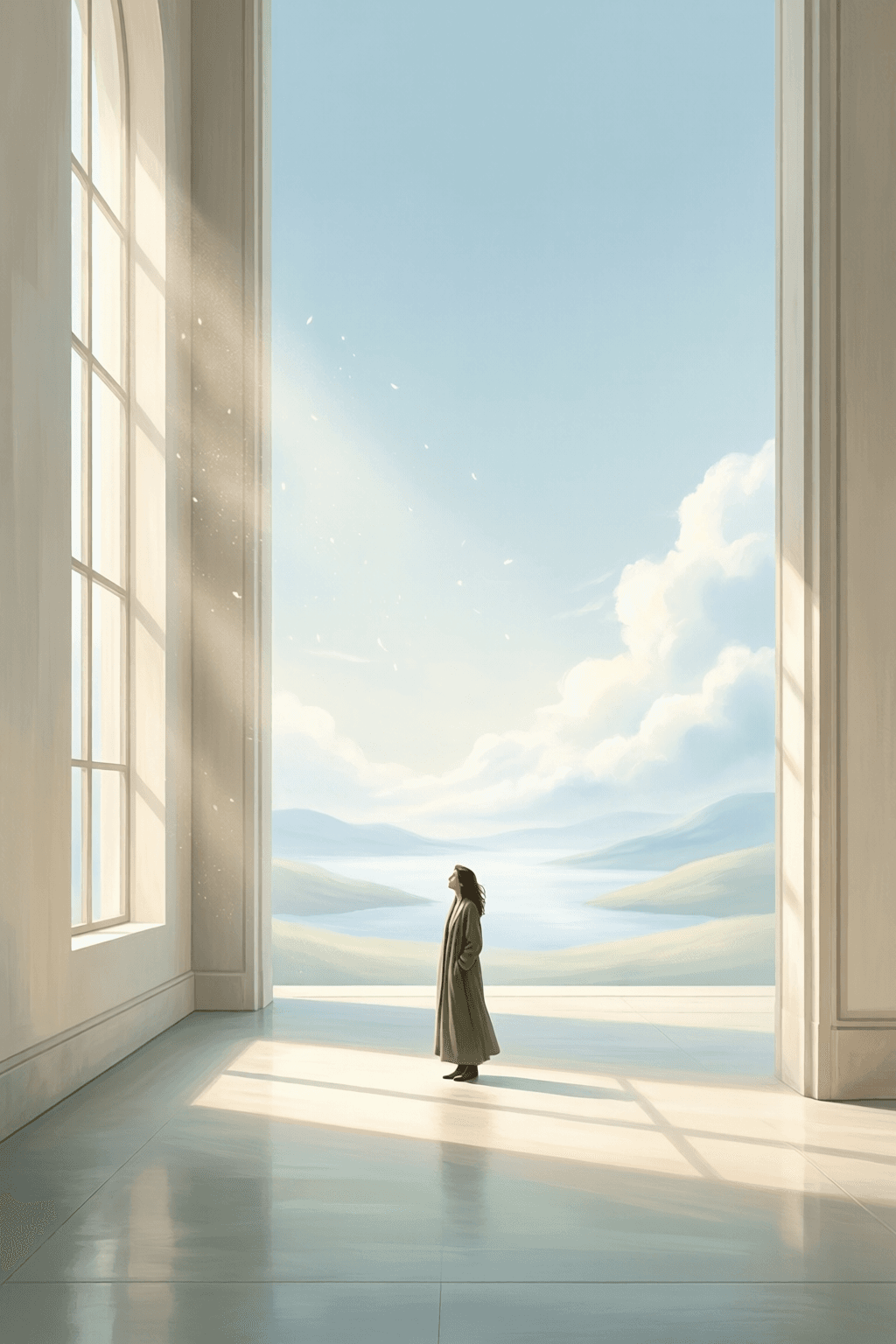
What art offers is space—a certain breathing room for the spirit. — John Updike
—What lingers after this line?
A Metaphor of Inner Relief
At its core, John Updike’s remark frames art not as luxury but as necessity. By calling it “space” and “breathing room,” he suggests that art gives the inner life a pause from pressure, noise, and obligation. In this view, paintings, poems, novels, and music do not merely decorate existence; they make it inhabitable. This metaphor matters because breathing is automatic yet essential. Likewise, people may not always notice their need for art until life feels constricted. Updike’s phrasing implies that art opens an interior chamber where the spirit can recover itself, reminding us that nourishment is not only physical or practical but also emotional and imaginative.
Why the Spirit Needs Room
From there, the quote invites a broader reflection on modern life. Daily routines often compress attention into deadlines, transactions, and constant stimuli, leaving little room for contemplation. Art interrupts that compression. A Bach cello suite, a Vermeer interior, or a line from Mary Oliver can slow perception and return us to a more spacious awareness. In this sense, art does not solve every problem directly; instead, it changes the conditions under which we experience them. Much as Virginia Woolf’s essays argue for mental and literal space for creation, Updike implies that the spirit too requires intervals of openness. Art becomes the medium through which the self is not hurried, measured, or reduced.
Art as Refuge, Not Escape Alone
Yet Updike’s idea is richer than simple escapism. Although art can certainly console, its “breathing room” is not merely a hiding place from reality. Rather, it is a refuge that allows reality to be felt more truthfully. Pablo Picasso famously said, “Art washes away from the soul the dust of everyday life,” and that washing does not erase the world; it clarifies our encounter with it. Accordingly, a novel like Toni Morrison’s Beloved (1987) or Picasso’s Guernica (1937) offers no easy escape. Instead, such works create the spiritual room needed to face grief, violence, and memory without being overwhelmed. Art gives distance enough for reflection and closeness enough for feeling.
The Quiet Expansion of Perception
Furthermore, breathing room suggests expansion, and art expands perception by teaching us to notice. A haiku by Matsuo Bashō or a film by Yasujirō Ozu often appears modest on the surface, yet each makes ordinary moments newly vivid. Through form, rhythm, color, and silence, art widens the boundaries of what seems worthy of attention. As a result, the spirit is not only soothed but enlarged. We begin to sense nuances that hurried living ignores: the shape of longing, the dignity of routine, the hidden drama of a room at dusk. Updike’s statement therefore points to art’s subtle power to create inward spaciousness by refining the way we see outward things.
A Human Need Across Time
Seen historically, this insight reaches far beyond Updike. Aristotle’s Poetics (c. 335 BC) suggests that tragedy offers catharsis, a release and reordering of emotion; meanwhile, religious art from Gothic cathedrals to Zen ink painting has long provided settings for inward stillness. Across cultures, people have turned to artistic forms to make space for grief, wonder, devotion, and joy. Therefore, Updike’s sentence resonates because it names a constant human experience in simple terms. Whenever someone stands silently before Mark Rothko’s color fields, rereads a beloved passage of James Baldwin, or listens alone to Billie Holiday, art becomes a chamber of renewal. It gives the spirit room not to flee life, but to live it more fully.
One-minute reflection
What's one small action this suggests?
Related Quotes
6 selectedThe goal of life is rapture. Art is the way we experience it. — Joseph Campbell
Joseph Campbell
Joseph Campbell’s statement begins with a bold claim: life is not merely about survival, achievement, or social approval, but about rapture—a heightened state of wonder, intensity, and felt aliveness. By placing rapture...
Read full interpretation →All the arts we practice are apprenticeship. The big art is our life. — M.C. Richards
M.C. Richards
M.C. Richards turns the usual hierarchy upside down by suggesting that painting, music, poetry, and craft are not ultimate achievements but forms of preparation.
Read full interpretation →Craftsmanship is the visible edge of art. — David Bayles
David Bayles
At first glance, David Bayles’s line suggests that craftsmanship is the point where inner vision becomes outward form. Art may begin in imagination, intuition, or feeling, but it only enters the world through skillful ex...
Read full interpretation →Art is not a thing; it is a way. — Elbert Hubbard
Elbert Hubbard
Elbert Hubbard’s line immediately shifts attention away from paintings, sculptures, or books as isolated products. Instead, he suggests that art lives in the manner of seeing, choosing, and shaping experience.
Read full interpretation →It is not the language of painters but the language of nature which one should listen to. — Pablo Picasso
Pablo Picasso
At first glance, Picasso’s remark challenges the authority of artistic convention. By contrasting ‘the language of painters’ with ‘the language of nature,’ he suggests that art should not merely imitate established techn...
Read full interpretation →Art is man's expression of his joy in labor. — Henry Kissinger
Henry Kissinger
At first glance, Henry Kissinger’s remark suggests that art does not arise apart from work but grows directly out of it. In this view, labor is not merely toil or obligation; it becomes meaningful when human beings impri...
Read full interpretation →More From Author
More from John Updike →